
What Does It Really Cost to Buy a Home? The Hidden Expenses Buyers Often Miss
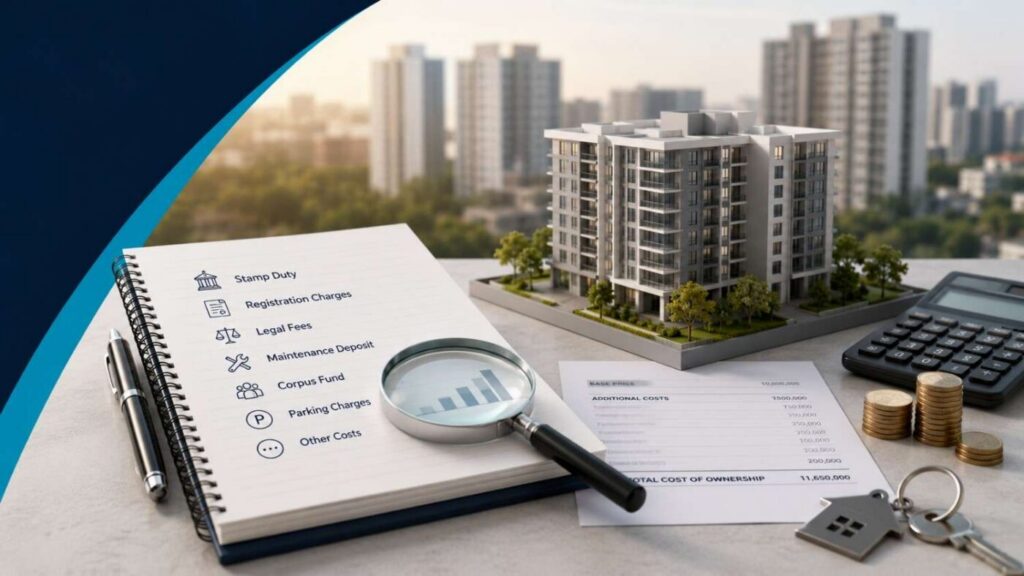
Most homebuyers start by looking at the apartment price. But that is not the full cost of buying a home. A home advertised at ₹75 lakh, for example, may end up costing considerably more once you factor in stamp duty and registration, home loan-related expenses, legal verification, maintenance deposits, interiors, moving costs, and other property-related charges. Some of these costs are easy to anticipate, while others only become clear as you move closer to the purchase.
This is where many buyers get caught off guard. They plan their home-buying budget around the property’s quoted price, only to discover additional expenses later, when they have already committed to the purchase.
So, what is the total cost of buying a home? How much should you keep aside beyond the property price, and which expenses should you account for before deciding whether a home is truly affordable?
The answer is more than just the number on the builder’s price sheet. Understanding the total cost upfront can help you plan your finances more effectively, compare properties more realistically, and avoid unpleasant surprises during the buying process.
The Property Price Is Only the Beginning
Suppose you find an apartment advertised at ₹90 lakh.
At first glance, it appears to fit a ₹1 crore budget.
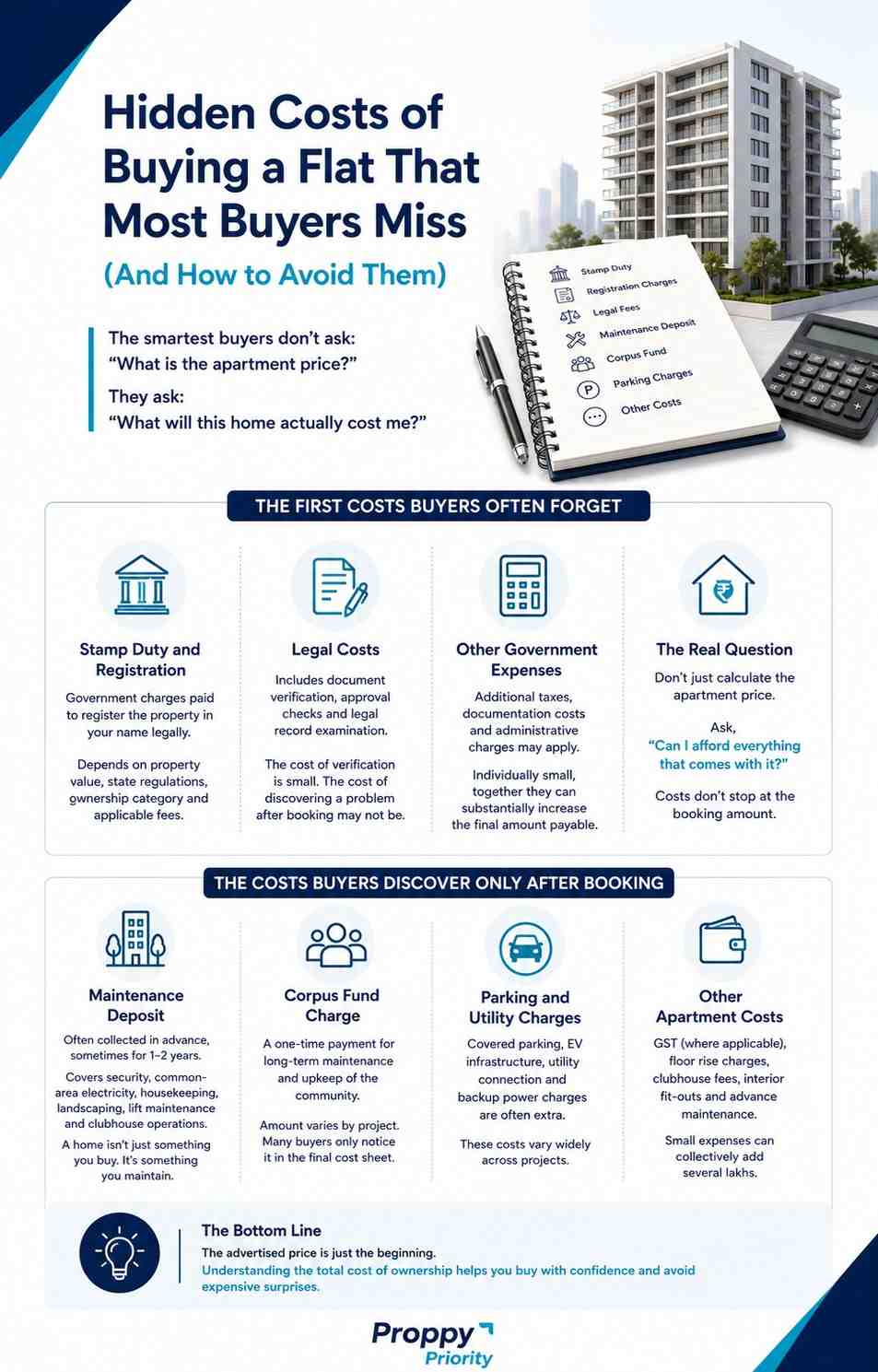
But now consider everything else that may need to be accounted for:
- Applicable stamp duty
- Registration charges
- Taxes, depending on the property and stage
- Floor-rise or preferential location charges
- Parking or other project-specific charges
- Maintenance advance
- Corpus contribution
- Home-loan processing and related expenses
- Legal and technical due diligence
- Interior work
- Appliances and fixtures
- Moving expenses
Not every cost applies to every property.
The exact amount depends on the project, transaction structure, state rules, construction stage, financing arrangements, and the buyer’s choices.
But the principle remains the same:
The advertised property price and the buyer’s total financial commitment are not always the same number.
What Is the Total Cost of Buying a Home?
The total cost of buying a home can be broken into four broad layers.
1. Property acquisition cost
This includes the amount payable for the apartment itself, as well as applicable project-specific charges.
2. Government and statutory costs
These may include stamp duty, registration, and applicable taxes.
3. Financing and professional costs
These can include home loan charges, legal review, and other professional services.
4. Making the home liveable
This includes interiors, appliances, furnishings, moving and other setup expenses.
Looking at all four layers gives you a more realistic home-buying budget.
1. Start With the Actual Property Cost
The property price is an important starting point, but it shouldn’t be the only number you consider.
If you’re buying a new apartment, the final amount you spend may include several additional costs, depending on the project, builder, and purchase terms.
For example:
| Cost | Example Amount |
| Base apartment price | ₹90,00,000 |
| Floor-rise / location premium | ₹3,00,000 |
| Parking / project-specific charges | ₹2,00,000 |
| Maintenance advance | ₹1,00,000 |
| Corpus contribution | ₹1,00,000 |
| Other applicable charges | ₹1,00,000 |
| Property-related subtotal | ₹98,00,000 |
This is only a hypothetical example.
The purpose isn’t to suggest that every project uses these exact charges.
It demonstrates why buyers should calculate the actual cost using the builder’s detailed cost sheet rather than relying on the headline price.
2. Stamp Duty and Registration Are Part of the Budget
One of the biggest mistakes in calculating home purchase costs is treating government charges as an afterthought.
When a property is registered, applicable stamp duty and registration charges can create a significant additional expense.
The exact amount depends on the state, transaction value, property type, and applicable rules.
So if you’re buying in Bengaluru, for example, don’t simply calculate:
Apartment price = total budget required
Instead, include the applicable government charges in your purchase planning.
These costs can be substantial enough to affect how much cash you need at registration.
Because rates and rules can change, buyers should verify the applicable charges with the relevant government authority or a qualified professional before finalizing their budget.
3. Taxes Can Change the Final Number
Tax treatment differs depending on factors such as whether the property is under construction or completed and the structure of the transaction.
For example, the tax treatment of a completed property can differ from that of an under-construction property.
That is why buyers shouldn’t assume one tax calculation applies to every apartment.
When preparing a property purchase budget, ask:
- Is the quoted price tax-inclusive?
- Are taxes separately payable?
- At what stage are they payable?
- Are there any project-specific tax components?
- Has the builder clearly shown them in the cost sheet?
If you’re unsure, get the calculation confirmed before committing.
4. Home-Loan Costs Go Beyond the EMI
Most buyers calculate the EMI.
Far fewer calculate the complete cost of financing.
A home loan can involve expenses such as:
- Processing fees
- Legal evaluation
- Technical valuation
- Documentation charges
- Insurance, where applicable
- Other lender-specific charges
Exact charges vary by lender and loan product.
There is also a larger financial question:
How much interest will I pay over the life of the loan?
A ₹70 lakh loan and a ₹70 lakh apartment are not equivalent financial commitments.
The apartment has a purchase price.
The loan has a cost of borrowing.
That distinction belongs in any serious home-buying guide for Indian buyers.
5. Legal Verification Is a Cost Worth Budgeting For
Buying a home without understanding the property’s legal status can lead to much bigger problems later.
Before committing, buyers may need to review relevant documents relating to:
- Title
- Ownership
- Encumbrances
- Approvals
- RERA registration where applicable
- Development rights
- Agreements
- Project documentation
This is where property legal verification and professional legal due diligence can be valuable.
The important point is that legal review should not be treated as an unnecessary expense simply because the builder has provided documents.
A builder providing documents and an independent professional reviewing those documents are two different things.
For a transaction worth tens of lakhs or more, spending appropriately on due diligence can be small compared with the potential financial consequences of overlooking a serious issue.
6. Maintenance and Corpus Charges Can Arrive Earlier Than Expected
A buyer may budget for the apartment and registration but forget about the amount required for maintenance and corpus contributions.
These charges vary by project.
You may encounter:
- Advance maintenance
- Corpus fund
- Facility-related charges
- Clubhouse or amenity-related charges
- Other community-level expenses
Confirm the exact structure in the project’s cost sheet and agreement.
The important thing is to ask:
“What do I need to pay before or around possession?”
Not simply:
“What is the apartment price?”
7. Interiors Can Become a Second Budget
This is one of the easiest expenses to underestimate.
You buy the apartment.
Then reality arrives.
You need:
- Wardrobes
- Modular kitchen
- Lighting
- Curtains
- Storage
- Beds
- Sofa
- Dining furniture
- Appliances
- Fans
- Air conditioning
- Electrical additions
- Décor
A buyer who spends nearly the entire available budget on the apartment may then have very little left to make the home functional.
That’s why you should consider interior costs for a new home before booking, not after.
You don’t need to complete every interior immediately.
But you should know what is essential, what can wait, and how much cash you want to retain after purchase.
8. Moving Into the Home Has Its Own Costs
Even after registration and interiors, there can be smaller expenses.
For example:
- Moving services
- Utility connections
- Basic repairs
- Additional electrical work
- Internet installation
- Appliances
- Furniture
- Housewarming expenses
- Initial maintenance
Individually, some of these may seem insignificant.
Together, they can create another meaningful expense immediately after purchase.
This is why the real cost of buying a house doesn’t end on registration day.
The Difference Between Buying the Home and Owning the Home
This is a useful distinction.
Buying the home
Includes costs directly connected to acquiring the property.
Owning the home
Includes ongoing expenses after acquisition.
These can include:
- Monthly maintenance
- Property taxes
- Repairs
- Utilities
- Insurance
- Home-loan interest
- Renovation
- Replacement of appliances and fixtures
A good budget should account for both.
Otherwise, a buyer can technically afford the purchase but find the ongoing ownership costs uncomfortable.
How Much Extra Should I Budget When Buying an Apartment?
There isn’t one universal percentage that works for every buyer.
Anyone who says:
“Just keep exactly X% extra.”
is simplifying a calculation that depends on the property and transaction.
Instead, calculate the actual categories.
Start with:
- Property price
- Project-specific charges
- Government charges
- Taxes, where applicable
- Loan costs
- Professional due diligence
- Initial interiors
- Moving/setup costs
=
Your realistic acquisition and move-in budget
This approach is much more reliable than using a generic percentage.
A Practical Example
Imagine a buyer has a total home-buying budget of ₹1 crore.
They find a property priced at ₹90 lakh.
They might think:
₹10 lakh remaining = enough buffer.
But now suppose the buyer needs to account for:
- Government charges
- Project-specific charges
- Loan-related expenses
- Legal verification
- Basic interiors
- Moving/setup costs
The remaining ₹10 lakh can disappear much faster than expected.
That doesn’t necessarily mean the buyer should reject the apartment.
It means the buyer needs to know the complete financial commitment before booking.
What Are the Hidden Costs When Buying a Home?
If you’re searching for what the hidden costs when buying a home are, start with these categories:
Property-related
- Floor-rise charges
- PLC
- Parking
- Maintenance advance
- Corpus
- Other project-specific charges
Government/statutory
- Stamp duty
- Registration
- Applicable taxes
Financing
- Loan processing
- Legal/technical evaluation
- Other lender-specific charges
Professional
- Legal due diligence
- Technical inspection, where appropriate
- Valuation, where separately required
Post-purchase
- Interiors
- Appliances
- Furniture
- Moving
- Initial repairs/setup
Not all of these are “hidden” in the sense of being undisclosed.
Many are not included in the headline property price.
That distinction is important.
The Builder’s Cost Sheet Is Not Your Entire Home-Buying Budget
The builder’s cost sheet is essential. But it doesn’t necessarily include everything you’ll spend.
For example, the builder may provide a detailed calculation covering:
Apartment + project charges + applicable taxes
Your personal budget still needs to consider:
Loan + legal review + interiors + furniture + moving + emergency reserves
That’s why buyers should create two separate calculations:
Builder-side cost
What do I have to pay the developer?
Buyer-side total budget
What will I spend actually to purchase and set up this home?
That second number matters most for your finances.
How to Avoid Unexpected Costs When Buying a Home
A simple process can make the numbers much clearer.
Step 1: Ask for the complete cost sheet
Don’t budget from the brochure price.
Step 2: Separate included and excluded costs
Mark every charge that is already included.
Step 3: Ask about variable charges
Find out whether any component can change.
Step 4: Calculate government costs separately
Verify current applicable rates.
Step 5: Calculate financing costs
Look beyond the EMI.
Step 6: Budget for due diligence
Legal and technical review can help identify risks before commitment.
Step 7: Create an interiors budget
Decide what you need immediately versus what you can wait on.
Step 8: Keep an emergency reserve
Don’t spend every available rupee on the purchase.
A home should improve your financial position, not leave you with no liquidity.
How can Proppy help
This is where Proppy Priority comes in.
The purpose isn’t simply to add another expense to the home-buying budget.
It provides several services that a buyer might otherwise have to coordinate separately.
Proppy Priority currently includes:
- Dedicated Relationship Manager
- Personalized property shortlisting
- Legal documentation review and due diligence
- Home-loan assistance
- Independent project evaluation
- Interior design consultation with a 3D floor plan
- Vastu review
- Priority post-booking support
- Cashback/rewards, subject to applicable conditions. (proppy.ai)
The current Priority fee is a one-time fee of ₹999, and Proppy states an estimated service value of ₹1,13,000 for the package, subject to the applicable terms. (proppy.ai)
For a buyer concerned about unexpected expenses, the relevant question isn’t simply:
“Does Priority cost ₹999?”
It is:
“Could the services included help me identify or avoid costs and mistakes that would otherwise be much more expensive?”
That is where professional support can have value.
How Can Home-Buying Services Save Money?
Good home buying services don’t necessarily save money by finding the cheapest apartment.
They can create savings by helping buyers make better decisions.
For example:
Better shortlisting
You may spend less time visiting unsuitable projects.
Project evaluation
You may identify issues that make one project less attractive than another.
Legal due diligence
You may identify documentation questions before committing.
Loan assistance
You may better understand available financing options and associated costs.
Interior consultation
You may plan the space more efficiently before spending on interiors.
Dedicated support
You may have one point of contact instead of coordinating several stages yourself.
None of these should be presented as guaranteed savings.
But they can reduce the likelihood of expensive mistakes.
Can ₹999 Save Lakhs?
The answer needs to be handled carefully.
₹999 does not guarantee that you will save lakhs.
The actual financial benefit depends on the buyer, the property, the transaction, and the services used.
But the potential value of professional support can far exceed its fee if it helps a buyer avoid a significant mistake.
Consider a simple hypothetical situation.
A buyer is comparing two ₹1.2 crore apartments.
One appears cheaper.
A deeper evaluation reveals that its total cost is higher once premiums and other charges are included.
If that changes the buyer’s decision, the value isn’t necessarily a ₹999 saving.
The value is the financial consequence of making a better-informed decision.
That’s the more responsible way to understand the Proppy Priority proposition.
What Should I Include in My Home-Buying Budget?
Use this checklist: (Make image)
- Property price
- Floor-rise / PLC/project premiums
- Parking and project charges
- Maintenance advance
- Corpus
- Applicable taxes
- Stamp duty
- Registration
- Home-loan costs
- Legal verification
- Technical inspection where appropriate
- Interior work
- Furniture and appliances
- Moving
- Initial setup
- Emergency reserve
If you can estimate these categories before booking, your budget becomes much more realistic.
The Most Expensive Home-Buying Mistake May Be Budgeting for the Wrong Number
A buyer can spend months searching for a home that fits a ₹1 crore budget.
But if they define “₹1 crore” as the apartment’s advertised price rather than the total financial commitment, they may be solving the wrong problem.
The better approach is:
Start with your maximum comfortable total budget.
How much needs to be available for registration?
How much for taxes?
How much for the loan-related costs?
How much for interiors?
How much should remain as an emergency reserve?
Only then determine the apartment price you can comfortably consider.
This approach protects the buyer from becoming house-rich but cash-poor immediately after purchase.
A Home Is More Than Its Purchase Price
Buying a home isn’t a one-time decision. It’s a collection of decisions.
The apartment price matters. But so do the charges attached to it.
The government costs matter. So does financing.
Legal due diligence matters. So do interiors and the money you need after possession.
That’s why the right home-buying guide for India buyers should go beyond property listings and advertised prices.
It should help them understand the financial journey from:
“I found an apartment.”
to:
“I can actually afford to buy, set up, and own this home comfortably.”
Make Your Home-Buying Budget Work Before You Make the Booking
The biggest surprise in home buying often isn’t that an additional charge exists.
It’s that the buyer never included it in the original budget.
A ₹90 lakh apartment can require considerably more than ₹90 lakh once you factor in all applicable acquisition, statutory, financing, and setup costs.
The answer isn’t to avoid every additional expense.
- It’s to identify them early.
- Get the complete cost sheet.
- Separate the base price from project-specific charges.
- Verify applicable government costs.
- Understand your loan expenses.
- Budget for legal and technical due diligence.
- Plan your interiors.
- Keep an emergency reserve.
And compare the total financial commitment, not just the number used to attract you to the property.
This is also where Proppy Priority can add value.
For a one-time fee of ₹999, Proppy Priority brings together services including legal documentation review and due diligence, independent project evaluation, home-loan assistance, interior consultation with a 3D floor plan, personalized shortlisting, and a Dedicated Relationship Manager. Proppy also lists cashback benefits of up to ₹50,000, subject to applicable eligibility and terms.
The point isn’t that ₹999 guarantees lakhs in savings.
The point is that better information and timely professional support can help prevent much more expensive mistakes.
When you’re buying a home, don’t budget only for the apartment.
Budget for the decision, the transaction, and the life that begins after it. That is what understanding the real cost of homeownership looks like.The Property Price Is Only the Beginning
Frequently Asked Questions:
The total cost of buying a home includes the property price plus applicable project charges, taxes, stamp duty, registration fees, financing costs, professional due diligence, and expenses required to make the property ready to live in.
Common additional costs can include floor-rise or PLC charges, parking, maintenance advance, corpus contributions, applicable taxes, stamp duty, registration, loan-related expenses, legal review, interiors, furniture, appliances, and moving costs. The exact costs vary by property and transaction.
There is no single percentage that applies to every purchase. The realistic figure depends on the property price, project charges, government costs, taxes, financing, professional services, and post-purchase setup expenses.
Start with the apartment price, then account for applicable project charges, government charges, taxes, loan expenses, legal and technical due diligence, interiors, furniture, moving, and an emergency reserve.
Not necessarily. Buyers should request a complete cost sheet and confirm which charges are included and which are excluded. The advertised base price should not automatically be treated as the final amount payable.
The base price is the starting price of the apartment. The all-in cost aims to capture applicable additional charges, taxes, government costs, and other expenses to provide a clear picture of the buyer’s overall financial commitment.
It is sensible to account for appropriate legal due diligence when planning a major property purchase. The exact scope should depend on the property and documentation, and important legal questions should be reviewed by a qualified professional.
They are government charges associated with registering a property transaction. The applicable amount depends on the relevant state rules and the circumstances of the transaction, so buyers should verify current rates with the appropriate authority or professional.
9. What home-loan costs should I include in my budget?
Depending on the lender and loan, buyers may encounter processing fees, legal or technical evaluation charges, insurance, and other lender-specific costs. Buyers should ask the lender for the complete schedule of applicable charges.
There is no universal amount. It depends on the size of the property, the materials, the design requirements, the appliances, the furniture, and how much work you want to complete immediately. A useful approach is to separate essential move-in work from upgrades that can wait.
Add the base property price, applicable project-specific charges, taxes, stamp duty, registration, financing expenses, professional due diligence, and initial setup costs. Then keep a separate emergency reserve rather than allocating your entire available budget to the purchase.
They can help buyers avoid unnecessary costs or costly mistakes by improving shortlisting, project evaluation, documentation review, financing guidance, and other parts of the buying process. Savings are not guaranteed and depend on the individual transaction.
Proppy Priority currently includes personalized property shortlisting, a Dedicated Relationship Manager, legal documentation review and due diligence, independent project evaluation, home-loan assistance, interior design consultation with a 3D floor plan, Vastu review, priority post-booking support, and eligible cashback/rewards. (proppy.ai)
Proppy Priority currently costs ₹999 as a one-time fee. Proppy states an estimated service value of ₹1,13,000 across the package, subject to applicable terms and conditions.(proppy.ai)
No. The service can provide additional support, evaluation, and professional assistance, but individual savings depend on the property and transaction. Buyers should not treat the ₹1,13,000 estimated service value as guaranteed cash savings.
Eligible customers can receive up to ₹50,000 cashback, subject to applicable eligibility requirements and terms. Buyers should review the current Priority terms rather than treating the cashback amount as guaranteed.
The most common budgeting problem is focusing only on the apartment’s advertised price and failing to account for applicable acquisition, government, financing, and setup expenses.
Ask for the complete cost sheet, identify included and excluded charges, verify applicable taxes and government fees, understand financing costs, review key documents, and create a separate budget for interiors and moving.
Buyers should consider maintaining an appropriate emergency reserve rather than using every available rupee for the purchase. The right reserve depends on income, existing obligations, loan structure, and personal circumstances.
Compare their total financial commitment, not just their advertised base prices. Look at project-specific charges, applicable government costs, configuration, location, quality, connectivity, financing requirements, maintenance, and the overall suitability of each property for your needs.
Related Posts

How AI-Powered Property Search Helped a Couple Book a Home in Bengaluru in 72 Hours
From Six Months of Searching to a Home Booking in 72 Hours For Prasad and Sandhya, buying a home in...
Read More →
The Metro Effect: How Phase 2B Could Reshape Property Prices in North Bengaluru
The Real Question Isn’t Whether Prices Will Rise. It’s Whether You’re Paying Too Much Today. A property near a proposed...
Read More →
Property Registration Charges in Karnataka 2026: Stamp Duty, Registration Fee, GST and Other Costs Explained
Buying a property in Karnataka involves several statutory payments, and understanding how each is calculated matters before you sign a...
Read More →