
Why Bengaluru Homebuyers Regret Their First Purchase – And the Mistakes Behind It

Buying a home in Bengaluru is rarely just about finding an apartment you like and deciding whether you can afford the EMI.
For many first-time buyers, the difficult part begins after the initial excitement: the location that seemed perfect starts feeling inconvenient, the commute changes, the actual cost turns out to be higher than expected, the promised possession timeline moves, or the apartment itself does not work as well for everyday life as it did during the site visit.
That does not mean every homebuyer regrets their purchase. But it does highlight an important question for anyone planning to buy a home:
Why do homebuyers regret buying a flat in Bangalore, and what can they do differently before booking?
A Bengaluru-specific discussion reported by Hindustan Times in 2025 highlighted one particularly relevant issue: buyers can make decisions around their current lifestyle, commute and workplace, only to find that those circumstances change within a relatively short period.
The lesson is not that a particular locality or property type is wrong. It is that a home purchase needs to be evaluated beyond the circumstances of the day you buy it.
For first-time buyers, the following areas deserve attention before you pay a booking amount.
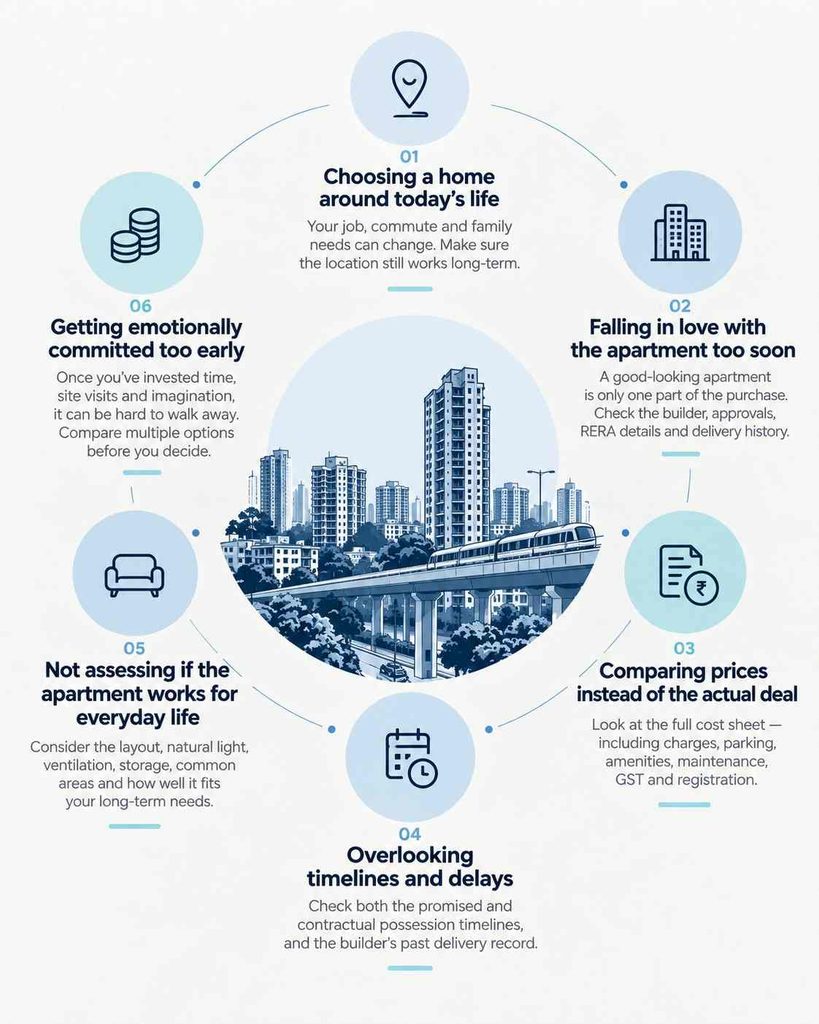
Why do homebuyers regret buying a flat in Bangalore?
Regret can come from very different sources.
Sometimes the problem is financial: the EMI leaves too little room for other priorities. Sometimes it is practical: the daily commute becomes exhausting. In other cases, buyers discover issues with the builder, documentation, the construction timeline, or the apartment itself.
There is also a less obvious problem: buyers can become emotionally committed to a property before completing their evaluation.
Once you have spent weekends visiting the project, spoken to the sales team, imagined your furniture in the living room, and started thinking about possession day, walking away can become psychologically difficult—even when another option may suit your requirements better.
That is why the strongest protection against homebuyer regret in Bangalore is not simply finding more properties.
It is creating a better decision-making process before you become attached to one.
Mistake #1: Choosing a home around today’s life
One of the most common homebuying mistakes in Bangalore is treating today’s routine as though it will remain unchanged for the next decade.
Your current office may be nearby. Your current employer may offer a convenient hybrid schedule. Your children may not be in school yet. Your family situation may be different today than it will be a few years from now.
Bengaluru’s employment centres and commuting patterns can change, and buyers themselves can change jobs or work arrangements.
That does not mean you need to predict the future perfectly.
Instead, ask:
- How manageable is the commute if my workplace changes?
- What happens if I need to travel regularly to another part of the city?
- Are schools and healthcare accessible?
- How dependent am I on one particular road or route?
- Will the location still work if my family requirements change?
- Is the neighbourhood useful beyond the immediate project?
A home should fit your life, but it is worth checking whether it will still fit if your circumstances change.
Mistake #2: Falling in love with the apartment before comparing the project
A beautifully staged apartment can make a property feel like the obvious choice.
But the apartment is only one part of the purchase.
Before deciding, compare the project itself:
- Who is the builder?
- What is the builder’s delivery history?
- What are the project’s approvals and RERA details?
- What is the construction status?
- What are the promised and contractual timelines?
- What is included in the quoted price?
- What are the project’s maintenance and operational considerations?
- How does this project compare with alternatives in the same micro-market?
This matters because choosing the wrong builder can create problems that cannot be solved simply by changing your interior design later.
A recent Karnataka RERA case involving a Bengaluru project also illustrates why written commitments matter: a buyer’s contractual entitlement regarding parking was supported by the sale deed and other project documentation when the promised provision was not delivered.
The practical takeaway is simple:
If something matters to your purchase, don’t rely only on what was said during a sales conversation. Check what is documented.
Mistake #3: Comparing apartment prices instead of comparing the actual deal
A lower quoted price does not automatically mean a lower-cost purchase.
When comparing two apartments, buyers should look beyond the base price and identify what is included and excluded.
The cost sheet may contain items such as:
- PLC or preferential-location charges
- Floor-rise charges
- Parking
- Infrastructure charges
- Clubhouse or amenity charges
- Utility-related deposits
- Advance maintenance
- Corpus contribution
- Other project-specific charges
- GST, where applicable
- Registration and stamp duty
This is one reason overpaying for a flat in Bangalore does not necessarily mean paying more for the apartment itself.
You can also overpay by accepting an expensive configuration that doesn’t provide equivalent value, overlooking additional charges, or choosing a property without adequately comparing comparable alternatives.
The right question is not:
“Is this apartment within my budget?”
It is:
“What am I paying, what am I getting, and how does that compare with my alternatives?”
Mistake #4: Treating loan eligibility as affordability
One of the most dangerous property affordability mistakes is confusing the amount a bank is willing to lend with the amount you should comfortably borrow.
A lender’s eligibility assessment is based on its own criteria.
Your personal affordability needs to account for much more:
- EMI
- Interest-rate changes
- Down payment
- Registration and transaction costs
- Interiors and furnishing
- Insurance
- Maintenance
- Emergency savings
- Existing financial commitments
- Future family expenses
A property can technically fit within your loan eligibility and still leave your monthly finances uncomfortably stretched.
This matters because the financial consequences of a home purchase continue long after registration.
Before committing, calculate the EMI alongside your other recurring expenses rather than looking at the home loan in isolation.
Mistake #5: Assuming the builder’s documentation is the same as independent verification
A builder provides documents as part of the sales process, but a buyer still needs to understand what they’re buying and what to verify independently.
This is where property legal issues in Bangalore can become particularly important.
Depending on the property and transaction, buyers may need to examine matters such as:
- Title and ownership records
- Encumbrances
- Project approvals
- RERA registration and disclosures
- Sanctioned plans
- Commencement and occupancy documentation, where applicable
- Sale agreement
- Sale deed
- Project-specific commitments
The objective is not to assume that every property has a legal problem.
It is to identify potential issues before making an irreversible financial commitment.
Proppy’s own Priority terms make an important distinction here: its legal review is a preliminary review based on information made available to Proppy, and it is not a substitute for independent legal counsel or a certified legal opinion.
That is the right principle for any property-buying process: verification should happen before commitment, not after a problem appears.
Mistake #6: Looking at RERA only when something goes wrong
Many buyers hear about RERA complaints only after a dispute develops.
A better approach is to use the information available before booking.
For a registered project, buyers can review relevant project information and compare what’s disclosed with what the sales team is promising.
Look at:
- Project registration details
- Promoter information
- Proposed completion timelines
- Project details
- Approved information available through the regulatory framework
- Any relevant disclosures or updates
RERA information is not a substitute for every form of property due diligence, but it is an important part of the verification process.
The broader principle is:
Don’t wait for a dispute to start researching the project.
Mistake #7: Believing every sales promise will automatically become part of the deal
A sales representative might discuss:
- Possession timelines
- Parking
- Clubhouse access
- Amenities
- Specifications
- Discounts
- Waivers
- Maintenance
- Other benefits
But buyers should distinguish between what was discussed and what the contract documents.
If a particular promise is important enough to influence your decision, ask where it appears in the relevant written documentation.
This matters most when the promise affects the property’s value or how you expect to use it.
A recent Karnataka RERA matter involving a Bengaluru homebuyer demonstrates why written project commitments can become important evidence in a dispute.
What should I check before booking an apartment?
A useful apartment buying checklist in Bangalore should cover more than the apartment itself.
| CHECK | WHAT TO VERIFY |
| Location | Commute, connectivity, schools, healthcare and everyday infrastructure |
| Builder | Track record, delivery history and previous projects |
| Legal | Title, encumbrances, approvals and relevant documentation |
| RERA | Project registration and available project information |
| Apartment | Layout, orientation, ventilation, natural light and usable space |
| Cost | Complete cost sheet, GST where applicable and additional charges |
| Loan | EMI, interest-rate exposure and overall affordability |
| Project | Construction progress and contractual possession timeline |
| Agreement | Important obligations, commitments and relevant clauses |
| Future suitability | Whether the property can continue to work as your circumstances change |
A checklist isn’t meant to make buying a home unnecessarily complicated.
It prevents one attractive feature from overshadowing ten important questions.
How can you avoid buying the wrong apartment in Bangalore?
Start by separating must-haves from preferences.
For example, a buyer may consider a particular floor, balcony view or clubhouse feature desirable, while commute time, budget and legal clarity may be non-negotiable.
Then compare properties against the same criteria.
Instead of asking:
“Which apartment do I like most?”
ask:
“Which property best meets the requirements I identified before I started looking?”
That small change can make the process more objective.
It also makes it easier to reject a property that looks attractive but does not actually fit your requirements.
How can you avoid overpaying for a flat in Bangalore?
Overpaying is not always about negotiating the final price down.
It can happen when buyers:
- Compare only one or two projects
- Don’t examine the complete cost sheet
- Pay a premium for features they don’t actually need
- Choose a larger apartment than their requirements justify
- Ignore comparable properties in the same micro-market
- Focus on discounts rather than the final payable amount
- Decide under time pressure
A better approach is to compare like-for-like properties.
Look at location, project quality, apartment size, configuration, specifications, possession stage, additional charges and overall cost together.
A discount is only meaningful when you understand the price it was calculated from and what you are actually paying after all applicable charges.
What should first-time homebuyers do before paying a booking amount?
The booking amount is often where the decision becomes financially real.
Before paying it, make sure you can answer these questions:
Why this location?
Why this builder?
Why this particular project?
Why this unit?
What is the complete cost?
What documentation has been checked?
What happens if the transaction does not proceed?
What exactly has the builder committed to in writing?
If you cannot answer these questions yet, that does not necessarily mean the property is wrong.
It may simply mean the decision isn’t ready.
How can Proppy help reduce homebuying mistakes?
This is where structured support can become useful.
Proppy’s home-discovery platform is designed around property discovery, comparison and buyer support. For buyers who want additional assistance, Proppy Priority currently costs ₹999 as a one-time membership. It includes a Dedicated Relationship Manager, legal due diligence, independent project reports, Vastu review, interior consultation with a 3D floor plan, home-loan assistance and priority post-booking support. Proppy currently states ₹1L+ in potential included value and cashback of up to ₹50,000, subject to eligibility and applicable terms.
For this particular problem, not every Priority benefit is equally relevant.
The most relevant are the ones that address the decision before the buyer commits:
Dedicated Relationship Manager
A dedicated Relationship Manager can help buyers understand their requirements, shortlist projects, coordinate site visits, compare projects and support them through the buying process. Proppy states that it assigns an RM within 24 hours of activation.
Independent project reports
Proppy Priority includes project reports covering aspects such as builder track record and livability, helping buyers look beyond the sales pitch when comparing shortlisted projects.
Legal due diligence
Priority includes a preliminary legal documentation review covering areas such as Title, encumbrances and municipal approvals. However, it is important to understand its limits: Proppy explicitly states that this is not a substitute for independent legal counsel or a certified legal opinion.
Home-loan assistance
Loan assistance can help buyers compare financing options and understand the borrowing side of the purchase, although Proppy does not guarantee loan approval.
The value of this support isn’t that it decides for the buyer.
It helps bring the right questions into the process before the buyer decides to book.
What are the biggest first-time homebuyer mistakes in Bangalore?
If you reduce the entire process to a simple checklist, the mistakes usually come down to a few patterns:
Buying for today’s lifestyle without considering how your needs may change.
Choosing an apartment before evaluating the project.
Comparing advertised prices instead of complete costs.
Treating loan eligibility as personal affordability.
Relying on verbal promises instead of written commitments.
Leaving legal and project verification until after the booking decision.
Allowing urgency or sales pressure to replace comparison.
None of these mistakes means that a buyer is careless.
Buying a home is a complex decision involving location, finance, documentation, construction, lifestyle and long-term plans. The problem is often not a lack of effort; it is that the effort is spent on the wrong questions at the wrong time.
The Best Time to Find a Problem Is Before You Book
A home purchase becomes difficult to reverse once you’ve made a substantial financial commitment.
That is why the most valuable part of the buying process is often not the final negotiation or the registration appointment. It is the period before the booking decision, when you can still compare projects, question assumptions, verify documents, and walk away without building your plans around one property.
Bengaluru offers a wide range of apartments, locations and price points, which gives buyers plenty of choice, but choice is useful only when it is structured.
So before asking:
“Which flat should I buy?”
ask:
“What would make me regret buying this flat later?”
Then work through those questions before you book.
Because avoiding a bad property decision is not about predicting the future perfectly.
It is about doing enough verification today that tomorrow’s surprises are fewer.
Frequently Asked Questions:
Homebuyers may regret a purchase when the property doesn’t match their long-term needs, the total cost is higher than expected, the project faces delays, or important legal, builder, and documentation checks weren’t completed before booking.
Common mistakes include choosing a property based only on location or appearance, comparing only the quoted apartment price, underestimating the total cost, relying entirely on builder-provided information, and not evaluating whether the property will remain suitable as circumstances change.
Check the location, builder track record, legal documentation, RERA information, apartment layout, complete cost sheet, loan affordability, construction progress, agreement clauses and future suitability before paying a booking amount.
Look beyond the advertised base price and compare the complete cost, including applicable GST, additional charges, floor or other premiums, parking and other project-related costs. Comparing similar projects can also help put the quoted price into context.
Review the builder’s previous projects, delivery history, construction quality, project track record and available information about completed and ongoing developments. Do not base the decision only on the sales presentation for the project you are considering.
RERA information is an important part of the pre-booking review. Buyers should check the project’s registration and available project information and compare those details with the information provided by the developer.
No. Loan eligibility indicates what a lender may be willing to finance; it does not necessarily mean the resulting EMI and overall housing costs fit your household budget.
Proppy can help buyers discover and compare residential properties using its AI-powered home discovery platform, with information and support designed to help with the homebuying journey.
Proppy Priority includes services such as a Dedicated Relationship Manager, legal due diligence, independent project reports, Vastu review, interior consultation with a 3D floor plan, home-loan assistance and priority post-booking support, along with eligible cashback benefits
No. Priority is designed to provide additional support and checks during the homebuying process, but it does not guarantee a purchase outcome, loan approval, property appreciation or legal title clearance. Buyers should independently verify important information before making a purchase decision.
Related Posts

How AI-Powered Property Search Helped a Couple Book a Home in Bengaluru in 72 Hours
From Six Months of Searching to a Home Booking in 72 Hours For Prasad and Sandhya, buying a home in...
Read More →
The Metro Effect: How Phase 2B Could Reshape Property Prices in North Bengaluru
The Real Question Isn’t Whether Prices Will Rise. It’s Whether You’re Paying Too Much Today. A property near a proposed...
Read More →
Property Registration Charges in Karnataka 2026: Stamp Duty, Registration Fee, GST and Other Costs Explained
Buying a property in Karnataka involves several statutory payments, and understanding how each is calculated matters before you sign a...
Read More →