
The Metro Effect: How Phase 2B Could Reshape Property Prices in North Bengaluru
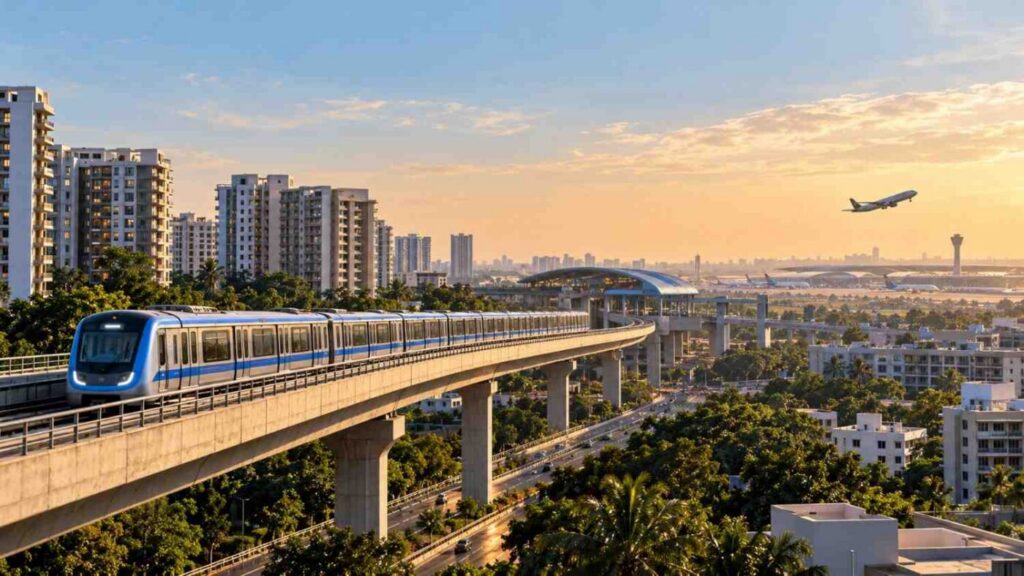
The Real Question Isn’t Whether Prices Will Rise. It’s Whether You’re Paying Too Much Today.
A property near a proposed Metro station can look like an attractive investment. The location is expected to become more accessible; developers highlight future connectivity, and buyers are beginning to anticipate stronger demand.
But there is a catch: by the time a buyer hears about an infrastructure opportunity, some of that expectation may already be reflected in the property’s asking price.
That is the central issue with property prices in Bangalore Metro Phase 2 B. The planned airport corridor could improve connectivity across parts of North Bengaluru, but better connectivity and better investment returns are not the same thing.
A property can become more convenient without appreciating enough to justify the premium you pay. Equally, a home in a less-hyped location may offer better value if it already has the amenities, access, and rental demand its buyer needs.
For anyone considering property investment in North Bengaluru, the more useful question is this: How much extra should you pay today for a connectivity benefit that has not yet arrived?
This guide examines the proposed Blue Line, the differences between key North Bengaluru locations, a practical way to assess the Metro premium, and how buyers can evaluate residential projects without relying on guaranteed appreciation claims.
Bangalore Metro Phase 2B: What Buyers Need to Know
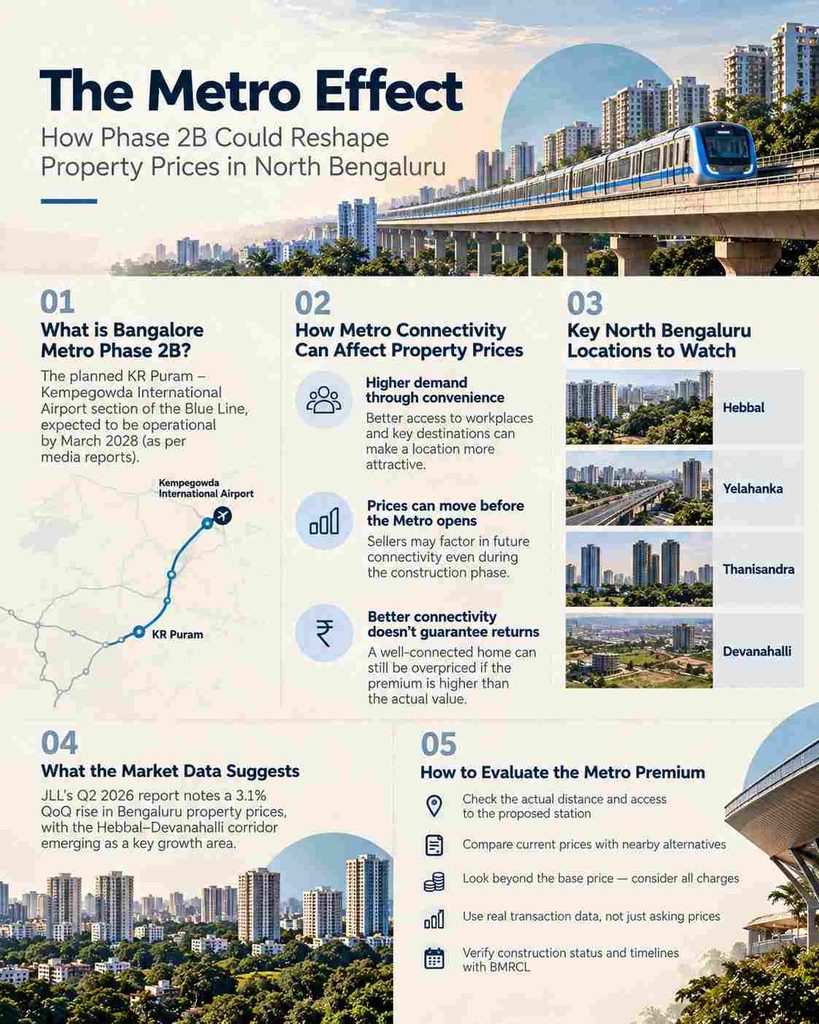
Bangalore Metro Phase 2B is the planned KR Puram–Kempegowda International Airport section of the Blue Line. Together with Phase 2A, which runs between Central Silk Board and KR Puram along the Outer Ring Road, it forms part of the wider corridor intended to connect the airport with Bengaluru’s Metro network.
For property buyers, the distinction between these sections matters. A home near the Outer Ring Road section does not necessarily get the same benefit as one near the airport-bound section. The relevant station, the route to it, and the destinations it serves determine how useful the connection will be.
The Blue Line is not yet fully operational. In October 2026, The Times of India reported that the full corridor was expected to become operational by March 2028, with different sections targeted to open at different times. These are reported targets, not guaranteed passenger-service dates.
Buyers should verify the latest status with Bangalore Metro Rail Corporation Limited (BMRCL) before committing to a property based on the assumption that a particular station will open by a specific date.
Source: The Times of India — Bengaluru Blue Line opening timeline, October 2026.
How Does Metro Connectivity Affect Property Prices?
The metro’s impact on real estate is not limited to a possible increase in property values. It can affect where people choose to live, which homes landlords can attract tenants to, and how much buyers are willing to pay for convenience.
Three effects are worth separating.
1. Convenience can change demand
A Metro station may make a neighborhood more practical for people traveling to employment hubs, commercial districts, and other connected destinations. For regular commuters, that convenience can make a property more attractive.
However, the benefit depends on the actual journey. A property advertised as being near the metro may still require a long feeder trip or an inconvenient walk to reach the station.
For buyers comparing flats near Metro stations in Bangalore, practical access matters more than a station symbol on a map. Consider the route from the apartment entrance, the time it takes to reach the station, and whether the line serves the destinations you actually need.
2. Expectations can influence prices before services begin
Property markets can respond to anticipated infrastructure. As construction progresses, developers and sellers may factor future connectivity into asking prices.
That creates a risk for buyers: they may pay for a future advantage before experiencing it.
A higher asking price does not prove that a property has appreciated by the same amount. Nor does it prove that the metro caused the price movement. Employment growth, new residential supply, road improvements, construction costs, and changes in buyer demand can all affect local prices.
To understand the actual impact, buyers need comparable property data over time and a clear distinction between asking prices and completed transactions.
3. Better connectivity does not guarantee better returns
A well-connected home can still be overpriced. A property near a proposed station may also face strong competition from similar apartments or weak rental demand.
Even if the metro opens as expected, the added convenience may not be sufficient to justify a substantial premium today.
The key investment question is not whether the metro adds value. It is whether the added value justifies the price you are paying.
What the Bengaluru Property Market Data Tells Us
JLL’s Bengaluru residential market research for Q2 2026 reported that overall property prices across the city rose 3.1% quarter-on-quarter. The report also identified the Hebbal–Devanahalli corridor as an important area for new office and residential development.
This provides useful context for the North Bengaluru market. However, the citywide price movement does not show that Phase 2B drove price rises in Hebbal, Yelahanka, Thanisandra, or Devanahalli.
Source: JLL — Bengaluru Residential Market Dynamics, Q2 2026.
Locality-level portals can provide additional price indicators, but their averages and advertised ranges may reflect different property types, listing samples, and methodologies. They should not be treated as a substitute for verified transaction data.
For a property purchase, compare similar homes in the same micro-market and use reliable transaction evidence where available. If the evidence only shows current asking prices, describe it as asking-price data rather than realized appreciation.
This distinction matters because a locality can experience price growth for several reasons at once. Without comparable evidence, attributing a specific increase to the metro alone would be misleading.
Hebbal, Yelahanka, Thanisandra and Devanahalli: Which Investment Case Fits You?
These locations offer different residential propositions. Instead of ranking them by speculative appreciation, assess what supports demand today and what depends on future infrastructure.
| Location | Existing investment consideration | What the Metro could add | Main risk to evaluate |
| Hebbal | An established residential market and access to employment destinations, including the Manyata Tech Park area. | An additional transport option and potentially more convenient journeys for suitable destinations. | Paying a premium for connectivity that may already be reflected in the asking price. |
| Yelahanka | Residential communities, everyday amenities and established road connections. | Better access to the wider Metro network, depending on the project and station. | Assuming all homes in the locality will benefit equally. |
| Thanisandra | Access to employment destinations and a range of residential developments. | Improved public transport options where station access is practical. | Competing residential supply and differences in actual access to the station. |
| Devanahalli | An investment case influenced by airport access and longer-term regional development. | Potentially stronger connectivity as the corridor develops. | Depending too heavily on future infrastructure and development milestones. |
These are decision factors, not an appreciation ranking.
Hebbal: Is the Premium Justified in an Established Market?
For buyers considering flats near Hebbal Metro, the question is how much additional value the proposed Blue Line could add to a location that already has established road connectivity and access to employment.
Compare similar projects, current asking prices and practical station access. If a project is already priced above comparable homes, identify what justifies the difference. The answer might include better construction quality, amenities, location or existing convenience—not necessarily the metro alone.
Yelahanka: Will Connectivity Improve Your Actual Commute?
For buyers evaluating apartments near Yelahanka, the useful comparison is between the current commute and the journeys that could become easier once the relevant section opens.
The exact project location matters. Two homes in the same broad locality may have very different routes to a station, access to everyday services, and commuting experiences.
Thanisandra: Does the Project Offer More Than a Metro Story?
If you’re researching Thanisandra property prices, compare similar residential projects by total cost, builder, construction status, amenities, employment access, and the practical route to public transport.
A future Metro connection can strengthen a property’s appeal, but it shouldn’t overshadow the factors that determine whether the home suits its intended use today.
Devanahalli: Can the Investment Work Without Rapid Appreciation?
For buyers considering Devanahalli property prices, the key question is how much of the purchase decision depends on future development.
Assess current residential demand, everyday amenities, access to employment, and the property’s intended use. Then evaluate the metro as a potential added benefit, not the sole reason to buy.
A longer holding period may suit some buyers, but it doesn’t eliminate the risks of delays, competing supply, or a purchase price based on optimistic growth.
The Metro Premium Test: How to Decide Whether Paying Extra Makes Sense
A simple comparison can show why the purchase price matters as much as the infrastructure.
Imagine two otherwise comparable apartments:
- Apartment A costs ₹1 crore and has convenient access to existing transport and daily amenities.
- Apartment B costs ₹1.05 crore and is marketed on its proximity to a proposed Metro station.
Apartment B carries a ₹5 lakh premium, or 5%, over Apartment A. That extra amount is a hypothetical illustration, not a reported market premium.
The question is what the buyer receives in exchange for paying more.
Test: What to examine/Why it matters
Price difference Compare the premium with similar homes, not just the developer’s advertised benefits. Establishes how much extra you are paying.
Current convenience Compare existing commuting options, amenities and access to employment. Shows whether the home is useful before the metro opens.
Station access Assess the actual route from the property to the station. A nearby station may offer limited value if access is inconvenient.
Rental potential Compare current rents for similar homes and likely tenant demand tests whether the property has a plausible rental case.
Delivery risk Check the official project status and consider possible delays. Helps you avoid depending on an uncertain opening date.
Resale competition Examine other projects that may offer similar connectivity. A Metro benefit is less distinctive if many competing homes offer the same advantage.
How the premium affects rental yield
Suppose both apartments in the illustration could rent for ₹30,000 per month. This is a hypothetical example, not a rent estimate for either locality.
At ₹30,000 per month, annual rent would be ₹3.6 lakh.
- Apartment A, purchased for ₹1 crore, would have a gross rental yield of 3.6%.
- Apartment B, purchased for ₹1.05 crore, would have a gross rental yield of approximately 3.43%.
The calculation is:
Gross rental yield = (Annual rent ÷ Property purchase price) × 100
If both homes generate the same rent, the more expensive apartment produces a lower gross yield. For the higher-priced property to deliver the same gross yield, it would need higher rental income or another benefit that justifies the premium.
Actual investment returns will also depend on maintenance, vacancy, transaction costs, financing, and eventual resale value.
Many infrastructure-led investment discussions overlook this: a better-connected property isn’t automatically a better-value purchase if its price rises faster than its income potential.
Is Buying an Apartment Near the Airport Metro a Good Investment?
It can suit some buyers, but the decision should make sense under more than one possible outcome.
If connectivity improves as expected: the property may become more convenient and attractive to selected buyers or tenants. The benefit will depend on its precise location and the price paid.
If the metro is delayed: residents may have to rely on existing roads and transport for longer. A property that is impractical today could be harder to live in or rent out during that period.
If the metro opens but competing supply is high: improved access may not translate into exceptional appreciation or rental income for every project.
If the buyer pays too much upfront: even a genuine improvement in connectivity may not deliver the expected return if the purchase price already reflects the anticipated benefit.
Before investing, make sure the property has a credible case based on its current location, price, intended use, and demand. Treat the metro as a potential advantage, not a guarantee of returns.
How Proppy Priority Can Help You Compare Properties
When a property investment depends partly on future infrastructure, comparing shortlisted projects becomes especially important. Buyers need to understand the price, the property’s current advantages, its documentation, and the assumptions behind its investment case.
Proppy Priority is a ₹999 one-time membership that includes a dedicated Relationship Manager, legal due diligence, independent reports for up to three shortlisted projects, a Vastu consultation, interior design consultation with a 3D floor plan, home-loan assistance, and priority post-booking support. Eligible buyers may also receive cashback of up to ₹50,000, subject to the applicable terms.
For buyers evaluating North Bengaluru projects, these services can support the purchase process:
- Project comparison: Independent reports cover up to three shortlisted projects, helping buyers review relevant project information.
- Documentation review: Legal review applies to one shortlisted project and is based on the documentation made available.
- Purchase coordination: A dedicated Relationship Manager can help coordinate shortlisting, site visits, and next steps.
- Planning support: Home-loan assistance and interior consultation can help buyers prepare for parts of the purchase and move-in process.
These services support an organized evaluation, but they do not replace independent investment analysis or professional advice where required. The legal summary is a preliminary review; it is not a certified legal opinion and does not guarantee marketable or encumbrance-free title. Loan approval, appreciation, and cashback on every transaction are not guaranteed.
Priority is valid for up to 90 days. The legal summary and Vastu consultation apply to one shortlisted project, while the interior consultation applies to one selected property. Cashback is subject to eligibility, builder participation, registration through Proppy, and the current applicable policy.
Review the full service scope and conditions on the official Proppy Priority page.
The purpose is not to encourage buyers to purchase simply because a property is near a future Metro station. It helps them organize their evaluation and make a more informed decision.
The Bottom Line: Buy the Value, Not Just the Connectivity Story
Bangalore Metro Phase 2B could strengthen the connectivity proposition of selected locations across North Bengaluru. But the impact on Bangalore Metro Phase 2B property prices will depend on how that improvement interacts with existing demand, competing housing supply, project quality, and the price buyers pay.
Hebbal buyers should test whether the anticipated benefit justifies the premium in an established market. Yelahanka and Thanisandra buyers should focus on practical station access and comparisons at the project level. Devanahalli buyers should pay particular attention to current residential demand and the risks of a longer development timeline.
There is no reliable basis to assume every property along the corridor will appreciate by the same amount, or that the metro will guarantee a particular return. The better investment is not necessarily the property closest to a proposed station. It is the property whose price, present-day usefulness, and realistic future benefits make sense together.
Related Posts

How AI-Powered Property Search Helped a Couple Book a Home in Bengaluru in 72 Hours
From Six Months of Searching to a Home Booking in 72 Hours For Prasad and Sandhya, buying a home in...
Read More →
Property Registration Charges in Karnataka 2026: Stamp Duty, Registration Fee, GST and Other Costs Explained
Buying a property in Karnataka involves several statutory payments, and understanding how each is calculated matters before you sign a...
Read More →
Why Bengaluru Homebuyers Regret Their First Purchase – And the Mistakes Behind It
Buying a home in Bengaluru is rarely just about finding an apartment you like and deciding whether you can afford...
Read More →