
The Real Cost of a ₹1 Crore Apartment in Bengaluru (2026 Breakdown)
A ₹1 crore apartment in Bengaluru sounds like a straightforward budget.
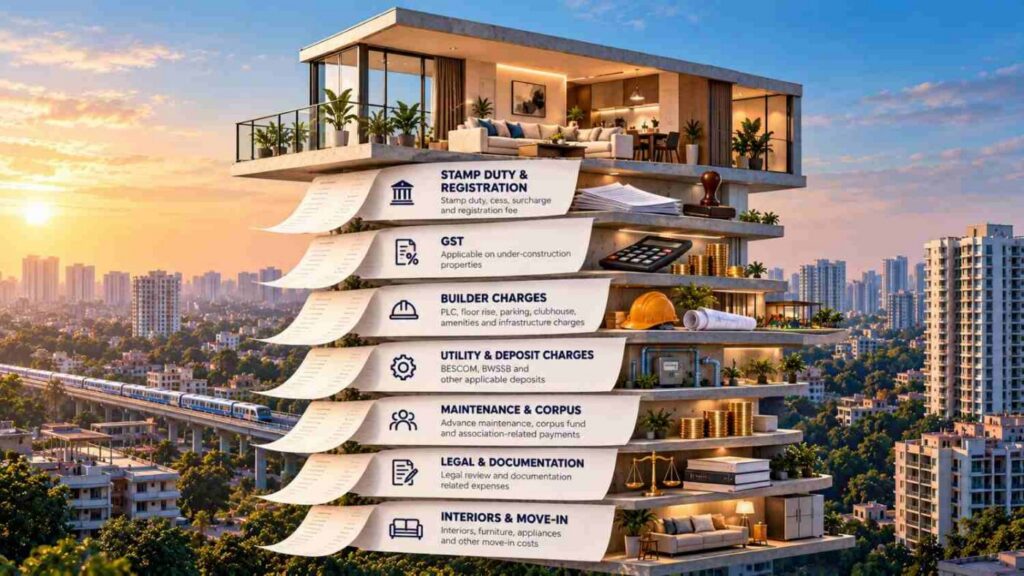
You find a property listed at ₹1 crore, arrange the down payment, check your home-loan eligibility and start calculating the EMI. But the ₹1 crore you see on the property price is usually only the starting point. Once you add builder-specific charges, statutory costs, taxes, deposits, maintenance, legal expenses and other purchase-related costs, the amount you actually need to budget can be significantly higher.
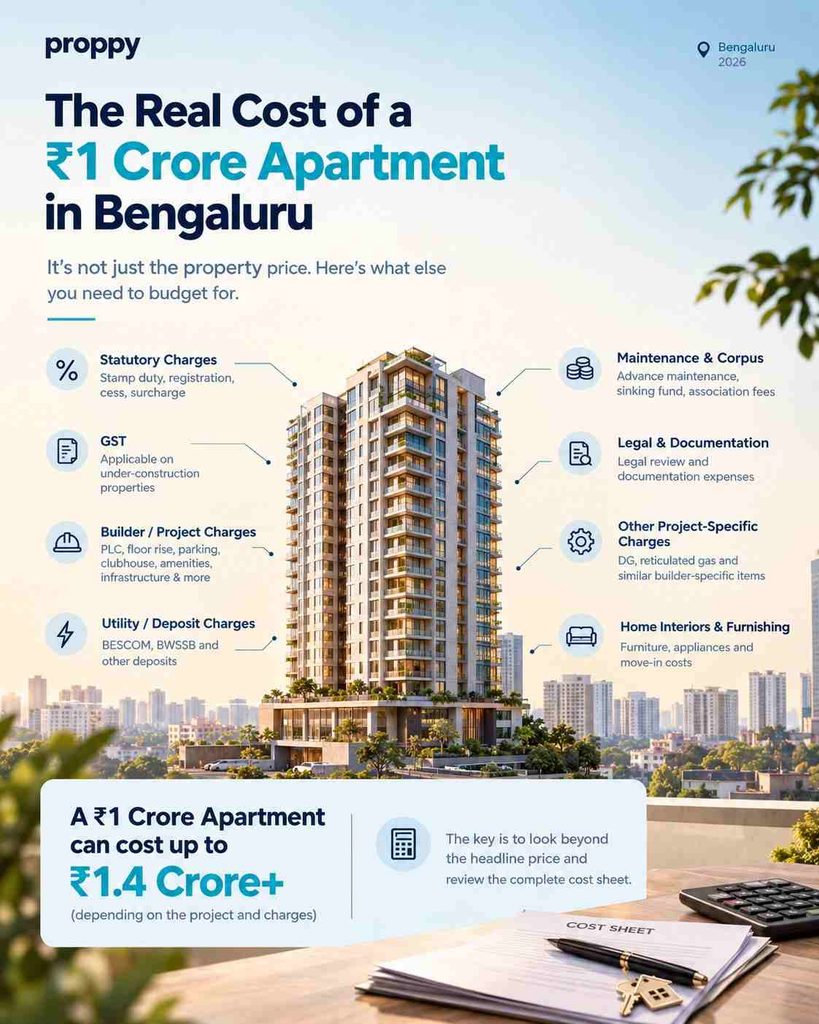
In some Bengaluru projects, these additional costs can add up to as much as 40% over the base unit price, depending on what the builder includes in the quoted price and which charges apply to the particular property.
So, how much does a ₹1 crore apartment actually cost in Bengaluru?
No single number applies to every buyer. The final amount depends on the project, builder, construction stage, cost sheet, applicable taxes, financing structure and the expenses associated with making the apartment ready to live in.
The key is understanding what sits between the advertised unit price and the actual amount you need to budget.
First, ₹1 crore is the base property price, not necessarily your total budget.
Let’s start with the number most buyers see first:
Apartment price: ₹1 crore
Now look at what can sit on top of that amount.
A buyer may encounter:
- Stamp duty and registration charges
- GST, where applicable
- PLC or preferential location charges
- Floor-rise charges
- Car parking charges
- Clubhouse and amenity charges
- Infrastructure charges
- BESCOM and BWSSB deposits
- Advance maintenance
- Corpus fund
- Legal and documentation fees
- Builder-specific charges such as DG or reticulated gas charges
- Other project-specific payments
- Home interiors and furnishing
- Loan-related expenses
Not every project will have every charge, and some builders may include certain components in the quoted price while others may itemise them separately.
That is why a buyer should not assume that a ₹1 crore apartment means a ₹1 crore purchase budget.
How the costs can stack up
| Cost category | What it can include |
| Base property price | Apartment’s quoted unit price |
| Statutory charges | Stamp duty, registration, applicable cess and surcharge |
| GST | Applicable primarily to qualifying under-construction transactions |
| Builder/project charges | PLC, floor rise, parking, clubhouse, amenities, infrastructure and other charges |
| Utility/deposit charges | BESCOM, BWSSB and other applicable deposits |
| Maintenance & corpus | Advance maintenance, sinking/corpus fund and association-related payments |
| Legal/documentation | Legal review and documentation-related expenses |
| Other project-specific charges | DG, reticulated gas and similar builder-specific items |
| Home setup | Interiors, furniture, appliances and other move-in costs |
This is why you need to calculate the total cost of buying a ₹1 crore flat from the complete cost sheet, not the headline property price.
1. Stamp duty and registration on a ₹1 crore property
Stamp duty and registration are two separate charges and should not be treated as a single percentage.
For the ₹1 crore Bengaluru example covered in this article, the base stamp duty is 5% under the applicable conveyance provision. The applicable cess and surcharge are additional, as is the registration fee.
For illustration:
| Cost component | Rate / calculation | ₹1 crore example |
| Stamp duty | 5% | ₹5,00,000 |
| Cess | 10% of stamp duty | ₹50,000 |
| Urban surcharge | 2% of stamp duty | ₹10,000 |
| Registration fee | 2% | ₹2,00,000 |
| Total illustrative statutory charges | 7.6% | ₹7,60,000 |
Karnataka increased the registration fee from 1% to 2% effective 31 August 2025, so older property calculators may show a lower figure.
So, for this illustration:
₹1 crore property price + ₹7.6 lakh in statutory charges = ₹1.076 crore
But this is not the final cost of the home.
It does not include GST (where applicable), builder-specific charges, deposits, maintenance, legal fees, interiors, or financing costs.
Also, confirm the exact statutory amount for the specific transaction, as the applicable valuation and transaction structure matter.
2. GST on a ₹1 crore apartment
GST is another major variable, especially when comparing an under-construction property with a completed apartment.
Under the current GST framework, the effective rate is generally 5% for residential apartments outside the affordable segment and 1% for qualifying affordable residential apartments, subject to the applicable conditions. Bengaluru is classified as a metropolitan city for the affordable-housing definition.
However, you should not simply take ₹1 crore and automatically add 5%.
The first question is:
Is the apartment still under construction?
The construction-service GST provision applies to qualifying construction intended for sale, subject to the applicable conditions. It does not apply in the same way when the entire consideration is received after the required completion certificate or first occupation, whichever is earlier.
So, if a qualifying taxable value of ₹1 crore were subject to an effective 5% GST rate, that would amount to ₹5 lakh. But that does not mean every ₹1 crore apartment automatically attracts ₹5 lakh GST.
Confirm the property’s status, applicable valuation, and GST treatment from the builder’s cost sheet and transaction documents.
3. PLC and floor-rise charges can change the base price significantly
The advertised apartment price is not always the same as the price of the specific unit you eventually choose.
A buyer may select a particular floor, corner unit, preferred view or another location within the project and encounter additional charges such as:
- Preferential Location Charges (PLC)
- Floor-rise charges
- View-related premiums
- Other unit-specific premiums
This is why two apartments in the same project can have different final prices even when they have the same configuration.
If you are comparing a ₹1 crore flat in Bangalore, ask whether the quoted price already includes the charges applicable to the exact unit you are considering.
4. Parking, clubhouse and amenity charges
Parking is another cost to check separately in the builder’s cost sheet.
Depending on the project and agreement, parking may be included, separately charged or structured differently.
Similarly, some projects may have charges associated with:
- Clubhouse
- Amenities
- Facilities
- Infrastructure
- Other project-level provisions
The important question is not simply:
“What is the apartment price?”
It is:
“What exactly is included in the quoted apartment price?”
A ₹98 lakh apartment with several separately payable charges may result in a higher overall cash outflow than a ₹1 crore apartment where more components are already included.
5. Infrastructure and utility deposits
Some projects may also include charges or deposits related to infrastructure and utilities.
These can include:
- Infrastructure charges
- BESCOM deposits
- BWSSB deposits
- Utility-related payments
- Other project-specific deposits
The amount and structure can vary by project, so don’t estimate it using a single universal number.
This is another reason why buyers looking at 1 crore flats in Bangalore should ask for the complete cost sheet before comparing projects.
6. Advance maintenance and corpus fund
The purchase price does not necessarily cover the costs associated with maintaining the property after possession.
Depending on the project, buyers may encounter:
- Advance maintenance
- Corpus or sinking fund
- Association-related charges
- Utility deposits
- Facility-related charges
Some projects may collect maintenance in advance for an extended period, while corpus contributions can also add a significant amount to the initial cash requirement.
For example, a corpus contribution of ₹1–2 lakh would be an additional upfront expense, not part of the ₹1 crore apartment price.
The exact amount depends on the project.
7. Legal and documentation costs
Legal expenses can also form part of the overall homebuying budget.
A buyer may choose to engage an independent lawyer to review documentation, agreements or other property-related records.
These costs are separate from statutory stamp duty and registration charges.
For a high-value purchase, treating legal review as part of the overall purchase budget can be more realistic than looking only at the advertised apartment price.
8. Builder-specific charges can add further costs
Not every project follows the same cost structure.
Some builders may have additional itemised charges depending on the project, configuration and services provided.
These can include charges such as:
- DG charges
- Reticulated gas charges
- Additional utility-related charges
- Other project-specific infrastructure or service charges
The point is not that every buyer will pay every one of these charges.
The point is that the base unit price alone does not tell you what the final purchase outlay will be.
That is why a buyer should ask the builder for a complete, itemised cost sheet before deciding.
9. So, can the additional costs really go up to 40%?
They can add up to around 40% over the base unit price in some projects, depending on the combination of charges applicable to the property.
Don’t treat this as a standard fixed percentage for every Bengaluru apartment.
For one project, some charges may already be included in the quoted price. Another project may itemise PLC, floor rise, parking, infrastructure, amenities, deposits, GST and other costs separately.
For example, the difference between:
Base apartment price
and
Base apartment price + statutory charges + builder/project charges + taxes + deposits + maintenance + legal costs
can become substantial.
That is why using only a fixed percentage as a shortcut can be misleading.
The better approach is to calculate the actual cost for the specific apartment.
A more realistic budgeting framework
| Cost category | Illustrative treatment |
| Base apartment price | ₹1,00,00,000 |
| Stamp duty + registration-related charges | Approximately ₹7,60,000 in the illustrative statutory example |
| GST | Depends on applicability |
| PLC/floor rise | Project- and unit-specific |
| Parking | Project-specific |
| Clubhouse/amenities | Project-specific |
| Infrastructure charges | Project-specific |
| BESCOM / BWSSB deposits | Project-specific |
| Advance maintenance | Project-specific |
| Corpus fund | Project-specific |
| Legal / documentation | Buyer-specific |
| DG / reticulated gas and other charges | Where applicable |
| Home interiors | Buyer-specific |
| Actual total | Can be substantially higher than ₹1 crore |
The important takeaway is that “up to 40% higher” is a potential planning range, not a standard charge.
10. What about interiors?
Even after completing the purchase, the apartment still needs to become a home.
Depending on your requirements, you may need to budget for:
- Modular kitchen
- Wardrobes
- Lighting
- Curtains and blinds
- Electrical work
- Storage
- Furniture
- Appliances
- False ceiling
- Décor and finishing
Interior costs vary widely depending on the size of the apartment, materials, design preferences and level of customisation.
For this reason, treat interiors as a separate, buyer-specific budget rather than a standard percentage of the property price.
For example:
₹1 crore property + purchase-related costs + ₹8 lakh interior budget
is a more realistic way to think about the total financial commitment than simply calling it a “₹1 crore home.”
11. How much down payment do you need?
The down payment depends on the loan amount the lender sanctions and its applicable loan-to-value and underwriting rules.
Suppose, purely for illustration, that you borrow ₹80 lakh for a ₹1 crore property.
That leaves:
₹20 lakh from your own funds
But your upfront cash requirement may not stop there.
You may also need to fund registration-related charges, applicable GST, project deposits, maintenance, corpus contributions and other expenses that may not be financed in the same way as the property value.
So instead of thinking:
“I have ₹20 lakh, therefore I can buy a ₹1 crore flat.”
a better calculation is:
Down payment + purchase charges + applicable taxes + project deposits + initial home setup = upfront cash requirement
12. What is the EMI for a ₹1 crore home loan?
A ₹1 crore property does not necessarily mean a ₹1 crore home loan.
Suppose a buyer borrows ₹80 lakh.
At an assumed interest rate of 8% per year for 20 years, the EMI would be approximately ₹66,900 per month.
This is only an illustration.
The actual EMI depends on the lender, interest rate, tenure, loan amount and borrower’s profile.
If you took the same ₹80 lakh loan for 25 years at 8%, the EMI would be about ₹61,700 per month, although the longer tenure would increase the total interest paid over the loan period.
That is why searching for EMI for a ₹1 crore home loan is incomplete unless you also specify the loan amount, interest rate and tenure.
13. How much salary is required to buy a ₹1 crore apartment?
No single salary number applies to every buyer.
Lenders typically consider factors such as:
- Income
- Existing obligations
- Credit profile
- Age
- Employment
- Down payment
- Loan amount
- Repayment tenure
Your own financial comfort also matters.
An ₹80 lakh loan at an illustrative 8% interest rate over 20 years results in an EMI of around ₹66,900, but whether that EMI is comfortable depends on your income and existing commitments.
A more useful question is:
“What loan amount can I comfortably service after accounting for my existing obligations and the full cost of homeownership?”
14. Can I buy a 2 BHK under ₹1 crore in Bangalore?
Yes, ₹1 crore can still be a search budget for 2 BHK apartments in Bengaluru, but what you find will depend heavily on location, project, size, construction stage and developer.
The phrase “2 BHK under 1 crore Bangalore” therefore needs a location attached.
A ₹1 crore budget in one micro-market can offer a very different set of options than the same budget elsewhere in the city.
Compare:
- Carpet area
- Location and commute
- Project age
- Builder track record
- Amenities
- Maintenance costs
- Construction status
- Connectivity
- Complete purchase cost
The cheapest apartment isn’t automatically the lowest-cost home once you factor in all surrounding expenses.
15. Can I buy a 3 BHK under ₹1 crore in Bangalore?
You can find 3 BHK apartments under ₹1 crore in Bangalore, but options depend heavily on location, project stage, size, and specifications.
The phrase “affordable 3 BHK Bangalore” should therefore not be treated as a single property category.
A 3 BHK at ₹95 lakh may have a very different carpet area, location and cost structure from a ₹1 crore 3 BHK elsewhere.
If a 3 BHK matters to you, compare usable space and total cost, not just the number of rooms.
What should you actually budget for a ₹1 crore apartment?
The biggest mistake is to treat the advertised unit price as the complete financial commitment.
A better framework is:
Base unit price
Statutory charges
GST, where applicable
Builder and project-specific charges
Deposits and maintenance
Legal and documentation costs
Loan-related expenses
Interiors and move-in costs = Actual homebuying budget
Additional costs can run up to around 40% over the base unit price in some projects, but treat that as a potential range rather than a fixed rule.
The only reliable way to know the actual number is to examine the complete cost sheet for the specific property.
Where Proppy fits into the ₹1 crore homebuying decision
Once you move beyond the ₹1 crore headline price, comparing properties becomes more complicated.
You may be comparing different builders, locations, floor plans and cost sheets while also trying to understand which charges are included, which are additional and how the total cost compares across projects.
That is where Proppy fits into the journey.
Proppy is an AI-powered home discovery companion that helps buyers search and compare homes based on factors such as budget, location and lifestyle, while providing verified property information and support through the buying journey.
Instead of simply asking:
“Show me every apartment around ₹1 crore.”
a more useful question is:
“Which homes fit my requirements within my actual budget, and what should I compare before I commit?”
That distinction matters because two homes with the same advertised price can have very different final costs.
Where Proppy Priority can add support
For buyers moving from property search towards purchase, Proppy Priority provides a more structured layer of support.
The current Proppy Priority plan costs ₹999 as a one-time membership. It includes a Dedicated Relationship Manager, legal due diligence, independent project reports, a Vastu review, interior consultation with a 3D floor plan, home-loan assistance and priority post-booking support. Eligible buyers may also receive cashback of up to ₹50,000, subject to applicable conditions.
For a ₹1 crore buyer, the value isn’t just the membership fee. It is the support across several stages of the buying process.
A Relationship Manager can help coordinate the shortlist, site visits, project comparison, builder communication and registration-related support.
Legal due diligence provides a preliminary review of title, encumbrances and relevant municipal approvals within Proppy’s stated scope.
Independent project reports can help compare up to three shortlisted projects on areas such as builder track record and livability.
Home-loan assistance can support bank matching and rate comparison.
Interior consultation and a 3D floor plan can help buyers think through the apartment’s practical use before moving in.
There are important limitations too. Proppy’s legal review is preliminary and does not replace independent legal counsel or constitute a certified legal opinion. Priority does not guarantee loan approval, property appreciation, legal title clearance or cashback on every transaction.
So, view priority as a support layer around the homebuying process, not a promise that every ₹1 crore purchase will be risk-free.
A ₹1 crore apartment: the checklist before you book
Before paying a booking amount, ask:
1. What exactly is included in the ₹1 crore quoted price?
2. Are PLC or floor-rise charges applicable to this unit?
3. Is parking included or separately charged?
4. Are clubhouse and amenity charges included?
5. What infrastructure charges apply?
6. Are BESCOM or BWSSB deposits payable separately?
7. Does GST apply to this property?
8. What are the applicable stamp duty and registration charges?
9. How much advance maintenance is payable?
10. Is there a corpus or sinking fund contribution?
11. Are there DG, reticulated gas or other project-specific charges?
12. What legal and documentation costs should I budget for?
13. What will my actual down payment be?
14. What loan amount am I comfortable servicing?
15. What should I reserve for interiors and move-in costs?
16. What is the complete cost from booking to possession?
17. How does this property compare with other projects at the same total budget?
These questions turn a ₹1 crore search into an actual homebuying plan.
The real cost of a ₹1 crore apartment
A ₹1 crore apartment in Bengaluru is not necessarily a ₹1 crore purchase.
The ₹1 crore figure is often the base unit price. From there, statutory charges such as stamp duty and registration are added, followed by GST where applicable, builder and project-specific charges, utility deposits, maintenance, corpus, legal expenses and other payments.
In some projects, the additional costs can go up to around 40% over the base unit price, depending on the combination of charges applicable to the property.
And that is before considering home interiors, which are a separate buyer-specific expense.
So the better question is not:
“Can I find a ₹1 crore apartment in Bangalore?”
It is:
“What will this ₹1 crore home actually cost me from booking to move-in?”
Once you start comparing the complete cost rather than just the advertised price, you get a much more realistic picture of what you can actually afford.
Frequently Asked Questions:
The final cost can be substantially higher than ₹1 crore because, depending on the project, buyers may need to account for stamp duty, registration, GST, PLC, floor-rise charges, parking, infrastructure fees, utility deposits, maintenance, corpus, legal fees, other builder-specific charges and interiors.
For the illustrative Bengaluru example in this article, stamp duty, applicable cess and surcharge, and the 2% registration fee together amount to approximately ₹7.6 lakh. The exact amount should be confirmed based on the specific transaction and applicable valuation.
For the ₹1 crore apartment example, the base stamp duty is 5%, or ₹5 lakh. Applicable cess, surcharge and registration fees are additional.
In some projects, the combined additional costs can go up to around 40% over the base unit price, depending on the builder, project and charges applicable. This is not a fixed or universal percentage.
Depending on the project, these can include PLC, floor-rise charges, parking, clubhouse and amenity charges, infrastructure fees, BESCOM and BWSSB deposits, GST, advance maintenance, corpus fund, legal fees, DG charges, reticulated gas charges and other project-specific costs.
GST can apply to qualifying under-construction residential apartments, while the treatment differs when the entire consideration is received after the applicable completion certificate or first occupation milestone. The applicable rate also depends on whether the property qualifies for the affordable-housing rate.
There is no fixed salary requirement. Lenders consider factors such as income, existing obligations, credit profile, employment, down payment, loan amount and repayment tenure.
At an illustrative 8% interest rate for 20 years, a ₹1 crore home loan would have an EMI of approximately ₹83,600 per month. The actual EMI depends on the lender, interest rate, tenure and borrower profile.
It is possible, depending on the location, project, size, construction stage and specifications. Buyers should compare the complete cost and usable space rather than looking only at the ₹1 crore headline price.
Check the complete builder cost sheet, PLC and floor-rise charges, parking, infrastructure and utility deposits, GST applicability, stamp duty and registration, maintenance, corpus, legal costs, financing requirements and the amount required for interiors.
Yes. Proppy uses AI-powered home discovery to help buyers shortlist homes based on factors such as budget, location and lifestyle, with support through stages such as shortlisting, site visits and financing. Proppy Priority adds services such as a Dedicated Relationship Manager, preliminary legal due diligence, project reports, Vastu review, interior consultation with a 3D floor plan and home-loan assistance.
Related Posts

How AI-Powered Property Search Helped a Couple Book a Home in Bengaluru in 72 Hours
From Six Months of Searching to a Home Booking in 72 Hours For Prasad and Sandhya, buying a home in...
Read More →
The Metro Effect: How Phase 2B Could Reshape Property Prices in North Bengaluru
The Real Question Isn’t Whether Prices Will Rise. It’s Whether You’re Paying Too Much Today. A property near a proposed...
Read More →
Property Registration Charges in Karnataka 2026: Stamp Duty, Registration Fee, GST and Other Costs Explained
Buying a property in Karnataka involves several statutory payments, and understanding how each is calculated matters before you sign a...
Read More →