
The Cost Sheet Reality Check: Unmasking Floor-Rise, PLC and Hidden Builder Premiums

The price a builder quotes is rarely the amount a homebuyer finally pays.
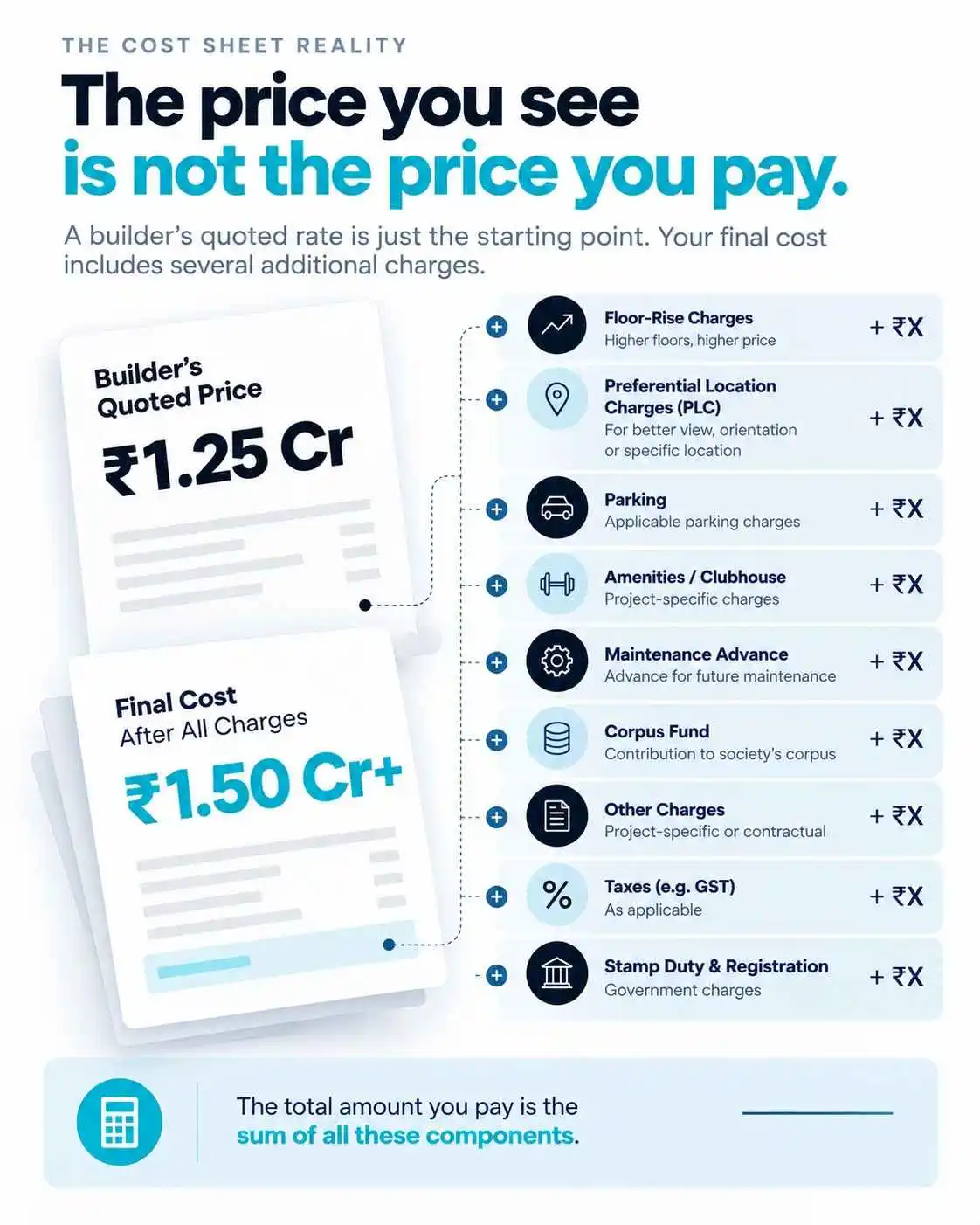
A brochure may advertise an apartment at ₹1.25 crore.
Then the cost sheet arrives.
- Base apartment price.
- Floor-rise charges.
- Preferential Location Charges (PLC).
- Parking.
- Clubhouse or amenity charges.
- Maintenance advance.
- Corpus fund.
- Legal or documentation charges.
- GST, where applicable.
- Registration and stamp duty.
The Builder’s Base Price Is Only the Starting Point
Suppose a builder quotes:
₹8,000 per sq. ft.
For a 1,500 sq. ft. apartment, the initial calculation looks straightforward:
1,500 × ₹8,000 = ₹1.20 crore
A buyer may assume the property costs ₹1.20 crore.
But the actual cost sheet could add:
- Floor-rise charges
- PLC
- Parking
- Clubhouse/amenity charges
- Maintenance advance
- Corpus contribution
- Other project-specific charges
- Applicable taxes
- Registration and stamp duty
The final financial commitment could therefore be materially higher.
That is why buyers comparing the quoted base price with the all-in cost should never evaluate an apartment using the advertised per-square-foot rate alone.
The right question is:
“What is my total acquisition cost?”
What Is a Real Estate Cost Sheet?
A builder’s cost sheet is a financial breakdown of the charges associated with purchasing a particular unit.
The exact format differs by developer and project.
A typical sheet may contain several categories:
| Cost Component | What It Usually Represents |
| Base apartment price | Price of the apartment based on the builder’s quoted rate and applicable area |
| Floor-rise charge | Additional amount based on the floor selected |
| PLC | Charge for a preferred location, floor, view, orientation or other feature |
| Parking | Charge associated with parking, where applicable |
| Amenities/clubhouse | Project-specific amenity-related charges |
| Maintenance advance | Advance payment toward maintenance |
| Corpus fund | Contribution toward a project/community corpus |
| Other charges | Project-specific or contractual charges |
| Taxes | Applicable taxes depending on the transaction and stage |
| Stamp duty & registration | Government charges payable for registration, subject to applicable law |
Not every project will have every item. Some developers may bundle certain charges.
Others may separate them. That is exactly why buyers need to read the actual cost sheet rather than rely on a sales representative’s verbal estimate.
Floor-Rise Charges: What Are You Actually Paying For?
Floor-rise charges in high-rise apartments are additional amounts based on the floor on which the apartment is located.
A builder might quote one rate for the lower floors and progressively higher rates for the upper floors.
For example, a hypothetical project might use:
- Base rate: ₹8,000/sq. ft.
- Floors 1–5: No floor-rise premium
- Floors 6–10: ₹100/sq. ft.
- Floors 11–15: ₹200/sq. ft.
- Floors 16+: ₹300/sq. ft.
For a 1,500 sq. ft. apartment on a higher floor, even a seemingly small ₹200/sq. ft. premium represents:
₹3,00,000
That is not a small difference for a buyer working within a fixed budget.
The key question isn’t whether floor-rise charges are inherently good or bad.
It is:
Does the additional price make sense for the specific floor and the buyer’s priorities?
A higher floor may offer better views, privacy, or ventilation.
But a buyer should still compare the premium against comparable units and the overall project pricing.
Preferential Location Charges: What Does PLC Actually Buy You?
Preferential location charges that real estate buyers encounter can apply when a unit is considered more desirable due to its position within the project.
Examples may include:
- Park-facing units
- Pool-facing units
- Corner apartments
- Units with particular views
- Apartments close to amenities
- Specific orientations
- Premium floors
- Other project-defined preferences
The exact basis for PLC differs from project to project.
That makes the cost-sheet language important.
A buyer should ask:
What specific characteristic is this PLC paying for?
Then ask:
Does that characteristic have enough value to justify the premium?
A ₹5 lakh PLC might look reasonable when viewed as a percentage of a ₹1.5 crore property.
But it still represents ₹5 lakh.
For a buyer comparing several apartments, that money could instead affect:
- Loan size
- EMI
- Interior budget
- Emergency savings
- Registration expenses
- Investment returns
- Overall affordability
The right decision depends on the buyer’s priorities.
The Difference Between “Base Price” and “All-In Cost”
This is the heart of all-inclusive property price calculation.
Imagine this hypothetical example:
| Component | Amount |
| Base apartment price | ₹1,20,00,000 |
| Floor-rise charges | ₹3,00,000 |
| PLC | ₹4,00,000 |
| Parking/other project charges | ₹2,00,000 |
| Maintenance advance | ₹1,50,000 |
| Corpus contribution | ₹1,00,000 |
| Other applicable charges | ₹1,50,000 |
| Subtotal before applicable taxes/government charges | ₹1,33,00,000 |
The buyer who started with a ₹1.20 crore headline price is already looking at an additional ₹13 lakh in listed charges in this hypothetical example.
That is a 10.8% increase over the base price, before considering any further applicable government charges or taxes.
This is why a buyer should never ask only:
“What’s the price per square foot?”
Ask:
“What is the final amount payable, including every applicable charge?”
How to Calculate Total All-Inclusive Property Cost From the Builder Base Price
If you’re looking to calculate the total all-inclusive property cost from the builder’s base price, use a simple framework.
Step 1: Calculate the base apartment price
Applicable area × builder’s base rate
Step 2: Add unit-specific premiums
Add:
- Floor-rise charges
- PLC
- View/location premium
- Corner premium
- Other unit-specific charges
Step 3: Add project-level charges
Review:
- Parking
- Amenities
- Clubhouse
- Infrastructure charges
- Maintenance advance
- Corpus contribution
- Other stated charges
Step 4: Add applicable taxes
Determine which taxes apply to your transaction and stage of construction.
Step 5: Add government charges
Consider applicable:
- Stamp duty
- Registration charges
- Other statutory charges
Step 6: Add financing-related costs
If you are taking a home loan, also consider:
- Processing fees
- Legal/technical evaluation charges where applicable
- Insurance if required or selected
- Other loan-related costs
The result is much closer to your actual financial commitment than the advertised base price.
Why Buyers Miss Hidden Costs
Most buyers aren’t careless.
The problem is that property pricing is fragmented.
The brochure may focus on:
₹X per sq. ft.
The sales conversation may focus on:
“Starting from ₹X crore.”
The cost sheet then introduces additional components.
And the buyer may not see the full picture until they are already emotionally attached to a particular apartment.
This is where hidden costs in builder agreements become important.
A cost isn’t necessarily “hidden” because the builder is deliberately concealing it.
It may simply be:
- Listed separately
- Explained in a different document
- Introduced later in the process
- Mentioned as a project-specific charge
- Excluded from the headline price
From the buyer’s perspective, the effect is the same:
The headline price is not the final number.
What Hidden Line Items Should You Look For in a Developer Agreement Cost Sheet?
If you’re researching what hidden line items to look for in a developer agreement cost sheet, start with these categories:
1. Floor-rise charges
Check how the charge is calculated and whether it applies to the entire chargeable area or on another basis.
2. PLCcostUnderstand exactly what makes the apartment “preferential.”
3. Parking
Check whether parking is included and what is being charged separately.
4. Maintenance advance
Understand the amount, duration and basis of the calculation.
5. Corpus
Check what the contribution represents and how it is treated.
6. Infrastructure or amenity charges
Look for project-specific charges that aren’t included in the base price.
7. Taxes
Determine which taxes apply and at what stage.
8. Registration and stamp duty
These are separate government costs and should be included when calculating your overall budget.
9. Cancellation or delay-related financial provisions
Review what happens to payments if the buyer cancels or the project is delayed, based on the agreement and applicable law.
10. Other contractual charges
Read the agreement rather than assuming the sales quote contains every possible cost.
Apartment Advance Maintenance and Corpus Charges: Don’t Ignore Them
Apartment advance maintenance and corpus charges can look relatively small compared with the apartment’s purchase price.
But they still affect the amount you need to arrange at or around the time of possession/booking, depending on the project and payment structure.
For example, if a buyer is already stretching their budget to make the down payment, an additional ₹1–2 lakh in project-related charges can strain their cash flow.
Ask:
- How much is the maintenance advance?
- What period does it cover?
- Is it refundable or adjustable?
- Who manages the fund?
- What is the corpus contribution for?
- Is it a one-time contribution?
- Are these charges already included elsewhere?
Don’t assume that every project uses the same structure.
How Builders Inflate Cost Sheets With Floor Rise and PLC Charges
The phrase “how builders inflate Apartment cost sheets with floor rise and PLC charges” is a useful search query, but buyers should approach the issue carefully.
Floor-rise and PLC charges are not automatically unreasonable.
The question is whether the premium is transparent and whether the final property remains competitively priced.
Consider two apartments:
Apartment A
Base price: ₹1.20 crore
Floor-rise + PLC: ₹7 lakh
Total before other charges: ₹1.27 crore
Apartment B
Base price: ₹1.25 crore
No comparable PLC/floor-rise premium
Total before other charges: ₹1.25 crore
A buyer who looks only at the base price may choose Apartment A because it appears ₹5 lakh cheaper.
A buyer who compares the actual cost sheet may reach the opposite conclusion.
This is why comparing only the advertised base rate can produce misleading conclusions.
The Fair Market Value Question
The next question is:
Is the final price reasonable?
This is where a fair-market-value real estate benchmark becomes useful.
A buyer can compare the property’s effective price against:
- Similar units in the same project
- Similar projects nearby
- Comparable configurations
- Floor differences
- View/location premiums
- Project age/stage
- Amenities
- Connectivity
- Developer reputation
- Recent transaction evidence where available
The goal isn’t to find one magic “correct” price.
Real estate doesn’t work that neatly.
The goal is to establish a reasonable range.
If a builder’s final cost is substantially above comparable properties, the buyer has a stronger basis for asking:
“What am I paying extra for?”
Why Registered Sale Deed Prices Can Be Useful as a Benchmark
One potentially useful source of market evidence is registered transaction data.
A registered sale deed formally records the transaction, subject to the information available in the relevant public records and the applicable registration system.
This can help buyers understand what properties have actually transacted for rather than relying entirely on asking prices.
But there are limitations.
A registered transaction may differ from another property because of:
- Floor
- View
- Unit size
- Configuration
- Timing
- Amenities
- Negotiated discounts
- Payment structure
- Seller/buyer circumstances
- Project stage
* Note: Make this image*
So registered sale deed data should be treated as benchmarking evidence, not as a guaranteed valuation of your specific apartment.
That distinction matters when using registered sale deed prices to negotiate builder cost sheets.
Can an Automated Valuation Tool Verify a Builder Quote?
Automated valuation models can help compare property prices against available market data.
They can potentially help identify whether a quoted price appears high, low or broadly in line with comparable transactions.
But an automated model is not the same thing as a certified valuation.
A useful automated valuation tool to verify a builder quote against sub-registrar data should ideally consider relevant comparable transactions rather than simply applying one average price to every apartment.
Factors such as:
- Location
- Size
- Configuration
- Floor
- Age
- Project
- Transaction date
- Unit characteristics
* Note: Make this image*
Can materially affect the comparison. Proppy’s current Bangalore platform says its property evaluation tools analyze fair-market pricing alongside factors such as connectivity, micro-market growth potential, rental demand, builder credibility, and future infrastructure.
This matters for cost-sheet evaluation because buyers should consider more than the builder’s quoted base rate.
However, buyers should still treat automated valuation as a decision-support tool, not a substitute for professional valuation or legal advice.
Where Proppy Priority Fits Into the Cost-Sheet Review
This is where Proppy Priority can become relevant without turning the article into a sales pitch.
The current Priority plan includes a Dedicated Relationship Manager, full legal due diligence, independent project reports, and other home-buying services for a one-time fee of ₹999. Proppy states a total estimated value of ₹1,13,000 across the package.
The current Proppy platform also claims to provide fair-market pricing analysis, hidden-cost visibility, and data-driven property evaluation tools.
That matters because a buyer reviewing a builder’s cost sheet needs two different perspectives:
What does the builder say this apartment costs?
and
Does the total price make sense relative to the property and market?
A Relationship Manager can also help the buyer coordinate questions around the cost sheet, project evaluation, documentation, and other stages of the purchase.
That doesn’t mean Proppy guarantees that a builder’s quote is wrong.
It means the buyer gets another layer of structured evaluation before committing.
What Does a Cost-Sheet Review Actually Tell You?
A useful review should answer more than:
“Is this calculation correct?”
It should help answer:
What am I actually paying?
Break the price into understandable components.
Which charges are mandatory?
Separate statutory costs from project-specific charges.
Which charges are optional or negotiable?
This depends on the specific project and agreement.
Which premiums are attached to the unit?
Floor, view, orientation, and location can materially change the price.
Is the final price competitive?
Compare against relevant alternatives and available transaction evidence.
What needs clarification?
Raise anything unclear before signing or paying.
Traditional Cost-Sheet Review vs Structured Evaluation
| Traditional Approach | Structured Cost-Sheet Evaluation |
| Starts with the builder’s quoted price | Starts with the complete cost sheet |
| Focuses on base ₹/sq. ft. | Calculates effective all-in cost |
| PLC may be considered separately | PLC is included in total price comparison |
| Floor-rise premium may be overlooked | Floor premium is quantified |
| Buyer compares brochure prices | Buyer compares final financial commitments |
| Market value may be based on asking prices | Comparable transaction evidence can add context |
| Questions are raised after reviewing the agreement | Questions are identified before commitment |
| Buyer coordinates different experts independently | Relevant support can be coordinated through the buying journey |
The objective isn’t to assume the builder is overcharging. It is to make the buyer’s comparison more accurate.
A Simple Cost-Sheet Reality Check
Before negotiating, take the builder’s quote and create four numbers.
Number 1: Advertised price
The number used in the marketing material.
Number 2: Base apartment price
The actual apartment price before additional premiums and charges.
Number 3: Effective property price
Base price + floor rise + PLC + other unit/project charges.
Number 4: Total acquisition cost
Effective property price + applicable taxes + registration + stamp duty + other relevant costs.
Now compare Number 4 with your budget.
Then compare the effective price with similar properties.
This simple exercise can reveal whether the apartment is actually affordable.
Don’t Negotiate the Base Price Alone
A builder may offer:
“₹5 lakh discount.”
That sounds attractive.
But what if another project has a lower PLC?
Or no floor-rise premium?
Or different maintenance charges?
Or a lower effective rate for a similar unit?
The better negotiation question is:
“What is the final payable amount for this exact apartment?”
Then negotiate the total.
A discount on the base rate isn’t necessarily the best deal if other charges remain high.
Questions to Ask the Builder Before Signing
Take the cost sheet and ask:
- What is the base rate?
- What area is the rate applied to?
- What is the total base apartment price?
- How is floor-rise calculated?
- Why does this unit have a PLC?
- Is PLC negotiable?
- Is parking included?
- What maintenance advance is payable?
- What is the corpus contribution?
- Are there infrastructure or amenity charges?
- Which taxes apply?
- What are the registration and stamp-duty costs?
- Are there any other charges not shown on the first quote?
- Does the agreement match the cost sheet?
- What happens if any charge changes before registration?
Ask for important clarifications in writing.
The Cost Sheet Is Part of the Property Decision
A homebuyer can spend weeks comparing:
- Location
- Amenities
- Floor plans
- Clubhouse
- Connectivity
- Builder reputation
and still make the wrong financial decision by overlooking the cost sheet.
The cost sheet determines the actual cost of the property.
And the actual cost determines:
- Loan requirement
- EMI
- Down payment
- Cash reserves
- Interior budget
- Registration budget
- Overall affordability
That’s why a real estate cost-sheet breakdown isn’t just an administrative exercise.
It is part of property due diligence.
What Proppy Priority Can Add
For buyers who want more structured support, Proppy Priority combines technology and human assistance.
The current plan includes:
- Dedicated Relationship Manager
- Personalized property shortlisting
- Legal documentation review and full due diligence
- Independent project reports
- Home-loan assistance
- Interior design consultation with 3D floor plan
- Vastu review
- Priority post-booking support
- Cashback/rewards subject to applicable conditions.
The plan currently costs ₹999 as a one-time fee, with Proppy estimating a total value of ₹1,13,000 across nine services.
For a cost-sheet-focused buyer, the most relevant components are:
Independent project evaluation
Legal documentation review
Fair-market pricing analysis
Dedicated Relationship Manager
These can help the buyer move from:
“The builder says this is the price.”
to:
“I understand what I’m paying, what the charges mean, and what questions I still need answered.”
That is a much stronger position from which to negotiate.
The ₹1 Crore Question Isn’t Really ₹1 Crore.
Imagine a buyer has a strict ₹1 crore budget.
A project advertises:
“Apartments from ₹95 lakh.”
The buyer assumes there is ₹5 lakh of headroom.
But after floor-rise, PLC, parking, maintenance, corpus, taxes and government charges, the actual commitment may move considerably higher.
The property may no longer fit the buyer’s original budget.
This is why buyers should work backwards.
Instead of asking:
“What apartment can I buy for ₹1 crore base price?”
ask:
“What apartment can I buy for ₹1 crore total acquisition cost?”
That change alone can eliminate unsuitable properties from the shortlist.
Don’t Let a Low Base Price Make an Expensive Property Look Cheap
The most useful number on a builder’s price sheet is not necessarily the first number you see.
It is the final number after all applicable costs have been identified.
Floor-rise charges. PLC. Maintenance. Corpus. Parking. Taxes. Registration.
Other project-specific charges.
Once those are added, the buyer can compare properties on a more meaningful basis.
And when the final number is compared with relevant market evidence, the buyer can ask a more informed question:
“Is this apartment worth the total amount I’m being asked to pay?”
That’s the real cost-sheet reality check.
Make the Cost Sheet Part of Your Due Diligence
A builder’s quoted base price tells you where the calculation starts. It doesn’t tell you where it ends. Before booking, calculate the complete cost. Identify every premium.
Understand every separate charge. Check which amounts are statutory and which are project-specific. Compare the effective price with similar properties.
Use available transaction data and valuation tools as benchmarks, while recognizing their limitations. Have the relevant documents reviewed before you commit.
Proppy Prioritya real estate advisory service in Bangalore is designed for buyers who want additional support across these stages. Its current offering combines a Dedicated Relationship Manager with legal documentation review, independent project evaluation, and other services under a one-time ₹999 plan.
Proppy’s current property platform also highlights fair-market pricing analysis, visibility into hidden costs, and data-driven evaluation tools, helping buyers look beyond the headline price.
The objective isn’t to assume every builder’s cost sheet is inflated.
It is to make sure you understand the number before you agree to it.
Because the difference between a ₹1 crore apartment and a ₹1.15 crore financial commitment isn’t hidden in the brochure. It is often sitting line by line in the cost sheet.
Read every line. Calculate the real number. Then negotiate.
Frequently Asked Questions:
A real estate cost sheet breakdown separates the different components that make up the amount payable for a property, including the base apartment price, floor-rise charges, PLC, parking, maintenance, corpus, applicable taxes, and other project-specific or statutory costs.
The quoted base price is generally the starting price of the apartment. The all-in cost includes applicable premiums, project charges, taxes, registration, stamp duty,, and other costs to understand the buyer’s overall financial commitment.
Start with the base apartment price, then add applicable floor-rise charges, PLC, parking, maintenance advance, corpus, other project-specific charges, applicable taxes, and government charges such as stamp duty and registration. Also account for relevant financing costs if you are taking a home loan.
Preferential Location Charges (PLC) are additional charges that a developer may apply to units deemed more desirable due to characteristics such as views, location within the project, floor, orientation, or proximity to specific amenities. The exact basis varies by project.
Floor-rise charges in high-rise apartments are additional amounts linked to the selected floor. Developers may use different rates or slabs depending on the project. Buyers should check exactly how the charge is calculated and applied.
No. They are not automatically unreasonable. The relevant question is whether the premium is clearly explained and whether the property’s final price remains reasonable compared with comparable units and projects.
A buyer should not assume that every separate premium is an attempt to inflate the price. However, floor-rise and PLC can materially increase the effective price even when the advertised base rate appears competitive. Compare the complete cost sheet rather than just the base rate.
Look for floor-rise charges, PLC, parking, amenity or infrastructure charges, maintenance advance, corpus contribution, taxes, registration-related costs, and other project-specific charges. Also compare the cost sheet with the agreement before signing.
Advance maintenance is generally a payment collected in advance toward future maintenance for a specified period or in accordance with the project’s structure. A corpus contribution is generally intended to create or support a fund for the residential community. The exact treatment varies by project and agreement.
Registered transaction records can provide useful evidence of actual recorded transactions, where relevant data is available. Compare transactions involving similar projects, configurations, sizes, floors, and dates, rather than relying on a single transaction as the definitive market value.
Not by themselves. A registered transaction can be a useful benchmark, but differences in floor, size, configuration, timing, project stage, discounts, and other factors can make direct comparisons difficult.
An automated valuation model can help compare a property’s quoted price with available market and transaction data. However, it should be treated as a decision-support tool rather than a certified valuation. The specific data sources and methodology used by any valuation tool should be checked before relying on its output.
Proppy’s current Bangalore platform says its data-driven property evaluation tools analyze fair-market pricing along with factors such as connectivity, micro-market growth, rental demand, builder credibility, and future infrastructure development.
Priority currently includes legal documentation review and full due diligence. The exact scope and limitations should be confirmed for the specific property and documentation. Proppy’s terms also state that its Legal Summary is a preliminary review and not a substitute for independent legal counsel or a certified legal opinion.
Yes. A Dedicated Relationship Manager is one of the services included in Proppy Priority.
Proppy’s current Bangalore platform says its property evaluation tools include hidden-cost visibility and transparent pricing. Buyers should still review the actual builder cost sheet and agreement because project-specific charges can vary.
Proppy Priority currently costs ₹999 as a one-time fee. Proppy states an estimated total value of ₹1,13,000 across the nine-service package.
No. Proppy provides tools, evaluation and expert support, but its disclaimer states that AI-generated suggestions and insights may contain inaccuracies and should not be treated as professional legal, financial or real-estate advice. Buyers should independently verify important information and obtain qualified professional advice where appropriate.
First calculate the complete cost. Then compare the effective price with comparable properties and available market evidence. Identify the largest premiums and ask the builder to explain or revise the relevant charges. Negotiating the final payable amount is generally more meaningful than negotiating only the headline base rate.
The biggest mistake is comparing properties based solely on the advertised base price. A buyer should compare the total applicable cost of acquiring the specific apartment, not just the initial ₹/sq. ft. figure.
Related Posts

How AI-Powered Property Search Helped a Couple Book a Home in Bengaluru in 72 Hours
From Six Months of Searching to a Home Booking in 72 Hours For Prasad and Sandhya, buying a home in...
Read More →
The Metro Effect: How Phase 2B Could Reshape Property Prices in North Bengaluru
The Real Question Isn’t Whether Prices Will Rise. It’s Whether You’re Paying Too Much Today. A property near a proposed...
Read More →
Property Registration Charges in Karnataka 2026: Stamp Duty, Registration Fee, GST and Other Costs Explained
Buying a property in Karnataka involves several statutory payments, and understanding how each is calculated matters before you sign a...
Read More →