
Bangalore Unsold Housing Inventory 2025: Nearly 65,000 Unsold Homes and What It Means for Buyers

Buying a home in Bengaluru has never been a one-size-fits-all decision. Over the past few years, the city has experienced strong property price appreciation, new infrastructure developments, and a steady influx of professionals relocating for work. At the same time, developers have launched thousands of new residential units to keep pace with demand. The result? Buyers today have more options than ever before.
One of the biggest talking points in the market is the rise in Bangalore’s unsold housing inventory in 2025. While the term “unsold inventory” may sound concerning at first, it doesn’t necessarily indicate a weak market. In fact, in a city like Bengaluru, it can offer valuable opportunities for homebuyers seeking better choices, stronger negotiating power, and access to projects across different price segments.
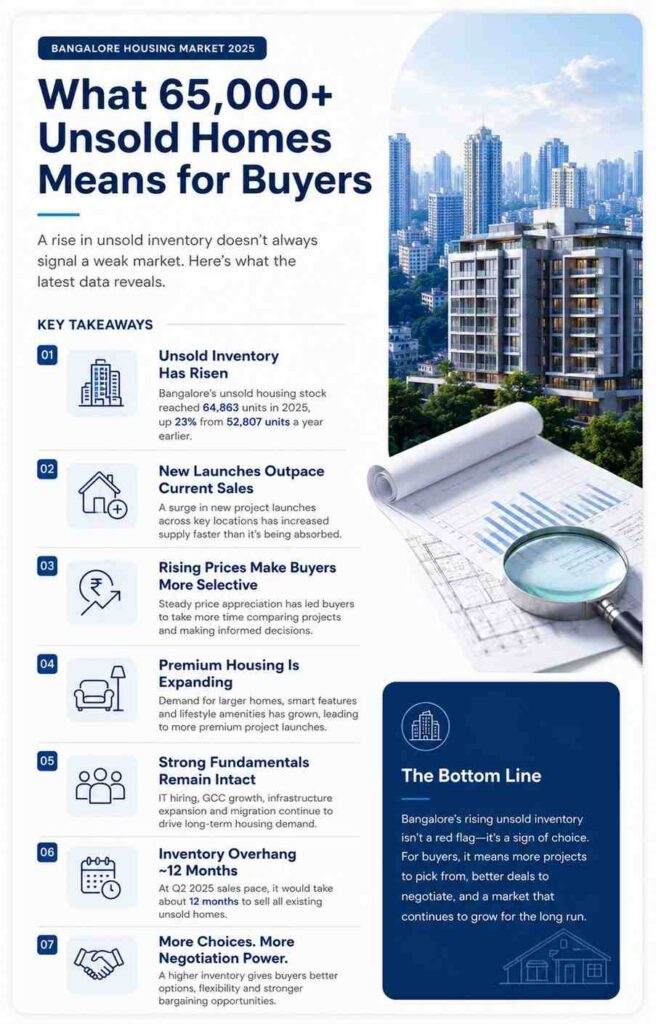
According to ANAROCK Research, Bengaluru’s unsold housing stock reached 64,863 units at the end of 2025, a 23% increase from 52,807 units recorded a year earlier. The increase was largely driven by a rise in new residential launches, even as housing demand moderated after a period of rapid price growth.
For buyers, the key question isn’t whether unsold inventory is rising; it’s what that rise actually means. Does it create better bargaining opportunities? Are developers more flexible? And is this the right time to buy?
Let’s break it down.
Understanding Bangalore Unsold Housing Inventory 2025
Before interpreting the numbers, it’s important to understand what unsold housing inventory actually means.
Unsold inventory refers to residential units launched by developers that are still available for purchase. These homes may be under construction, nearing completion, or ready to move in.
A higher inventory level does not automatically mean homes aren’t selling. In many cases, it simply reflects that developers have introduced more projects than the market has absorbed within a given period.
This distinction is especially relevant in Bengaluru, where developers continue to launch projects, confident in the city’s long-term growth prospects.
For example, during Q2 2025, Bengaluru recorded approximately 15,100 residential sales, while available inventory stood at around 58,900 units with an inventory overhang of about 12 months. This indicates that although buyers are taking more time to make purchasing decisions, demand remains active.
For anyone tracking the Bangalore housing market, inventory levels should always be viewed alongside demand, infrastructure growth, and employment trends rather than in isolation.
Why Has Unsold Inventory Increased?
Several market forces have contributed to the rise in Bangalore’s unsold housing inventory in 2025.
1. Developers Continue to Launch New Projects
Bengaluru remains one of India’s most attractive residential markets.
Driven by the city’s thriving technology ecosystem, Global Capability Centres (GCCs), startup activity, and expanding infrastructure, developers continue to introduce new residential projects across established and emerging locations.
Neighbourhoods such as Whitefield, Sarjapur Road, Thanisandra, North Bengaluru, Hebbal, and Devanahalli have witnessed significant project launches in recent years.
When new supply enters the market faster than homes are sold, available inventory naturally increases.
This doesn’t necessarily indicate slowing demand—it often reflects developer confidence in future housing requirements.
2. Rising Property Prices Have Made Buyers More Selective
Bengaluru has recorded steady price appreciation over the past few years.
As property values increase, buyers tend to spend more time evaluating options before making a purchase.
Instead of booking the first project they visit, today’s buyers compare:
- Builder reputation
- Floor plans
- Amenities
- Construction quality
- Connectivity
- Future appreciation potential
- Financing options
This longer decision-making process means homes remain in inventory for a longer period before being sold.
It’s one of the reasons why the Bangalore residential market is seeing healthy demand while inventory levels have simultaneously increased.
3. Premium Housing Is Expanding
The city’s housing preferences have evolved significantly since the pandemic.
Homebuyers are increasingly looking for:
- Larger apartments
- Dedicated workspaces
- Smart home features
- Community living
- Lifestyle amenities
- Green open spaces
To meet these expectations, developers have launched more premium residential projects.
Premium homes generally involve longer purchase cycles because buyers spend more time evaluating options and making financial decisions.
This naturally contributes to a higher level of unsold apartments in Bangalore, particularly in the premium segment.
4. Inventory Growth Doesn’t Mean Demand Has Disappeared
One of the biggest misconceptions in real estate is that rising inventory automatically signals a struggling market.
In Bengaluru, the data suggests otherwise.
While available inventory has increased, the city continues to benefit from:
- Strong IT hiring
- Growing GCC presence
- Metro expansion
- Infrastructure investments
- Consistent migration
- Long-term housing demand
These fundamentals continue to support the Bangalore property market, making it one of India’s most resilient residential destinations.
What Is Inventory Overhang and Why Does It Matter?
A term often used alongside unsold inventory is inventory overhang.
Inventory overhang measures the time it would take to sell all unsold homes if no additional projects were launched and homes continued to sell at the current pace.
For example, ANAROCK reported that Bengaluru had an inventory overhang of approximately 12 months during Q2 2025.
In simple terms, this suggests that the market has roughly one year’s worth of available housing stock based on existing sales momentum.
A moderate inventory overhang is generally considered healthy because it provides buyers with sufficient choices while allowing developers to continue launching new projects.
For buyers researching property investment in Bangalore, inventory overhang should be viewed alongside pricing trends, employment growth, and infrastructure development—not as a standalone indicator.
Does Higher Inventory Give Buyers More Negotiating Power?
In many situations, yes.
When buyers have access to more projects across multiple locations, developers naturally face stronger competition.
Rather than reducing headline property prices, many developers choose to offer additional value through:
- Flexible payment plans
- Stamp duty support
- Modular kitchen upgrades
- Interior fit-out packages
- Clubhouse memberships
- Waivers on floor-rise or parking charges
- Limited-period festive offers
These incentives can significantly improve the total value of a purchase while helping developers maintain pricing consistency across their projects.
For buyers exploring new apartments in Bangalore, this creates an opportunity to compare multiple developments and negotiate better overall terms.
More Choice Means Smarter Decisions
A larger inventory doesn’t simply mean there are more homes available—it also means buyers have the freedom to compare projects more carefully.
Instead of feeling pressured to make quick decisions, today’s buyers can evaluate builders, locations, amenities, and pricing before finalising their investment.
However, comparing dozens of projects manually can be time-consuming.
This is where Proppy simplifies the home-buying journey. By helping buyers discover verified residential projects that match their budget, preferred location, lifestyle, and investment goals, Proppy reduces search time and makes it easier to identify homes that truly fit their requirements.
Making the Most of a Buyer’s Market
A rise in Bangalore unsold housing inventory in 2025 doesn’t guarantee deep discounts, but it does improve a buyer’s position during negotiations. When multiple projects compete for the same buyer, developers are often more willing to provide additional value to close a sale.
Instead of expecting a significant reduction in the property’s advertised price, buyers should negotiate on the overall purchase package.
This may include:
- Flexible payment plans
- Waiver of floor-rise charges
- Free or discounted covered parking
- Modular kitchen or wardrobe upgrades
- Reduced maintenance charges for the initial period
- Stamp duty or registration support during promotional campaigns
- Complimentary clubhouse membership or interior packages
These benefits can substantially reduce the overall cost of homeownership while preserving the property’s long-term value.
Which Areas Offer the Best Opportunities?
Although inventory has increased across the city, not every locality offers the same investment potential.
Some areas continue to see strong buyer interest due to improving infrastructure, employment growth, and planned development.
Among the best places to buy property in Bangalore are:
- Whitefield – A mature IT hub supported by Metro connectivity and strong social infrastructure.
- Sarjapur Road – Popular among professionals working in Bengaluru’s technology corridor.
- Thanisandra – Benefiting from improved connectivity and increasing residential demand.
- Hebbal – Well connected to the airport corridor and major business districts.
- North Bengaluru – Emerging as a major residential and commercial destination due to airport-led growth.
- Devanahalli – Attracting long-term investors because of infrastructure and commercial developments.
Each micro-market offers different advantages depending on budget, lifestyle, and investment objectives. Buyers should compare projects carefully rather than focusing solely on headline prices.
What Should Buyers Evaluate Before Booking a Home?
With more projects available in the market, choosing the right property becomes even more important.
Before making a purchase, consider the following:
- Builder’s track record and delivery history
- RERA registration and statutory approvals
- Construction quality
- Connectivity to workplaces and Metro stations
- Schools, hospitals, and everyday conveniences nearby
- Future infrastructure projects
- Rental demand
- Long-term appreciation potential
A property with strong fundamentals is often a better investment than one that simply offers the biggest promotional discount.
Using Technology to Compare Projects More Efficiently
One of the biggest challenges for buyers today isn’t finding properties—it’s filtering through hundreds of available options.
Searching multiple property portals, visiting numerous sales offices, and comparing brochures can quickly become overwhelming.
This is where Proppy simplifies the process.
Instead of manually reviewing countless listings, buyers can use Proppy to discover verified residential projects based on their budget, preferred location, configuration, and lifestyle preferences. By combining intelligent recommendations with expert guidance, Proppy helps buyers shortlist projects more efficiently and focus on homes that genuinely meet their requirements.
For anyone navigating the Bangalore housing market, this can save considerable time while improving the quality of decision-making.
What Does the Future Hold for Bengaluru’s Housing Market?
Although Bangalore’s unsold housing inventory has increased in 2025, the city’s long-term outlook remains positive.
Bengaluru continues to benefit from several structural advantages:
- Continued expansion of the technology sector
- Growth of Global Capability Centres (GCCs)
- Metro network expansion
- Infrastructure-led development
- Strong migration for employment
- Healthy long-term housing demand
While buyers may take more time to finalise purchases due to rising property values, these underlying drivers continue to support the Bangalore real estate market.
As interest rates, affordability, and infrastructure continue to evolve, buyers who conduct thorough research are likely to be better positioned to identify projects offering lasting value.
Key Takeaways
The increase in Bangalore’s unsold housing inventory in 2025 should not be viewed in isolation as a negative development.
Instead, it reflects a market in which developers continue to invest in future demand, while buyers have become more selective.
Some important takeaways include:
- Bengaluru’s unsold housing stock reached 64,863 units at the end of 2025, reflecting increased project launches and moderated absorption.
- Buyers now have access to a wider range of residential options across multiple price segments.
- Higher inventory often creates better opportunities to negotiate payment plans and value-added benefits.
- Infrastructure growth and employment continue to support the Bangalore property market over the long term.
- Careful project selection remains more important than chasing the biggest discount.
Conclusion
The rise in Bangalore’s unsold housing inventory in 2025 should be viewed as an opportunity rather than a cause for concern.
While Bengaluru’s unsold housing stock reached nearly 65,000 units by the end of 2025, the increase is closely linked to new project launches, changing buyer behaviour, and an evolving market—not a collapse in demand. The city’s expanding technology ecosystem, improving infrastructure, and long-term housing demand continue to support confidence in the residential sector.
For homebuyers, this means more choices, greater flexibility during negotiations, and the ability to compare projects more carefully before making one of life’s biggest financial decisions.
Instead of spending weeks researching hundreds of developments, buyers can simplify the process with Proppy. By helping users discover verified residential projects tailored to their budget, preferred location, and lifestyle, Proppy makes it easier to compare options and make informed home-buying decisions with confidence.
As Bengaluru’s residential market continues to grow, buyers who combine careful research with the right tools will be in the strongest position to find a home that meets both their current needs and future aspirations.
Disclaimer
This article is intended for informational purposes only and should not be considered financial, legal, or investment advice. Real estate prices, inventory levels, and market conditions are subject to change based on economic trends, infrastructure developments, and government policies. Readers are encouraged to conduct independent research and consult qualified real estate professionals before making any property purchase or investment decision. The statistics referenced are based on publicly available ANAROCK reports and related industry publications available at the time of writing.
Frequently Asked Questions
It refers to residential units launched by developers that are still available for sale.
Not necessarily. Inventory is one indicator of market conditions. Prices also depend on demand, infrastructure growth, construction costs, and location.
Inventory overhang estimates how long it would take to sell all unsold homes at the current sales pace if no new projects were launched.
For buyers looking in the long term, the current market offers more choices and better negotiating opportunities while benefiting from Bengaluru’s strong economic fundamentals
Whitefield, Sarjapur Road, Thanisandra, Hebbal, North Bengaluru, and Devanahalli continue to attract buyers due to infrastructure and employment growth.
Proppy helps buyers discover verified residential projects based on their budget, preferred location, and lifestyle requirements, making property shortlisting faster and more informed.
Related Posts

The True Cost of “Free” Property Portals: Time, Trust, and Missed Opportunities
A property portal can cost you nothing to use. You can create an account, enter a location, set a budget,...
Read More →
Hidden Costs of Buying a Flat That Most Buyers Miss (And How to Avoid Them)
The ₹1 Crore Apartment That Doesn’t Actually Cost ₹1 Crore You’ve found the perfect apartment. The location works. The builder...
Read More →
Sarjapur Real Estate Outlook: Property Prices Touch ₹12,000 Per Sq Ft as Demand Continues to Rise
For years, Sarjapur was viewed as a location with potential. Today, it is progressively seen as a location with momentum....
Read More →