
The True Cost of “Free” Property Portals: Time, Trust, and Missed Opportunities

A property portal can cost you nothing to use.
You can create an account, enter a location, set a budget, browse hundreds of apartments, and save properties to your shortlist without paying a subscription fee.
On the surface, that sounds like the ideal way to buy a home.
But when a property purchase involves tens of lakhs or even crores of rupees, the search platform’s price is only one part of the equation.
The real cost can show up elsewhere: hours spent comparing irrelevant listings, difficulty verifying property information, repeated site visits, uncertainty around builder claims, missed negotiation opportunities, and the challenge of knowing which property is actually worth your money.
This does not mean free property portals are useless. They can be a useful starting point for understanding locations, prices, configurations, and available projects.
The question is what happens after the search.
Because finding 100 properties is not the same as finding the right one.
And seeing a property online is not the same as knowing whether it is worth buying.
That is where the difference between a listing platform and a more comprehensive homebuyer protection service becomes important.
Proppy Priority approaches the problem from the other end. Instead of charging buyers for access to listings, it offers a ₹999 one-time plan that adds legal due diligence, independent project reports, a dedicated Relationship Manager, interior consultation, Vastu review, home-loan support, priority post-booking assistance, and cashback benefits. The current Proppy Priority page states an estimated total customer value of ₹1,13,000 across nine services, subject to applicable terms and conditions.
So what is the true cost of “free” property search?
Let’s look beyond the subscription fee.
Free Property Search Is Not the Same as Free Home Buying
The growth of online property search has made it easier for buyers to discover homes.
A few filters can produce dozens or hundreds of results based on location, budget, size, and configuration. Buyers can compare photographs, amenities, and advertised prices from their phones.
This convenience is valuable.
But a search platform primarily solves one problem:
Finding properties.
Buying a property involves many more questions:
- Is the information current?
- Is the project suitable for your actual requirements?
- Is the builder’s track record worth considering?
- What should you verify before booking?
- Are there legal or documentation issues?
- Is the quoted price competitive?
- What will the property cost after all applicable charges?
- Which loan option makes sense?
- Is the floor plan practical?
- What happens after booking?
These questions require evaluation, not just search.
That distinction matters because the cost of a homebuying mistake can be significantly higher than the cost of any service designed to help prevent it.
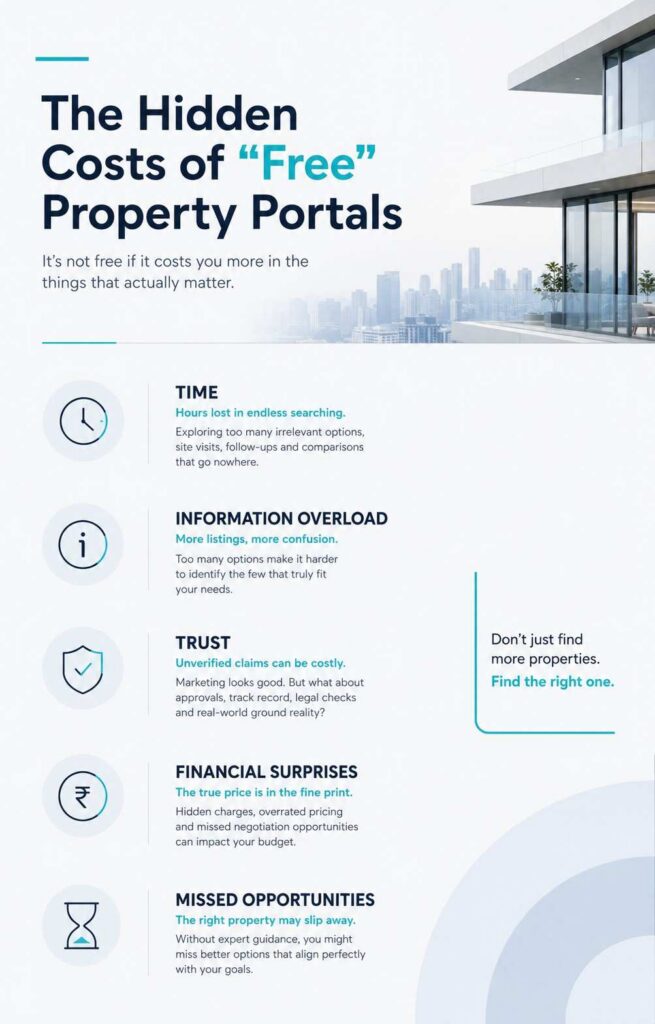
The First Hidden Cost: Your Time
Time is one of the easiest costs to ignore when comparing property search websites.
A buyer may start with a simple search:
“2BHK in Bengaluru under ₹1 crore.”
The results can quickly become overwhelming.
One project leads to another. Different websites show different listings. Similar projects appear repeatedly. Some options fall outside the preferred location. Others exceed the budget once the buyer looks beyond the headline price.
Then come site visits.
A buyer may spend multiple weekends traveling across Bengaluru, visiting projects that looked promising online but do not actually fit their requirements.
The cost isn’t necessarily a direct financial payment.
It is:
Hours researching + hours traveling + hours comparing + hours following up.
For a working professional, that can become a significant part of the homebuying process.
This is one reason buyers are increasingly looking beyond traditional real estate websites in India and considering guided discovery models.
The objective isn’t necessarily to see more properties.
It is to reduce the number of properties that need serious consideration.
The Second Hidden Cost: Information Overload
More listings do not automatically mean better decisions.
Imagine you have shortlisted 40 apartments.
You now have 40 sets of:
- Floor plans
- Amenities
- Prices
- Payment schedules
- Builder information
- Location claims
- Possession timelines
- Reviews
- Brochures
At some point, comparison becomes harder rather than easier.
This is the paradox of modern property search.
Technology has made it easier to find options, but an abundance of them can lead to decision fatigue.
The real question becomes:
Which three or four properties deserve deeper evaluation?
That is where AI-powered matching and human support can add another layer.
Proppy currently positions its AI-powered property search around matching buyers with homes based on their requirements, while combining verified information with expert support.
Instead of treating every listing as equally relevant, the goal is to move from broad discovery towards a more focused shortlist.
The Third Hidden Cost: Trust
Property information can look convincing online.
A project may have impressive photographs, a long list of amenities, and attractive promotional claims.
But a buyer still has to ask:
How much of this should I take at face value?
This is where a property verification service becomes relevant.
Verification can mean looking beyond marketing materials and checking the information that matters for the actual purchase decision.
For example:
- Is the project information current?
- What does the builder’s track record look like?
- What approvals and documents need to be reviewed?
- Does the project match its stated claims?
- What does the location offer in practical terms?
- Is the property suitable for the buyer’s needs?
A property portal can help you discover a project.
It does not automatically mean that every decision related to that project has been independently evaluated for you.
That is why property verification before purchase should be treated as a separate stage of the homebuying journey.
How to Verify a Property Before Buying
If you’re looking to verify property before buying, start with a structured approach rather than relying on a single source.
A buyer should consider:
1. Verify the Project and Property Information
Check the information available about the project, configuration, location, approvals and other relevant details.
Do not rely solely on the information presented in an advertisement.
2. Check Relevant Legal Documentation
Legal documentation can include title-related records, approvals and other documents relevant to the property.
A professional review can help identify areas that require further attention.
3. Check RERA Information Where Applicable
For projects covered by RERA, buyers can use the relevant state RERA authority’s records to review available project information.
For a buyer seeking RERA property verification, the key point is that registration information should be treated as one part of due diligence, not the only check required.
4. Evaluate the Builder
A builder’s reputation should not be based only on brand recognition.
Look at delivery history, completed projects, project claims and other relevant information.
This is why a builder’s track record check can be valuable before committing.
5. Compare the Project With Alternatives
Even if a project looks good on its own, the question is whether it is the best fit among the alternatives available within the same budget and location.
That is where independent project evaluation becomes useful.
The Fourth Hidden Cost: Buying Based on the Sales Pitch
A sales presentation is designed to sell a project.
That doesn’t automatically make the information incorrect.
But it does mean that buyers should separate marketing claims from decision-making information.
Proppy’s current Priority page specifically positions independent project reports around evaluating project claims, livability, and the developer’s historical delivery track record. Priority provides reports for up to three shortlisted projects.
This addresses one of the most important questions buyers should ask:
How do I verify a builder’s track record?
Instead of looking only at what a builder promises for the project you are considering, look at what the developer has delivered historically.
Questions can include:
- What projects has the developer completed?
- Were they delivered on time?
- What is the quality of completed projects?
- How does the current project compare with previous developments?
- Are there recurring concerns buyers should know about?
A property due diligence service can help structure this evaluation, rather than leaving the buyer to piece together information from multiple sources.
The Fifth Hidden Cost: Overpaying
The price shown on a property portal is not necessarily the same as the total cost of buying the home.
Buyers may need to consider applicable charges beyond the headline price, including registration, stamp duty, interiors, maintenance-related charges, financing costs and other project-specific expenses.
This is why how to avoid overpaying for a property is a more useful question than simply asking:
“What’s the cheapest apartment I can find?”
A lower-priced property is not necessarily better value.
The better question is:
What am I getting for the total amount I will spend?
Consider two apartments priced differently.
Apartment A costs less but has a less suitable floor plan, higher expected interior requirements, and weaker connectivity.
Apartment B costs more but better fits the buyer’s requirements and may reduce certain additional costs.
The cheaper property isn’t automatically the better purchase.
Price needs context.
The Sixth Hidden Cost: Missed Opportunities
Not every missed opportunity is about a property.
Sometimes it is about a better decision.
A buyer who spends weeks browsing may miss the chance to:
- Compare a stronger alternative
- Negotiate more effectively
- Identify a better-suited configuration
- Understand the total cost earlier
- Evaluate the builder more carefully
- Get professional input before booking
This is where the idea of expert homebuying assistance becomes relevant.
The purpose of assistance isn’t to decide for the buyer.
It is to help the buyer make a decision with better information.
Property Portal vs Property Consultant: What’s the Difference?
The difference becomes clearer when you compare the roles.
| Property Portal | Guided Home-Buying Support |
| Helps buyers discover properties | Helps buyers evaluate and navigate the purchase |
| Provides search and filtering tools | Adds structured guidance |
| Buyer usually compares options independently | Expert support can help narrow options |
| Information is available for the buyer to assess | Additional verification and evaluation can be provided |
| Buyer coordinates multiple steps | Support can continue across the buying journey |
| Primarily focused on discovery | Focuses on discovery, evaluation, and support |
This doesn’t mean a buyer must choose one or the other.
A portal can be useful for discovery.
A property-buying consultant or homebuyer advisory service can be useful when a buyer needs help making sense of the information.
The distinction is between:
“Here are properties.”
and
“Here are the properties that may fit, and here is the support you need to evaluate them.”
What Is an End-to-End Homebuying Service?
An end-to-end homebuying service aims to support buyers across multiple stages rather than stopping at property discovery.
That can include:
- Understanding the buyer’s requirements
- Shortlisting relevant properties
- Arranging or supporting site visits
- Evaluating projects
- Reviewing relevant documentation
- Assisting with financing
- Supporting interior planning
- Providing post-booking assistance
Proppy describes its broader journey as extending from discovery and shortlisting through verification, financial assistance, and post-booking support.
This is fundamentally different from a model where the buyer is given a list of properties and left to coordinate everything else.
Where Does Proppy Priority Fit?
Proppy already provides a free Proppy Promise to buyers. The current plan comparison states that the Promise includes personalized property shortlisting, home-loan assistance, one independent project evaluation, and expert guidance.
Proppy Priority is the paid layer for buyers who want broader support.
For a one-time ₹999 fee, the current Priority plan includes:
- Dedicated Relationship Manager
- Personalized property shortlisting
- Full legal documentation review and due diligence
- Home-loan assistance
- Interior design consultation with a 3D floor plan
- Independent project reports for up to three shortlisted projects
- Vastu review
- Priority post-booking support
- Exclusive rewards and cashback, including up to ₹50,000 cashback subject to applicable conditions
Proppy currently states an estimated total value of ₹1,13,000 across the nine services.
The important distinction is that Priority is not a fee to access Proppy’s property search.
It is a homebuying subscription designed for buyers who want additional services around the purchase.
What Does Proppy Priority Actually Help Eliminate?
The value becomes clearer when you consider the hidden costs it is designed to address.
Less Time Lost on Irrelevant Options
Personalized shortlisting can help buyers focus on properties that meet their stated requirements, rather than manually filtering through an overwhelming number of options.
Less Uncertainty Around Project Claims
An independent project evaluation provides an additional layer of assessment beyond the builder’s own presentation.
Less Fragmented Verification
Legal due diligence brings documentation review into the buying journey rather than leaving every buyer to coordinate it independently.
Less Confusion Around Financing
Home-loan assistance helps buyers navigate the financing side of the purchase.
Less Guesswork About Interiors
The interior consultation and 3D floor plan help buyers visualize how the space could be used.
Less Post-Booking Coordination
Priority customer support and a dedicated Relationship Manager provide continuity beyond the initial property search.
Potential Financial Benefit
Eligible buyers can receive up to ₹50,000 cashback under the applicable Priority conditions. The current Proppy terms state that cashback depends on the purchase being completed and registered through Proppy, builder eligibility, and other applicable conditions.
These aren’t guarantees against every possible homebuying problem.
They are layers of support designed to reduce avoidable friction and improve the information available before a major financial decision.
Is a Property Buying Membership Worth It?
A property buying membership is not automatically useful for every buyer.
If you already have a trusted lawyer, interior designer, loan advisor, and property consultant, you may prefer to coordinate the process yourself.
But the calculation changes if you are a first-time buyer or a busy professional who does not want to manage multiple service providers.
Ask yourself:
- How many hours will I spend researching properties?
- Can I independently verify the information I am relying on?
- Do I know what documents need to be reviewed?
- Can I evaluate builder history objectively?
- Do I know how to compare projects beyond price and amenities?
- Do I need help with financing?
- Would professional support reduce the number of site visits I need?
- Would having one point of contact make the process easier?
If several answers are “yes,” property-buying assistance may be worth considering.
The ₹999 question is therefore not simply:
“Why should I pay when property search is free?”
It is:
“How much is my time, decision-making confidence, and risk reduction worth during a purchase that may cost ₹50 lakh, ₹1 crore, or more?”
Free Search vs Guided Home Buying
The difference can be summarised.
| Free Property Search | Guided Home-Buying Approach |
| Search through large numbers of listings | Start with buyer requirements |
| Compare properties independently | Use structured shortlisting |
| Verify information yourself | Add professional verification and evaluation |
| Research builder history independently | Use independent project evaluation |
| Coordinate loan assistance separately | Receive home-loan assistance |
| Arrange interior consultation separately | Interior consultation and 3D floor plan |
| Manage multiple contacts | Dedicated Relationship Manager |
| Handle post-booking questions independently | Priority post-booking support |
| No paid membership required for search | Optional ₹999 Priority plan for additional services |
The first model is free to access.
The second model is designed to reduce the work that follows discovery.
Neither approach is automatically right for everyone.
The question is which one fits the level of support you want.
How to Choose the Right Property in India
If you’re searching for how to choose the right property in India, start by separating discovery from evaluation.
Step 1: Define Your Requirements
Set your budget, preferred locations, configuration, commute needs, and lifestyle priorities before browsing extensively.
Step 2: Build a Shortlist
Don’t treat every search result as an option worth visiting.
Focus on properties that meet your essential criteria.
Step 3: Compare Total Costs
Look beyond the advertised price and calculate the realistic cost of purchase and ownership.
Step 4: Verify the Property
Follow a structured process for property legal verification, documentation, and other relevant checks.
Step 5: Verify the Builder
Conduct a builder track record check rather than relying only on brand familiarity.
Step 6: Evaluate the Project
Compare livability, connectivity, project characteristics, configuration, and other factors that matter to your requirements.
Step 7: Review Financing
Understand the loan terms and financing costs before finalizing the purchase.
Step 8: Think Beyond Booking
Consider interiors, space utilization, post-booking support, and long-term suitability.
This process helps answer another important question:
What to check before buying an apartment?
The answer is: more than the apartment itself.
You need to evaluate the project, the documentation, the builder, the finances, and the long-term fit.
The Real Cost of “Free” Is What You Do After the Search
Free property portals have changed how buyers discover homes.
They have made property information easier to access and allowed buyers to compare projects from almost anywhere.
But discovery is only the first stage.
The hidden cost begins when buyers have to spend their own time filtering hundreds of options, verifying claims, checking documentation, comparing builders, calculating total costs, and coordinating different professionals.
For a purchase as significant as a home, the goal should not be to minimize every possible service cost.
It should be to minimize avoidable mistakes.
That’s where Proppy fits into the picture.
Proppy describes itself as an AI-powered home discovery platform that combines AI-powered search, verified information, and expert support. Its current platform also emphasizes no broker calls, no lead sharing, and a more guided homebuying journey.
For buyers who want broader support, Proppy Priority adds a premium layer for a one-time fee of ₹999.
The current Priority offering includes legal documentation review and due diligence, independent project reports, home-loan assistance, interior consultation with a 3D floor plan, Vastu review, a dedicated Relationship Manager, priority post-booking support, and cashback benefits. Proppy states an estimated total value of ₹1,13,000 across these nine services.
The ₹1,13,000 figure is an estimated service value, not a promise that every buyer will receive ₹1,13,000 in cash savings. Similarly, the cashback is up to ₹50,000 and is subject to applicable conditions.
That distinction matters.
Because the real value of a homebuyer protection service is not just a number attached to a package.
It is the time you don’t waste.
The information you don’t have to piece together alone.
The questions you ask before booking, instead of after.
And the confidence that comes from knowing your decision has been evaluated from more than one angle.
If you’re comparing the best property portals in India, researching property buying platforms, or considering whether a homebuying concierge or expert homebuying assistance would make your purchase easier, don’t stop at the question of which platform is free.
Ask what happens after you find the property.
Because the cheapest search is not necessarily the cheapest way to buy a home.
The real value lies in making the right decision before you sign.
Frequently Asked Questions:
A free property portal may not charge a subscription fee, but buyers still invest time in searching, comparing listings, verifying information, arranging site visits, and coordinating the purchase process. The indirect cost is the time and effort required after a property is found.
Proppy combines AI-powered property discovery with verified information and expert support. Its current positioning goes beyond listing discovery by supporting buyers through shortlisting, verification, financing, and other stages of the home-buying journey.
Start by checking the project’s relevant documentation, approvals, and registration information where applicable. Review ownership and title-related records, assess the builder’s track record, compare project information, and consider professional legal and technical due diligence before committing.
Look beyond the builder’s marketing material. Review its completed projects, delivery history, project claims, and other available information. A structured builder track record check can help buyers evaluate whether the developer’s past performance supports the claims being made about a new project.
Real estate due diligence is the process of reviewing relevant legal, project, financial, and property information before making a significant purchase. It helps buyers identify questions or risks that may need further investigation before they commit.
A property portal primarily helps buyers discover and compare listings. A property consultant or broader homebuyer advisory service can provide additional support with shortlisting, evaluation, verification, negotiation, or other stages of the buying journey.
Compare similar properties, look beyond the headline price, understand the total cost of purchase, evaluate the project’s location and characteristics, and consider whether the property’s features justify its price. Professional project evaluation can provide another perspective before you commit.
Proppy Priority is a one-time ₹999 plan that includes a dedicated Relationship Manager, personalized property shortlisting, legal documentation review and due diligence, home-loan assistance, interior design consultation with a 3D floor plan, independent project reports for up to three shortlisted projects, Vastu review, priority post-booking support, and cashback benefits
Yes. Proppy Priority is a one-time paid homebuying subscription that provides additional services beyond Proppy Promise. The current Priority page lists the fee as a one-time ₹999.
Yes, it is 100% refundable. The plan is valid for a maximum of 90 days from the earlier of sign-up or home purchase. The terms also state that if a buyer cannot find a suitable property through Proppy’s platform, a 100% refundable guarantee.
Eligible Proppy Priority customers can receive up to ₹50,000 cashback, subject to applicable terms and conditions. The current Proppy page states that the cashback is transferred within 45 days of the Sale Agreement being executed, after Proppy receives its revenue from the builder, subject to eligibility and applicable conditions.
Related Posts
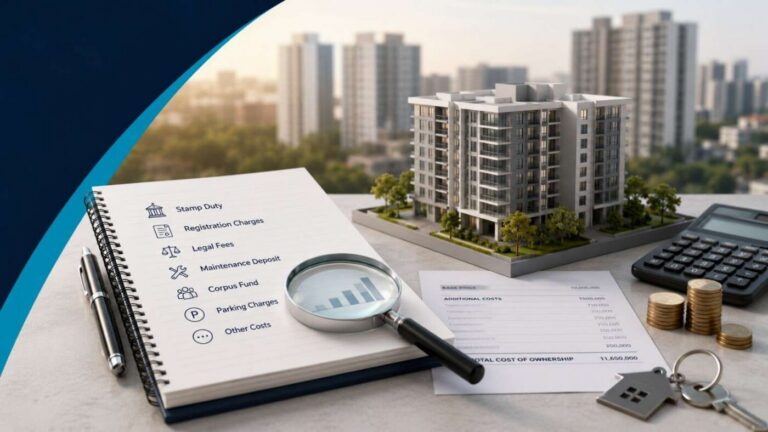
Hidden Costs of Buying a Flat That Most Buyers Miss (And How to Avoid Them)
The ₹1 Crore Apartment That Doesn’t Actually Cost ₹1 Crore You’ve found the perfect apartment. The location works. The builder...
Read More →
Sarjapur Real Estate Outlook: Property Prices Touch ₹12,000 Per Sq Ft as Demand Continues to Rise
For years, Sarjapur was viewed as a location with potential. Today, it is progressively seen as a location with momentum....
Read More →
Bangalore Unsold Housing Inventory 2025: Nearly 65,000 Unsold Homes and What It Means for Buyers
Buying a home in Bengaluru has never been a one-size-fits-all decision. Over the past few years, the city has experienced...
Read More →