
The “Zero-Ad” Advantage: Why Developer-Funded Property Portals Can Make Homebuyers Work Harder

Search for a home online, and the problem seems simple: enter a location, choose a budget, select 2BHK or 3BHK, and start comparing.
Then the results page gets crowded.
Sponsored listings appear alongside organic results. Some projects seem to have better visibility than others. Multiple developers promote similar apartments. Soon, the buyer is no longer asking only, “Which property is right for me?”
They are also wondering:
“Why am I seeing this property first?”
That question matters because the way properties are presented can influence what buyers notice, compare, and ultimately visit.
For analytical buyers, especially tech professionals and first-time homebuyers, this creates a different kind of property-search fatigue. The problem isn’t only too many listings. It is uncertainty about which information deserves attention.
This is where the idea of a zero-ad property portal becomes interesting.
A property search experience that reduces promotional clutter can help buyers focus on relevance instead of visibility.
But “ad-free” by itself isn’t enough.
A genuinely useful, unbiased Bangalore real estate platform also needs relevant property information, clear pricing, verification, useful filtering, and protection from unnecessary sales pressure.
That’s the larger problem Proppy is trying to address.
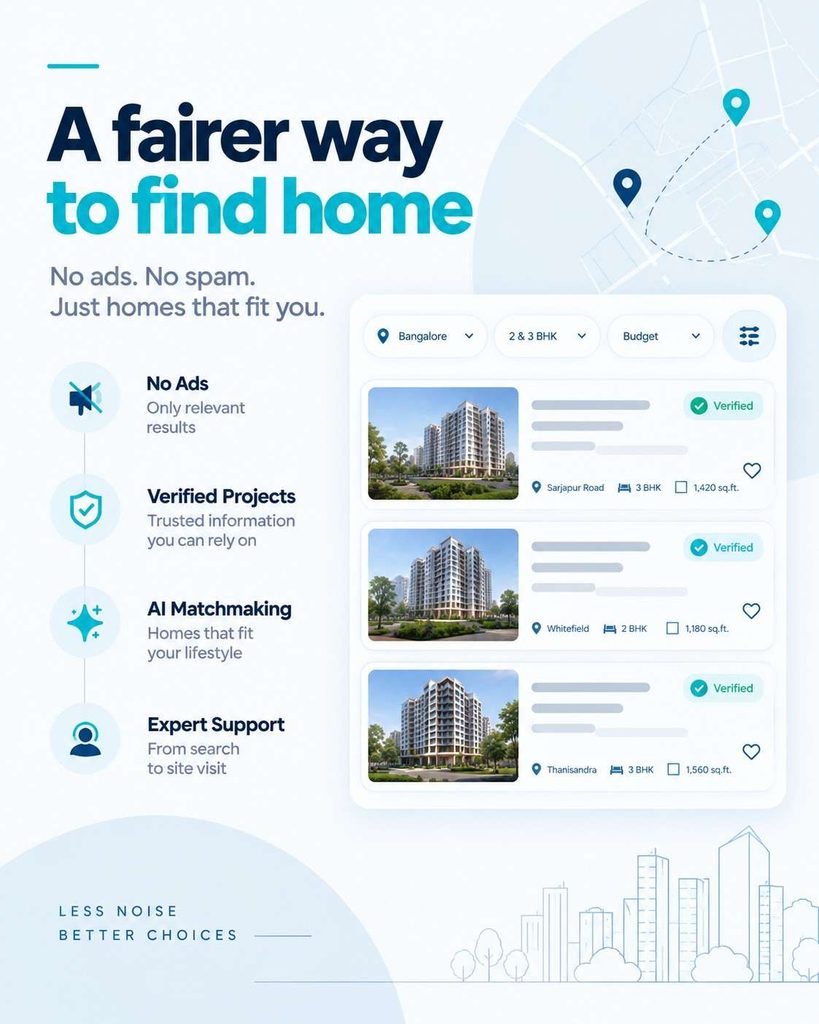
Proppy describes itself as an AI-powered home discovery companion that uses intelligent matchmaking, verified information, and expert support to help buyers move from discovery toward purchase. It also explicitly promises no broker calls, no lead sharing and no spam.
Why Traditional Property Search Can Become Exhausting
The problem with online property search isn’t that there are too few options.
There are too many.
A buyer searching for a home in Bangalore can encounter:
- Hundreds of similar listings
- Duplicate property information
- Sponsored visibility
- Different prices for apparently similar units
- Multiple contact forms
- Broker follow-ups
- Repeated calls
- Promotional offers
- Incomplete project information
For someone searching after work, the process can quickly become another job.
This is particularly frustrating for analytical buyers.
They don’t necessarily want more properties.
They want better reasons to consider fewer properties.
That’s why an objective property discovery engine should do more than return the largest possible list.
It should help buyers narrow the search based on factors that actually matter to them.
Budget. Location. Lifestyle. Commute. Configuration. Project stage. Developer. Investment objective. And, where available, verified project information.
Proppy’s current platform describes its AI matchmaking as using buyer preferences such as budget, location, lifestyle and proximity to schools and workplaces to curate relevant homes rather than making buyers sift through endless listings.
What Is the Problem With Developer-Sponsored Listings?
A sponsored listing isn’t automatically a bad listing.
A developer can advertise a good project.
The concern is different:
Can paid visibility influence what the buyer sees before they have evaluated what actually fits their needs?
This is the central issue behind the search for risks in developer-sponsored listings.
Imagine two projects.
Project A is highly relevant to your budget, commute, and preferred configuration.
Project B is less suitable but has paid for prominent placement.
If Project B appears first, the buyer may pay more attention to it simply because it was given greater visibility.
That doesn’t prove the promoted project is inferior.
It demonstrates why visibility and suitability are not the same thing.
For a buyer, those two concepts should ideally remain separate.
A property should be prominent because it matches the buyer’s requirements—not simply because it has greater promotional visibility.
Can Developer-Funded Rankings Mislead Homebuyers?
They can influence attention, which is why buyers should understand how a platform’s results are generated.
The search question “how developer sponsored rankings mislead homebuyers on property portals” is therefore less about assuming that every sponsored project is misleading and more about understanding the difference between:
Paid visibility
and
Buyer relevance.
The distinction is important.
If a platform clearly labels advertising, buyers can factor that information into their decisions.
If a buyer cannot easily distinguish between paid placements and relevance-based recommendations, the decision-making process becomes more difficult.
The safest approach is to ask:
- Why is this property appearing?
- Is it sponsored?
- Does it match my requirements?
- Are comparable projects being shown?
- Is the information independently verified?
- Are prices and charges clearly presented?
Those questions turn the buyer from a passive viewer into an active evaluator.
The Bigger Problem: Property Portal Conflict of Interest
The phrase property portal conflict of interest can sound more dramatic than the actual issue.
A platform may earn money from advertising, lead generation, listings, developer relationships, or other commercial arrangements.
That doesn’t automatically mean the information it provides is wrong.
But it does mean buyers should understand the platform’s commercial model.
The more a platform depends on paid visibility or lead generation, the more important transparency becomes.
A buyer should be able to distinguish:
“This property matches what I asked for.”
from:
“This property paid to be shown prominently.”
That distinction matters most when a buyer is making a decision worth tens of lakhs or more.
What Does an Ad-Free Real Estate Search Actually Solve?
An ad-free real estate search can remove one source of distraction.
It can make the search experience cleaner.
But it doesn’t automatically make every property recommendation objective.
An ad-free platform could still have:
- Poor property data
- Duplicate listings
- Incomplete project information
- Weak filtering
- Unverified claims
- Biased recommendations
So the real objective should be broader than “zero ads.”
The better goal is:
Less promotional noise + better relevance + stronger information quality + less sales pressure.
That’s closer to what buyers actually need.
How Proppy Approaches Property Discovery
Proppy currently positions itself as more than a conventional property portal.
Its platform uses AI-powered matchmaking to understand buyer requirements and curate relevant homes. It also states that property information is verified and updated, and its public positioning emphasises “No Spam, No Pressure.”
Its Bangalore property platform also highlights verified, legally checked listings, RERA-listed projects, and zero brokerage.
That changes the search experience importantly.
Instead of asking:
“How many properties can I show you?”
the model becomes:
“Which properties are actually relevant enough for you to consider?”
That’s a more useful question for a buyer who is already experiencing portal fatigue.
Why No Spam Matters More Than It Sounds
For many buyers, the biggest problem with submitting a phone number on a property website isn’t the form itself.
It’s what happens afterwards.
One enquiry can lead to:
- Multiple calls
- Different agents discussing the same project
- Repeated follow-ups
- WhatsApp messages
- Calls during working hours
- Calls after the buyer has already rejected the property
For a corporate professional, this quickly becomes frustrating.
For a first-time buyer, it can also feel pressured.
Proppy’s current Priority page explicitly states:
“No broker calls. No lead sharing. Ever.”
It also states:
“No follow-ups. No spam.”
That is directly relevant to the long-tail question:
“how to search homes online without getting spam calls from brokers.”
The answer isn’t simply “use an AI search engine.”
It’s about choosing a platform with transparent data and lead-sharing practices, and a stated process that reduces unnecessary sales contact.
Why Privacy Is Part of Property Search
Property search involves sensitive information.
A buyer may share:
- Phone number
- Email address
- Budget
- Preferred location
- Family requirements
- Investment plans
- Loan requirements
- Property preferences
That information has value.
This is why privacy in real estate lead generation should be considered alongside search quality.
A platform may offer an excellent search experience, but buyers should still understand:
- Why their information is collected
- Who can access it
- Whether leads are shared
- How communications are handled
- What privacy protections are offered
Proppy’s current public Priority page states that buyer details stay safe with Proppy and that it does not share leads or generate broker spam.
Buyers should still review the platform’s privacy policy and terms before submitting personal information.
What About Legal and RERA Checks?
This is where the original idea behind an automated RERA compliance scan and NLP real estate legal due diligence needs careful handling.
AI can help process and organize large volumes of property information.
But legal verification is not simply a keyword-search problem.
A property can have hundreds of pages of documentation.
The important questions may involve:
- Ownership
- Title
- Encumbrances
- Approvals
- Project registration
- Development rights
- Agreements
- Litigation
- Project-specific documentation
An AI system may help identify information or organize documents, but it is not a substitute for qualified legal review.
Proppy’s current Priority terms make this distinction explicit. Its Legal Summary is a preliminary review based on information made available to Proppy and is not a substitute for independent legal counsel or a certified legal opinion.
That is the more responsible way to use technology in property due diligence:
AI can help process information. Professional review remains important when legal judgment is required.
What Is an NLP Real Estate Legal Due-Diligence System?
Natural Language Processing, or NLP, can help computers work with large amounts of written information.
In a real-estate context, NLP could potentially help identify:
- Names
- Dates
- Clauses
- Project references
- Repeated entities
- Certain risk-related terms
- Document inconsistencies
But identifying a phrase is not the same as determining its legal significance.
For example, finding the word “litigation” in a document does not automatically tell a buyer:
- Whether the case is active
- Whether it affects the project
- Whether it affects title
- Whether it has been resolved
- What legal consequences it may have
That requires context.
So buyers should be careful with claims about NLP real estate legal due diligence.
Technology can support review.
It should not be marketed as a replacement for legal expertise.
How Can Buyers Check Builder Delays and Litigation?
This is another area where buyers should avoid relying on one automated score.
If you’re researching:
“why traditional real estate portals hide builder delays and legal issues”
the better approach is to ask whether the platform provides enough project information for the buyer to investigate these issues.
A practical review may include:
- RERA project information
- Project registration status
- Construction progress
- Developer track record
- Relevant disclosed cases
- Regulatory actions where available
- Project documentation
- Public records
- Independent legal review where appropriate
Proppy says its independent project evaluations consider project claims, livability and the developer’s historical delivery track record. Priority includes reports for up to three shortlisted projects.
That is more useful than promising that one automated “risk score” can tell a buyer whether a property is safe.
What Should an Objective Property Discovery Engine Actually Do?
A useful objective property discovery engine should help answer five questions.
1. Does the property match my requirements?
Budget, location, configuration, and lifestyle should matter.
2. Is the information sufficiently clear?
The buyer should know what is being represented.
3. Can I compare alternatives?
One project should not become the default simply because it has greater visibility.
4. What needs further verification?
The platform should make unanswered questions visible rather than hiding uncertainty.
5. Can I move from discovery to evaluation?
Finding a property is only the beginning.
This is where Proppy’s broader positioning is relevant.
Its current platform combines AI-powered discovery with verified information and expert support, rather than treating property search as a simple listing database.
Sponsored Visibility vs Buyer Relevance
| Sponsored Property Search | Buyer-Focused Discovery |
| Visibility may be influenced by promotion | Relevance is based on buyer requirements |
| Buyer may see more promoted projects | Buyer can focus on shortlisted options |
| More listings can mean more noise | Fewer relevant options can reduce decision fatigue |
| Lead generation can create follow-up pressure | Proppy states that it does not share leads or send broker spam |
| Buyer evaluates after seeing the listing | Buyer requirements shape the initial discovery |
| Advertising and relevance can overlap | Greater emphasis on matching and verification |
The point isn’t that every sponsored listing is bad.
Paid visibility and buyer suitability are different things.
A buyer should know what’s influencing what they see.
How Proppy Priority Adds Another Layer
The free Proppy experience already focuses on AI-powered Bangalore Property Discovery, verified information and reduced sales pressure.
Priority is designed for buyers who want additional support around the actual purchase.
The current Priority plan includes:
- Dedicated Relationship Manager
- Personalized property shortlisting
- Legal documentation review and due diligence
- Independent project evaluation
- Home-loan assistance
- Interior consultation with a 3D floor plan
- Vastu review
- Priority post-booking support
- Cashback/rewards subject to applicable conditions.
The current Priority fee is a one-time fee of ₹999, and Proppy states an estimated total service value of ₹1,13,000 for the package.
For this topic, however, the most relevant benefits aren’t the entire package.
They are:
- Relevant discovery.
- Project evaluation.
- Legal documentation review.
- Human support.
- Reduced sales pressure.
That is what makes Priority relevant to a buyer who is tired of property portals and not just looking for another list of apartments.
Does Proppy Eliminate Developer Promotions?
This is where buyers should distinguish between a marketing claim and a verified product feature.
The current public Proppy pages clearly state that Proppy provides AI-powered discovery, verified information, zero brokerage and no broker calls/lead sharing.
However, buyers should not assume that every ranking or property presentation on the platform is governed by a specific “zero sponsored ranking” algorithm unless Proppy explicitly publishes those rules.
The stronger claim is simpler:
Proppy is designed around buyer relevance and reduced sales pressure, rather than asking buyers to navigate a portal experience dominated by broker calls.
That claim is supported by its current public positioning.
What About the “Zero-Ad” Advantage?
An important distinction:
Zero ads and zero broker spam are not necessarily the same thing.
A platform could have no display advertisements but still pass leads to agents.
Another platform could have commercial relationships while still limiting direct sales pressure.
For the buyer, the important questions are:
- Are my details shared?
- Will brokers contact me repeatedly?
- Are properties relevant to my requirements?
- Can I compare projects?
- Is information verified?
- Are sponsored placements clearly identified?
- Can I understand why a property is being recommended?
Those questions matter more than the label “ad-free.”
Who Benefits Most From This Model?
Analytical Tech Professionals
If you are used to comparing products using data, you may find traditional property portals frustrating because the information isn’t always presented consistently.
You want to know:
Why this property?
Why this price?
Why this ranking?
What am I missing?
A structured discovery and evaluation process can reduce the amount of noise you have to process.
First-Time Buyers
First-time buyers may not know which project claims require verification.
They can benefit from having a clearer path from:
Search → shortlist → evaluate → verify → decide.
Buyers Experiencing Portal Fatigue
If your property search has already produced dozens of tabs, repeated listings and unwanted calls, reducing the number of irrelevant options can be more valuable than adding another hundred listings.
How to Search Homes Online Without Getting Spam Calls From Brokers
If this is your biggest concern, start with the platform’s data practices rather than its property count.
Before submitting your phone number, check:
- Does the platform state whether it shares leads?
- Does it promise broker-call protection?
- Is there a clear privacy policy?
- Can you search without submitting your number immediately?
- Are the properties relevant to your requirements?
- Is the platform transparent about its commercial model?
Proppy explicitly states that it does not share leads or send broker calls or spam.
That directly addresses one of the most common frustrations in online property search.
The Real Advantage Isn’t “No Ads”
The bigger advantage is less noise around a high-stakes decision.
A homebuyer doesn’t need to be protected from every commercial relationship in real estate.
They need enough transparency to understand what they are seeing and enough support to evaluate it properly.
That means:
Relevant search instead of endless listings.
Verified information instead of assumptions.
Evaluation instead of simply promotion.
Human support instead of repeated sales calls.
And when the purchase becomes more complex, additional legal, financial and project-level support.
That is the more meaningful interpretation of the “zero-ad advantage.”
Search Less. Evaluate More.
The traditional property search model asks buyers to do much of the filtering themselves.
Open the portal. Search the location. Filter the budget. Open dozens of listings. Submit an enquiry. Receive calls. Visit projects. Compare brochures. Repeat.
The technology exists to make that process more focused.
Proppy’s current model combines AI-powered matchmaking, verified property information and expert support to reduce the amount of irrelevant searching buyers have to do.
Priority adds a human support layer for buyers who want more assistance during the purchase journey.
Its Dedicated Relationship Manager provides continuity, while legal documentation review, project evaluation, and other Priority services address specific stages of the buying process.
The goal isn’t to tell buyers that every traditional portal is bad.
It is to give buyers a better question to ask:
“Is this platform helping me make a better decision, or simply helping me see more properties?”
That’s the difference between property discovery and property buying support.
The Best Property Search Is the One That Helps You Decide
A homebuyer doesn’t need another endless feed.
They need a way to reduce irrelevant choices, understand what they are seeing and identify what still needs to be verified.
For an analytical buyer, that means the search experience should answer more than:
“What properties are available?”
It should help answer:
“Which ones are worth my time?”
Proppy is built around that approach: AI-powered property discovery, verified information and expert support, combined with a stated commitment to no broker calls, no lead sharing and no spam.
For buyers who want additional support, Proppy Priority adds a Dedicated Property Relationship Manager in Bangalore, legal documentation review and due diligence, independent project evaluation, home-loan assistance, interior consultation, Vastu review, priority post-booking support, and eligible cashback benefits.
The current Priority plan costs ₹999 as a one-time fee. Its stated package value is ₹1,13,000, while cashback can be up to ₹50,000 subject to eligibility and applicable conditions.
The ₹999 fee does not guarantee a perfect property decision.
The AI does not replace legal advice.
And no platform should replace the buyer’s own judgment.
What it can do is reduce the noise around the decision and provide more structured support when the buyer needs it.
Because when you’re buying a home, the most valuable search result isn’t necessarily the one at the top of the page. It’s the one that gives you a better reason to keep looking.
Frequently Asked Questions:
Many online platforms use advertising, promoted listings or commercial partnerships as part of their business models. Sponsored visibility doesn’t automatically mean a property is unsuitable, but buyers should understand whether prominence is based on payment, relevance or another ranking factor
Sponsored placement can influence which properties receive attention first. Buyers should distinguish between paid visibility and actual suitability for their budget, location, configuration and other requirements.
A zero ad property portal is generally understood as a property-search platform that does not rely on conventional advertising placements to present properties. However, buyers should also examine whether the platform shares leads, uses sponsored rankings or has other commercial arrangements.
Check the platform’s lead-sharing and privacy practices before submitting your contact details. Proppy currently states that it does not share leads and does not send broker calls, follow-ups or spam.
A property portal conflict of interest can arise when a platform has commercial relationships that may influence how properties are promoted or presented. This does not automatically mean the information is inaccurate, but transparency about commercial relationships and ranking mechanisms can help buyers evaluate results more critically.
Yes. Proppy describes its platform as an AI-powered home discovery companion that uses intelligent matchmaking based on factors such as budget, location, lifestyle and proximity to schools and workplaces.
Proppy’s current Priority page states: “No broker calls. No lead sharing. Ever.” It also states “No follow-ups. No spam.”
Proppy states that its property information is verified and updated, and its Bangalore platform describes its listings as verified and legal-checked, with RERA-listed projects. Buyers should still independently verify information before making a purchase.
Yes. Priority includes legal documentation review and due diligence. Proppy’s terms clarify that the Legal Summary is a preliminary review and is not a substitute for independent legal counsel or a certified legal opinion.
Proppy’s current public Priority information supports legal documentation review and due diligence, but it does not establish that Priority provides a specific automated “RERA approval queue” or NLP litigation-scanning system. Buyers should not assume those specific capabilities unless Proppy confirms them for the service.
NLP-based review can use natural-language processing to identify and organise information in property documents. It can support document analysis, but identifying text or patterns is not the same as providing a legal opinion. Important legal questions should be reviewed by qualified professionals.
Yes. Priority includes independent project reports for up to three shortlisted projects. Proppy’s published description says these reports assess project claims, livability and the developer’s historical delivery track record.
The current public Priority information does not state that it uses a specific system that automatically eliminates every form of sponsored ranking. The safer description is that Proppy focuses on AI-powered matching, verified information and buyer requirements rather than positioning itself purely as a listing marketplace.
An objective property discovery engine aims to surface properties based primarily on buyer requirements and relevant information rather than simply presenting the largest possible number of listings. Buyers should still understand how a platform’s recommendations and commercial relationships work.
Proppy Priority currently costs ₹999 as a one-time fee. Proppy’s current terms state that the fee is non-refundable and the plan is valid for a maximum of 90 days from sign-up or home purchase, whichever is earlier.
Eligible Priority customers can receive up to ₹50,000 cashback, subject to applicable conditions. Proppy’s terms state that eligibility includes completing and registering the purchase through Proppy, builder eligibility and other applicable conditions.
It can be useful for buyers who want additional support with project evaluation, legal documentation, financing, interiors, coordination and post-booking assistance. Whether it is worthwhile depends on the buyer’s needs and how much professional support they would otherwise arrange separately.
Check how the platform handles buyer data, whether listings are verified, how sponsored content is identified, whether relevant alternatives are shown, what professional support is available and whether you can independently verify important property information.
No. Proppy’s own disclaimer says its AI-generated suggestions and insights may contain inaccuracies and should not be relied upon as professional legal, financial or real-estate advice. Buyers should independently verify important information and obtain qualified professional advice where appropriate.
The main advantage is reduced noise. But the real benefit comes when reduced promotional pressure is combined with relevant search, verified information, transparent pricing and useful support throughout the buying process.
Related Posts

The Metro Effect: How Phase 2B Could Reshape Property Prices in North Bengaluru
The Real Question Isn’t Whether Prices Will Rise. It’s Whether You’re Paying Too Much Today. A property near a proposed...
Read More →
Property Registration Charges in Karnataka 2026: Stamp Duty, Registration Fee, GST and Other Costs Explained
Buying a property in Karnataka involves several statutory payments, and understanding how each is calculated matters before you sign a...
Read More →
The Homebuying Gap Nobody Talks About: Who Helps You After You Find the Property?
Finding a property can feel like the biggest achievement in the homebuying journey. After weeks of browsing listings, comparing locations,...
Read More →