
Property Registration Charges in Karnataka 2026: Stamp Duty, Registration Fee, GST and Other Costs Explained

Buying a property in Karnataka involves several statutory payments, and understanding how each is calculated matters before you sign a sale deed or commit to a purchase.
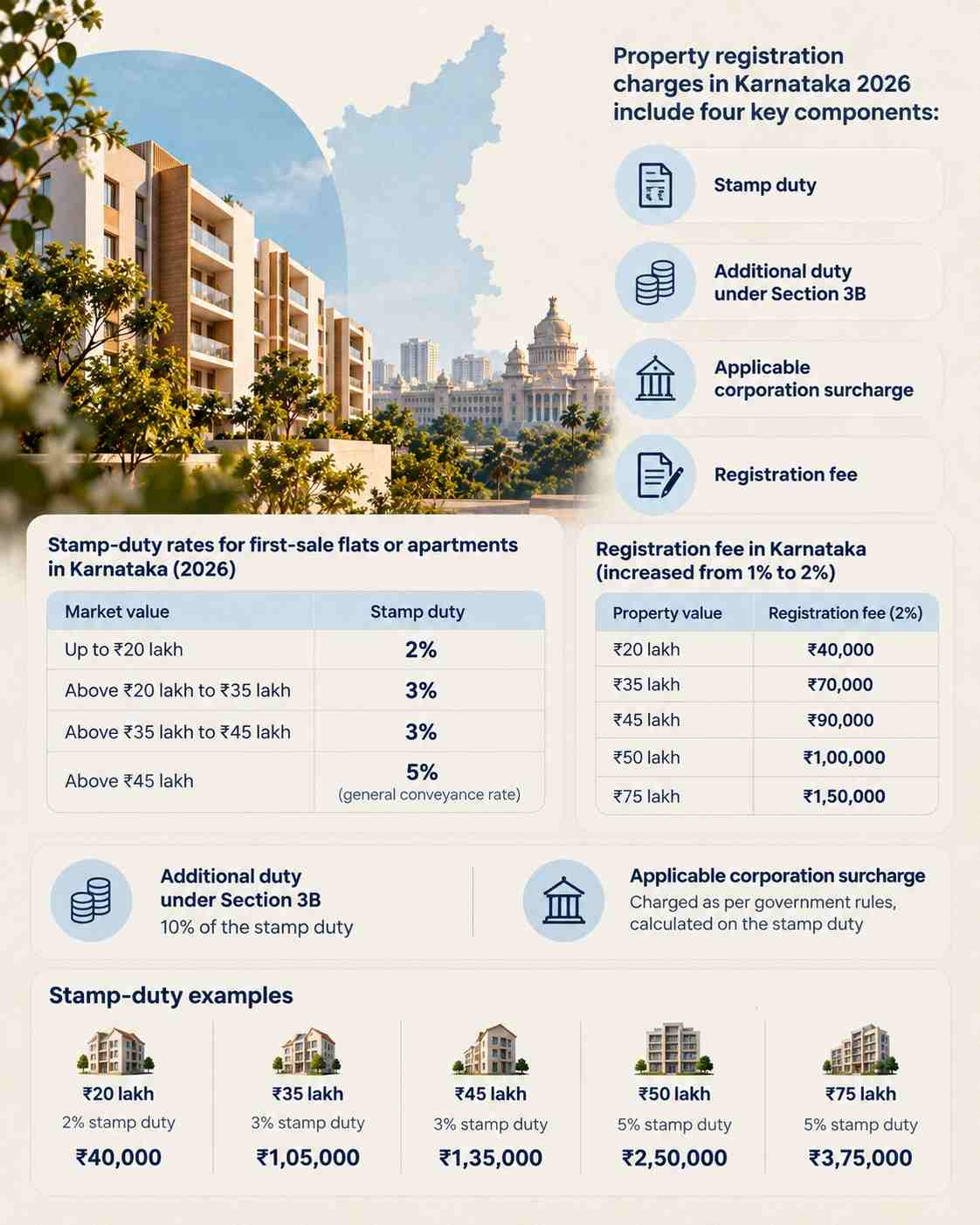
Property registration charges in Karnataka 2026 include more than the registration fee alone. Depending on the transaction, buyers may need to account for stamp duty, additional duty, applicable surcharge and registration fee, while GST may apply separately in certain residential property transactions.
The confusion often begins because these charges are discussed together as a single percentage, even though they are legally distinct components.
For apartment buyers in Bengaluru, another important distinction applies: Karnataka offers concessional stamp-duty rates for certain first-sale flats or apartments in lower-value categories. In contrast, the general conveyance rate is 5%. The registration fee, meanwhile, was increased from 1% to 2% from 31 August 2025.
So, what exactly do buyers need to pay in 2026, how do the 2%, 3% and 5% stamp-duty rates work, and where does GST fit into the calculation?
What are the property registration charges in Karnataka in 2026?
The statutory cost of registering a property can contain four key components:
- Stamp duty
- Additional duty under Section 3B
- Applicable corporation surcharge
- Registration fee
The standard conveyance provision under Article 20(1) of the Karnataka Stamp Act specifies stamp duty at 5% of the market value for the relevant category.
However, Article 20(2A) provides concessional stamp-duty rates for the first sale of certain flats or apartments:
Market value of first-sale flat/apartmentStamp duty
| Market value of first-sale flat/apartment | Stamp duty |
| Up to ₹20 lakh | 2% |
| Above ₹20 lakh to ₹35 lakh | 3% |
| Above ₹35 lakh to ₹45 lakh | 3% |
| Above ₹45 lakh | 5% under the general conveyance provision |
The 2% and 3% concessional rates specifically relate to the first sale of a flat or apartment covered by the relevant provision. They should not be treated as universal rates for every type of property transaction.
This distinction is important when searching for flat registration charges in Karnataka, because the applicable rate depends on the nature and value of the transaction.
What are the 2%, 3% and 5% stamp-duty rates?
The simplest way to understand Karnataka’s stamp-duty structure is through examples.
Example 1: First-sale apartment valued at ₹20 lakh
If the transaction qualifies for the first-sale concessional provision and the market value is ₹20 lakh or less:
Stamp duty = 2% of ₹20 lakh = ₹40,000
The additional statutory components are then calculated separately.
Example 2: First-sale apartment valued at ₹35 lakh
For a qualifying first-sale flat with a market value above ₹20 lakh and up to ₹35 lakh:
Stamp duty = 3% of ₹35 lakh = ₹1,05,000
Example 3: First-sale apartment valued at ₹45 lakh
For a qualifying first-sale flat with a market value above ₹35 lakh and up to ₹45 lakh:
Stamp duty = 3% of ₹45 lakh = ₹1,35,000
Example 4: Property valued at ₹50 lakh
Once the transaction falls outside the ₹45 lakh concessional first-sale category, the general 5% conveyance rate applies to the relevant transaction:
Stamp duty = 5% of ₹50 lakh = ₹2,50,000
Example 5: Property valued at ₹75 lakh
Under the general 5% conveyance rate:
Stamp duty = 5% of ₹75 lakh = ₹3,75,000
These examples demonstrate why buyers should not simply search for “Karnataka stamp duty 2026” and apply one percentage to every property.
The applicable rate depends on the transaction and the relevant statutory provision.
What is the registration fee in Karnataka in 2026?
The registration fee was increased from 1% to 2%, effective 31 August 2025. The Karnataka Government’s notification made the revised fee effective from that date.
Therefore, buyers completing relevant property registrations in 2026 need to account for the revised 2% rate rather than the earlier 1% rate.
For example:
| Property value | Registration fee at 2% |
| ₹20 lakh | ₹40,000 |
| ₹35 lakh | ₹70,000 |
| ₹45 lakh | ₹90,000 |
| ₹50 lakh | ₹1,00,000 |
| ₹75 lakh | ₹1,50,000 |
These are straightforward 2% illustrations and should not be confused with total statutory registration outgoings, because stamp duty and other applicable components are separate.
What is the additional duty under Section 3B?
Karnataka’s Stamp Act imposes an additional duty of 10% of the stamp duty on specified instruments, including conveyances of immovable property.
This means the additional duty changes based on the stamp duty applicable to the transaction.
For example:
| Stamp duty | Additional duty at 10% of stamp duty |
| ₹40,000 | ₹4,000 |
| ₹1,05,000 | ₹10,500 |
| ₹1,35,000 | ₹13,500 |
| ₹2,50,000 | ₹25,000 |
| ₹3,75,000 | ₹37,500 |
This is why describing the additional duty simply as a fixed percentage of the property value can be misleading. It is calculated as 10% of the applicable stamp duty.
Is there a surcharge on property registration in Bangalore?
For properties situated within the applicable corporation limits, a 2% surcharge on the stamp duty applies under the relevant municipal provisions. BBMP material also identifies a 2% surcharge on stamp duty for properties within the BBMP area.
Because the surcharge is calculated on stamp duty rather than directly on the property value, the effective percentage differs by stamp-duty category.
For example:
- If stamp duty is 2%, a 2% surcharge on that duty works out to 0.04% of the property value.
- If stamp duty is 3%, it works out to 0.06% of the property value.
- If stamp duty is 5%, it works out to 0.10% of the property value.
The surcharge should therefore be described as an applicable corporation surcharge, rather than assuming that every Karnataka property attracts it.
What does the total statutory calculation look like?
For an illustrative transaction where the applicable stamp duty is 2%, 3% or 5% and the relevant corporation surcharge applies, the components can be represented as follows:
| Component | If stamp duty is 2% | If stamp duty is 3% | If stamp duty is 5% |
| Stamp duty | 2% | 3% | 5% |
| Additional duty | 0.2% | 0.3% | 0.5% |
| Corporation surcharge | 0.04% | 0.06% | 0.10% |
| Registration fee | 2% | 2% | 2% |
| Combined statutory outgoings | 4.24% | 5.36% | 7.60% |
Where the applicable corporation surcharge applies.
This is a more useful way to understand property registration fees in Karnataka because it shows how the final percentage is built up rather than presenting one number without explanation.
For the 5% category, for example:
5% stamp duty + 0.5% additional duty + 0.1% applicable corporation surcharge + 2% registration fee = 7.6%.
The 7.6% figure should therefore not be described as the registration fee. It represents the combined statutory outgo under this particular calculation.
What is the registration cost for a ₹50 lakh property?
For a ₹50 lakh transaction falling under the general 5% conveyance category, the illustrative calculation would be:
- Stamp duty: ₹2,50,000
- Additional duty: ₹25,000
- Applicable corporation surcharge: ₹5,000
- Registration fee: ₹1,00,000
Combined statutory outgo: ₹3,80,000
This is an illustration of the statutory components and assumes the applicable corporation surcharge applies.
It does not include GST or project-specific charges.
Similarly, for a ₹75 lakh transaction under the 5% category:
- Stamp duty: ₹3,75,000
- Additional duty: ₹37,500
- Applicable corporation surcharge: ₹7,500
- Registration fee: ₹1,50,000
Combined statutory outgo: ₹5,70,000
These examples help with queries such as registration charges for a 50 lakh property, a 75 lakh flat, or a 1 crore property, but always confirm the exact calculation for the actual transaction.
What value is used to calculate stamp duty?
The relevant stamp-duty calculation is based on the applicable market value under the Karnataka Stamp Act and the relevant provisions governing valuation.
The Act includes provisions for determining market value and for action when the value stated in an instrument is considered inaccurate.
Therefore, buyers should not assume that they can take any negotiated figure and multiply it by the stamp-duty percentage without checking the applicable valuation basis.
A more accurate way to express the calculation is:
Stamp duty = applicable market value × applicable stamp-duty rate
The applicable rate then depends on the transaction category.
Does GST apply when buying a flat in Bangalore?
GST is separate from stamp duty and registration charges.
Under the reduced-rate real-estate GST framework, the effective GST rate is generally:
- 5% for residential apartments outside the affordable segment
- 1% for qualifying affordable residential apartments
subject to the applicable conditions. CBIC’s real-estate guidance specifies these effective rates.
For the affordable-housing definition used for this GST framework, a residential house or flat can qualify based on both value and carpet area. For metropolitan cities, the carpet-area limit is 60 square metres, with a ₹45 lakh value limit, subject to the applicable conditions. CBIC specifically includes Bengaluru among the metropolitan cities for this definition.
The GST treatment also depends on the nature and stage of the transaction. The applicable rate provisions distinguish construction services supplied before the relevant completion certificate or first occupation from transactions where the entire consideration is received after that point.
So, buyers should not simply add 5% GST to every apartment purchase.
Is GST included in property registration charges?
No.
GST and property registration charges are separate considerations.
Stamp duty and registration fee are state-level transaction charges, while GST is a central indirect tax applicable to qualifying supplies under the GST framework.
A builder’s cost sheet should therefore clearly distinguish:
Government registration-related charges from GST and Project-specific charges.
This separation helps buyers understand exactly what they are paying and to whom.
What other charges should apartment buyers check?
Not every amount associated with buying an apartment is a statutory registration charge.
Depending on the project, a buyer may encounter:
- Preferential location charges or PLC
- Floor-rise charges
- Parking or car-park charges
- Clubhouse and amenity charges
- Infrastructure charges
- BESCOM/BWSSB or other utility-related deposits
- Advance maintenance
- Corpus or sinking-fund contribution
- DG charges
- Reticulated gas charges
- Documentation or administrative charges, where applicable
These are project-specific or transaction-specific costs, not a standard percentage you can add to every property registration calculation.
The right approach is to ask the developer for a complete written cost sheet and identify which items are included in the quoted price and which are charged separately.
What is the property registration process in Karnataka?
The property registration process in Karnataka generally involves preparing the appropriate transaction document, paying the applicable statutory charges, executing the document and registering it with the competent registration authority.
For a buyer, the process can broadly be understood as:
Property selection → Agreement and transaction terms → Document verification → Calculation and payment of applicable charges → Sale deed preparation → Execution → Registration → Post-registration formalities
The exact requirements can vary depending on the property and transaction.
Importantly, do not confuse registration with legal due diligence.
Registration records the transaction. It does not, by itself, replace the need to review the relevant property documents before purchase.
What documents are required for property registration in Bangalore?
The exact documents required for property registration depend on the transaction. Still, buyers generally need the applicable sale deed and identity-related documents along with other property and transaction records required by the registration authorities.
Before registration, buyers should also ensure that the relevant property documentation has been reviewed.
This distinction matters because:
Registration documents help complete the registration process.
Due-diligence documents help buyers understand the property and assess relevant legal and transactional risks before proceeding.
How should buyers use a stamp duty and registration calculator?
A stamp duty and registration calculator that Karnataka buyers find online can help with an initial estimate. Still, don’t treat it as the final authority without checking what the calculator includes.
Before relying on one, check whether it accounts for:
- The current 2% registration fee
- The applicable stamp-duty category
- The 2% and 3% concessional first-sale provisions
- The general 5% conveyance rate
- Additional duty under Section 3B
- Applicable corporation surcharge
- The correct market-value basis
- The nature of the transaction
An outdated calculator using the earlier 1% registration fee can produce an incorrect estimate for a 2026 transaction.
How can Proppy help buyers navigate these costs?
Understanding property registration charges in Karnataka is only one part of buying a home. Buyers also need to compare projects, review relevant documentation, understand financing and evaluate the property before moving towards registration.
Proppy supports buyers throughout the broader homebuying journey, including property discovery, comparison, and support.
For buyers seeking additional assistance, Proppy Priority is currently offered as a one-time ₹999 membership. It includes a Dedicated Relationship Manager, legal documentation review and due diligence, independent project reports, Vastu review, interior consultation with a 3D floor plan, home-loan assistance and priority post-booking support. Proppy currently states ₹1L+ in potential included value and up to ₹50,000 in cashback, subject to eligibility and applicable terms. Proppy Priority
The legal review offered through priority should also be understood correctly: it is a preliminary review. It does not replace independent legal counsel, a certified legal opinion or a title certificate.
For a buyer trying to understand the difference between statutory charges, builder charges, and other transaction expenses, reviewing these components together can make the process easier to navigate.
The important distinction buyers should remember.
When looking at property registration fees in Karnataka, it is easy to focus on one percentage and overlook what sits behind it.
The applicable stamp duty may be 2%, 3% or 5%, depending on the transaction and statutory category. Additional duty is calculated as 10% of the stamp duty, the applicable corporation surcharge is calculated separately, and the registration fee is now 2% for relevant registrations from 31 August 2025.
GST is a separate consideration and can be 1% or 5% under the applicable reduced-rate residential framework, subject to the relevant conditions.
The most useful approach is therefore not to ask only, “What percentage is registration?”
Instead, ask:
What is the applicable stamp-duty category? What is the market-value basis? What is the current registration fee? Does the corporation surcharge apply? Does GST apply? And which other project-specific charges are payable?
Once you identify each component separately, the apartment registration cost in Bangalore becomes much easier to understand and verify before proceeding with the purchase.
Related Posts

How AI-Powered Property Search Helped a Couple Book a Home in Bengaluru in 72 Hours
From Six Months of Searching to a Home Booking in 72 Hours For Prasad and Sandhya, buying a home in...
Read More →
The Metro Effect: How Phase 2B Could Reshape Property Prices in North Bengaluru
The Real Question Isn’t Whether Prices Will Rise. It’s Whether You’re Paying Too Much Today. A property near a proposed...
Read More →
Why Bengaluru Homebuyers Regret Their First Purchase – And the Mistakes Behind It
Buying a home in Bengaluru is rarely just about finding an apartment you like and deciding whether you can afford...
Read More →