
How Do I Avoid Buying the Wrong Apartment? A Complete Home Buyer’s Decision Guide

Buying a home is exciting, but it can also be overwhelming. Every project promises world-class amenities, excellent connectivity and a better lifestyle. The sample flat looks perfect, the clubhouse is impressive, and the sales team assures you that you’ve found the right investment.
But months, or even years, later, many buyers realize that the apartment they chose doesn’t actually fit their lifestyle, budget or plans.
If you’re wondering how to avoid buying the wrong apartment, the answer isn’t simply finding the newest project or the biggest discount. It’s about making a decision that aligns with your needs, finances and long-term goals.
A home isn’t just a financial investment. It’s where you’ll spend years of your life, build memories and plan your future. That’s why a good apartment buying guide involves much more than comparing brochures and floor plans
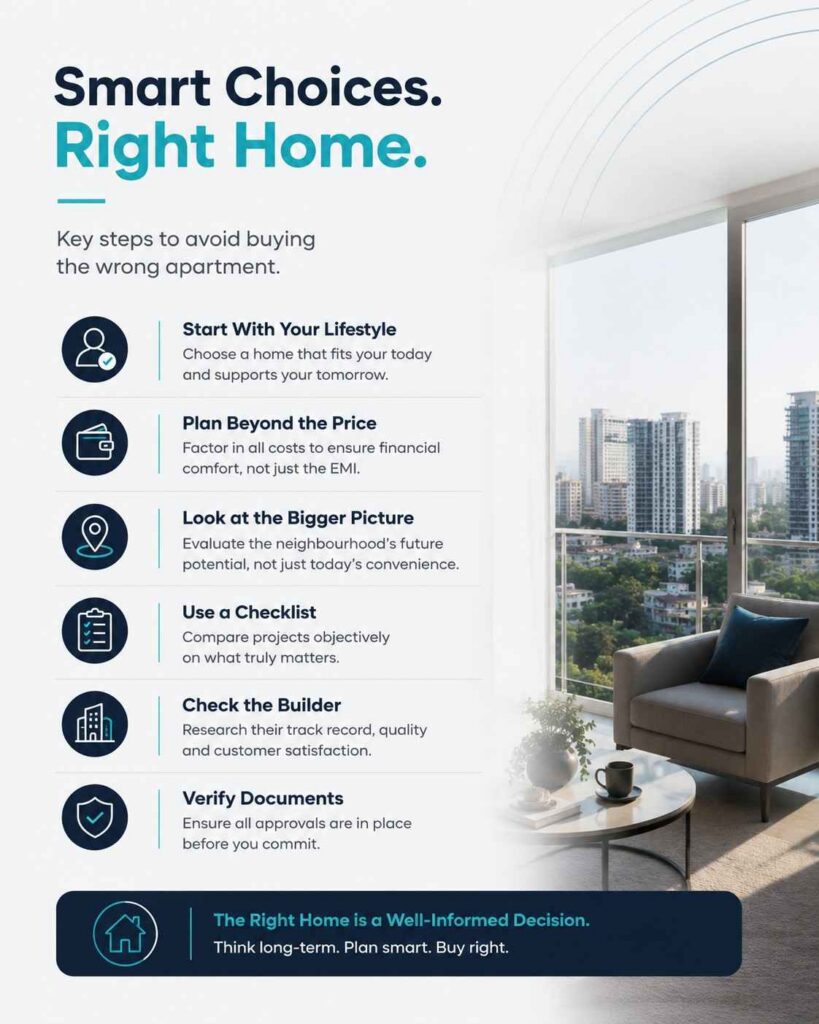
Start With Your Lifestyle, Not the Property
One of the biggest mistakes buyers make is choosing an apartment first and then trying to fit their lives around it.
Before shortlisting projects, take a step back and think about what you actually need. Are you buying the property for your family or as an investment? Do you work from home? Are you planning to expand your family in the future?
When thinking about how to choose the right apartment, ask yourself:
- How far is the property from your workplace?
- Are schools, hospitals and supermarkets nearby?
- Will the apartment still suit your lifestyle five years from now?
- Is the neighbourhood safe and convenient?
- Does the location support your daily routine?
The right apartment isn’t always the most luxurious one. An apartment that looks perfect on paper may not necessarily fit the way you live. The best choice is often the one that supports both your present lifestyle and your plans.
Don’t Focus Only on the Price
Many buyers decide whether they can afford a home simply by looking at the EMI. However, a smart apartment buying decision involves understanding your finances, future expenses and long-term goals.
The advertised price rarely tells the complete story. Many buyers underestimate the actual cost of homeownership because several one-time and recurring expenses are often overlooked.
Your budget should include:
- Registration and stamp duty charges
- Interior and furnishing costs
- Maintenance deposits
- Parking charges
- Monthly maintenance fees
- Future lifestyle expenses
Buying a larger apartment may seem attractive today, but financial comfort matters just as much as square footage.
The goal isn’t to buy the biggest apartment you can afford—it’s to buy one that allows you to maintain the lifestyle you want while still meeting your other financial goals.
Don’t Ignore the Neighbourhood’s Future Potential
An apartment isn’t just about the four walls you live in—it’s also about the neighbourhood around it. A project that looks attractive today may not offer the same convenience or value in the future.
Before making a decision, spend some time understanding how the area is likely to develop over the next five to ten years.
Ask yourself:
- Are there any upcoming metro lines or infrastructure projects planned nearby?
- Will the area experience heavy traffic congestion in the future?
- Are schools, hospitals and shopping centres easily accessible?
- Does the neighbourhood have enough green spaces and recreational facilities?
- Is the locality primarily residential, commercial or industrial?
Many buyers focus entirely on the apartment and overlook the importance of the surrounding ecosystem. However, location plays a major role in determining convenience, resale value and long-term appreciation.
A home that saves you two hours of commuting every day can significantly improve your quality of life.
Create a Checklist Before You Compare Apartments
It’s easy to get emotionally attached to a project after visiting a beautiful sample flat. But emotions shouldn’t make the final decision.
Creating an apartment buying checklist can help you evaluate projects objectively and compare apartments based on factors that truly matter.
A simple apartment comparison checklist should include:
- Location and connectivity
- Builder reputation
- Carpet area and layout
- Amenities offered
- Maintenance costs
- Construction quality
- Future infrastructure developments
- Resale and rental potential
Two apartments may have the same price, but their long-term value can be completely different.
Sometimes, the better choice isn’t the apartment with the biggest clubhouse—it’s the one with better connectivity, lower maintenance costs and stronger appreciation potential.
The Builder Is Just as Important as the Apartment
One of the most common property buying mistakes is focusing entirely on the apartment while ignoring the builder behind it.
Understanding how to compare builders is just as important as comparing floor plans and amenities.
Before booking a property, take the time to research:
- The builder’s previous projects
- Delivery timelines
- Customer reviews
- Construction quality
- Legal approvals
- Post-possession support
If possible, visit completed projects and speak to existing residents. Their experiences can tell you far more than any sales brochure.
The apartment may be brand new, but the builder’s reputation already exists.
Verify the Documents Before Paying the Booking Amount
Excitement and urgency often push buyers to make quick decisions, especially when sales teams emphasize limited-time offers and discounts. However, verifying the paperwork is one of the most important steps in the homebuying process.
Before making any payment, ensure that the following documents are in place:
- RERA registration details
- Land ownership documents
- Building approvals and permits
- Sale agreement
- Occupancy and completion certificates (for ready-to-move-in projects)
- Loan approvals from reputed banks
Many buyers assume that if a project looks premium, all the paperwork must already be in order. Unfortunately, that’s not always the case.
Taking the time to verify legal documents can help you avoid unnecessary complications in the future and give you greater confidence in your purchase decision.
Don’t Let the Sample Flat Make the Decision
Sample flats are designed to impress. The lighting is perfect, the furniture is carefully selected, and every room is planned to look spacious.
But the apartment you eventually receive may feel very different once it’s empty.
As part of a first-time home buyer guide, ask practical questions that go beyond appearances:
- What is the actual carpet area?
- Does the apartment receive enough natural light?
- Is there enough storage space?
- Will future construction affect the view?
- Is the apartment properly ventilated?
A beautiful sample flat should encourage you to explore a project, not decide for you.
Take Your Time Before Making the Final Decision
Real-estate sales teams often create urgency.
“Only a few units are left.”
“Prices will increase next month.”
“The offer ends this weekend.”
While some offers may be genuine, rushing into a decision rarely works in the buyer’s favour.
Some of the best apartment buying tips are surprisingly simple. Visit multiple projects, compare layouts, review documents carefully and discuss the decision with your family before paying the booking amount.
A home purchase affects your finances and lifestyle for years, which is why slowing down before making a decision is rarely a mistake.
Remember, choosing the wrong apartment can cost much more than taking a little extra time to make the right choice.
Avoiding the wrong apartment isn’t just about finding more options—it’s about asking the right questions at every stage of the homebuying process, from comparing projects and understanding costs to evaluating builders and reviewing documents. Making an informed decision requires looking beyond brochures and advertisements.
Proppy supports buyers throughout different stages of homebuying, helping them compare projects, understand key details and make decisions that align with their lifestyle, budget and long-term goals.
Final Thoughts
The best apartment isn’t necessarily the newest, the cheapest or the one with the biggest clubhouse. It’s the one that aligns with your needs, budget and long-term goals.
Taking the time to compare projects, understand costs, verify documentation and evaluate builders can help you make a more informed decision. At the end of the day, buying the right apartment isn’t about finding a perfect property; it’s about finding the property that’s perfect for you.
Related Posts

Stranded Pre-Launches & EOI Schemes: Spotting Cash-Flow Red Flags Before You Pay
A pre-launch apartment can look like a smart bargain. The developer offers an early-bird price. The sales team says the...
Read More →
5 Homebuying Mistakes Proppy Priority Could Help You Avoid
Buying a home in Bangalore can feel straightforward. You decide on a budget, choose a location, shortlist a few apartments,...
Read More →
What If Your Property Search Came With a Dedicated Relationship Manager? The Concierge Experience Explained
Buying a home can start with a simple question: “Can someone help me find the right property?” But the moment...
Read More →