
Bangalore Housing Market Forecast FY26: Decoding ICRA’s 3–5% Growth Projection

At first glance, it doesn’t look like an exciting number.
After all, Bengaluru’s residential real estate market has spent the past few years breaking records. So why is ICRA forecasting a relatively modest 3–5% growth in residential sales for FY2026?
The answer is surprisingly positive.
Rather than signalling a slowdown, the forecast reflects a market that is becoming more balanced, sustainable, and resilient after an extraordinary growth cycle. Bengaluru isn’t running out of buyers; it’s evolving into a more mature housing market where demand is driven by genuine end-users, rising incomes, and long-term economic fundamentals instead of speculative activity.
The numbers tell an interesting story.
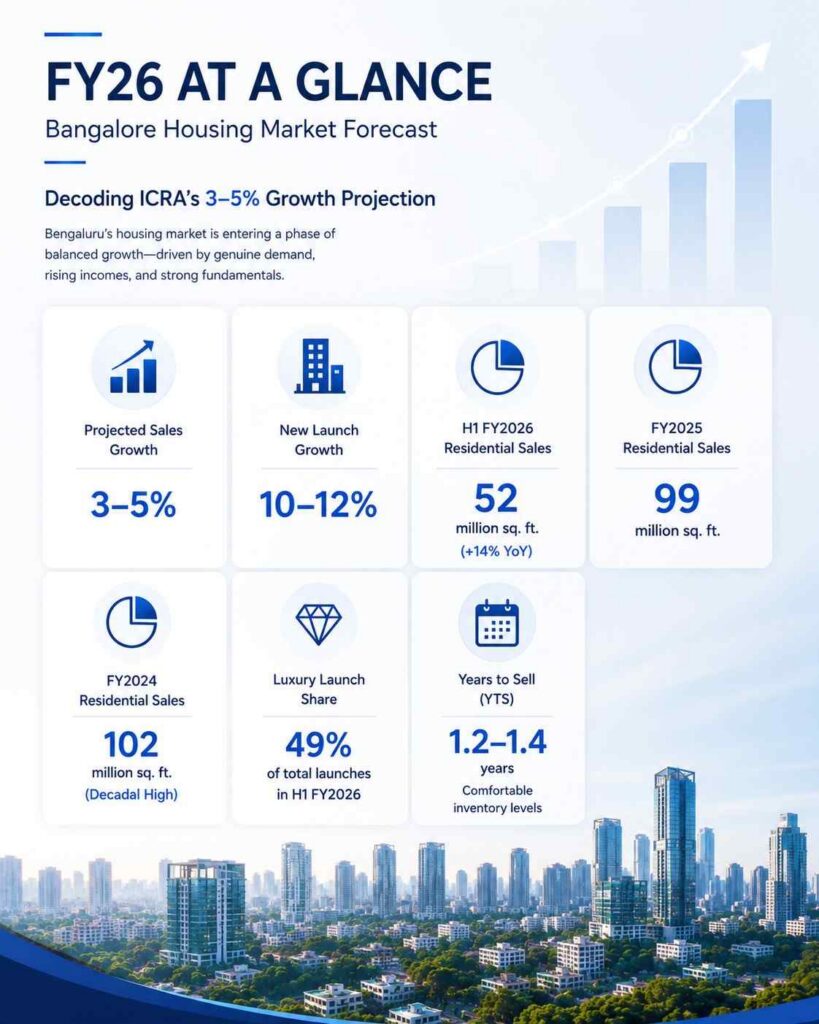
After reaching a decadal high of 102 million sq. ft. of residential sales in FY2024, Bengaluru recorded 99 million sq. ft. in FY2025, a marginal 2% decline from the previous year’s record. However, the market bounced back strongly in the first half of FY2026, with 52 million sq. ft. of residential sales, representing a 14% year-on-year increase.
At the same time, developers haven’t slowed down.
ICRA expects new residential launches to increase by 10–12% in FY2026, supported by healthy inventory levels, continued demand in the ₹2–3.5 crore housing segment, and improvements in Bengaluru’s e-khata process.
So, what does this mean for buyers?
Whether you’re a first-time homebuyer, an investor, an NRI, or someone planning to upgrade to a larger home, understanding the Bangalore housing market forecast for FY26 can help you make smarter property decisions.
Let’s decode what ICRA’s outlook really means.
Bengaluru Housing Market FY26: At a Glance
Before diving deeper, here’s a snapshot of Bengaluru’s residential market based on ICRA’s latest outlook.
| Projected Sales Growth | 3–5% |
| New Launch Growth | 10–12% |
| H1 FY2026 Residential Sales | 52 million sq. ft. (+14% YoY) |
| FY2025 Residential Sales | 99 million sq. ft. |
| FY2024 Residential Sales | 102 million sq. ft. (Decadal High) |
| Luxury Launch Share | 49% of total launches in H1 FY2026 |
| Years to Sell (YTS) | Expected at 1.2–1.4 years, indicating comfortable inventory levels |
What This Means for Buyers
The market isn’t cooling; it is normalising.
A healthy housing market isn’t one where prices or sales grow at unsustainable double-digit rates every year. Instead, a stable market balances buyer demand, new launches, and inventory, allowing both homebuyers and developers to make better long-term decisions.
Why Is ICRA Forecasting Only 3–5% Growth?
On paper, 3–5% growth may appear conservative.
However, context matters.
Between FY2021 and FY2024, Bengaluru witnessed exceptional residential expansion, recording a 27% compound annual growth rate (CAGR) in area sold before reaching the record 102 million sq. ft. mark in FY2024. Following such rapid expansion, it is natural for growth to moderate rather than continue accelerating indefinitely.
ICRA believes the market has entered what it describes as a stabilisation phase, in which growth is supported by genuine demand rather than speculative momentum.
Several factors are shaping this outlook.
1. Bengaluru Is Growing from a High Base
Growing by 3–5% after selling 99 million sq. ft. is very different from growing 3–5% in a smaller market.
Bengaluru is already India’s fourth-largest residential market among the top seven cities, contributing approximately 14–15% of the total residential area sold between FY2021 and FY2025.
What This Means
Large, mature markets naturally grow at a steadier pace because they are building on a much larger base.
This is often viewed as a sign of market stability rather than weakness.
2. Buyer Preferences Have Changed
One of the biggest shifts highlighted by ICRA is where buyers are spending their money.
Affordable housing has slowed considerably.
In FY2025:
- Affordable housing sales declined by 41%
- Affordable homes now account for only 6% of total residential sales
- Meanwhile, mid-income and luxury housing each recorded 3% growth, helping offset the decline in affordable housing.
This reflects a major transformation in Bengaluru’s housing market.
Today’s buyers are increasingly prioritising:
- Larger apartments
- Better amenities
- Hybrid work-friendly homes
- Premium communities
- Lifestyle-driven developments
Instead of buying the smallest affordable unit possible, many professionals are choosing homes that better suit long-term living and evolving lifestyle needs.
3. Luxury Housing Is Becoming the New Growth Engine
Perhaps the most striking finding in ICRA’s report is the rise of premium housing.
For the first time, luxury launches overtook mid-income launches, accounting for 49% of all residential launches in H1 FY2026.
To understand how significant this shift is:
- FY2021: Luxury launches represented 19%
- FY2025: Luxury launches increased to 37%
- H1 FY2026: Luxury launches reached 49%
What This Means
Developers are responding to changing buyer preferences.
Rather than launching more affordable projects, they’re introducing premium developments that cater to higher-income professionals, entrepreneurs, NRIs, and established investors.
This trend is also contributing to higher average selling prices across Bengaluru.
More Homes Are Coming to the Market
While demand remains healthy, supply is also increasing.
ICRA expects new residential launches to grow by 10–12% during FY2026.
Several factors are driving this:
- Healthy inventory levels
- Continued demand in the ₹2–3.5 crore segment
- Improving e-khata implementation
- Strong developer confidence
- Infrastructure-led expansion across Bengaluru
What This Means for Buyers
More launches mean more choice.
Instead of rushing into the first suitable project, buyers are likely to have a wider selection across locations, builders, and price segments.
However, having more options also makes the decision-making process more complex.
Is Inventory Becoming a Concern?
One of the healthiest indicators in Bengaluru’s residential market isn’t sales; it’s inventory.
ICRA uses the Years to Sell (YTS) metric to estimate how long it would take to sell the available unsold inventory.
The numbers are encouraging.
- June 2020: 2.5 years
- March 2024: 0.8 years
- March & September 2025: 1.1 years
- Expected by March 2026: 1.2–1.4 years
Although YTS is expected to rise slightly due to an increase in luxury launches, it remains within the range analysts consider comfortable.
What This Means
A balanced inventory level benefits everyone.
Buyers enjoy greater choice, while developers avoid excessive unsold stock. This helps maintain pricing discipline and supports a healthier, more sustainable market.
Proppy Insight
A forecast like 3–5% growth can easily be misunderstood if viewed in isolation.
The bigger story is that Bengaluru is entering a phase where quality of projects, location, and builder credibility matter more than simply buying early.
As developers launch more projects in FY2026, buyers will have more opportunities, but also more decisions to make. This is where Proppy simplifies the process by helping homebuyers compare verified residential projects based on their budget, preferred location, builder reputation, and long-term investment goals, making it easier to identify the right home in a growing market.
What Does the FY26 Forecast Mean for Different Buyer Profiles?
The most valuable part of ICRA’s report isn’t the 3–5% growth forecast itself—it’s understanding how that outlook affects different types of buyers.
A first-time buyer and a long-term investor won’t interpret the same market conditions in the same way.
Let’s break it down.
For First-Time Homebuyers
If you’re planning to buy your first home, ICRA’s outlook is largely encouraging.
A market growing at 3–5% is generally more predictable than one experiencing rapid, double-digit expansion. Buyers have more time to evaluate projects, compare builders, and negotiate without feeling pressured by sharply rising prices.
At the same time, the expected 10–12% increase in new launches means there will likely be a wider range of residential projects across Bengaluru.
What This Means
Instead of rushing into a purchase because of fear of missing out, buyers can focus on:
- Choosing a reputed developer.
- Evaluating connectivity and infrastructure.
- Comparing floor plans and amenities.
- Looking at long-term liveability rather than short-term discounts.
A balanced market rewards informed decisions.
For End-Users Looking to Upgrade
Many Bengaluru homeowners are now moving from compact apartments to larger homes that offer dedicated workspaces, better amenities, and improved community living.
ICRA’s findings reinforce this shift.
Luxury launches accounted for 49% of all launches in H1 FY2026, compared with 37% in FY2025 and just 19% in FY2021.
This reflects growing demand for premium lifestyles rather than just bigger homes.
What This Means
If you’re upgrading, FY2026 could provide:
- More premium projects to compare.
- Better layouts and larger configurations.
- Improved lifestyle amenities.
- A broader selection of communities in emerging growth corridors.
For Property Investors
Investors usually ask one question first:
Will my investment continue to appreciate?
Although ICRA forecasts moderate sales growth, Bengaluru’s long-term investment fundamentals remain intact.
The city continues to benefit from:
- India’s largest technology ecosystem.
- Expansion of Global Capability Centres (GCCs).
- Metro expansion.
- Commercial development.
- Strong migration for employment.
These structural drivers continue to support long-term housing demand, even as the market enters a more measured growth phase.
What This Means
Rather than chasing short-term price spikes, investors should focus on:
- Infrastructure-led locations.
- Established developers.
- Rental demand.
- Future employment hubs.
- Long-term appreciation potential.
For NRIs
Bengaluru has consistently remained one of the preferred residential destinations for Non-Resident Indians (NRIs).
The city’s global technology ecosystem, transparent regulatory environment, and strong rental demand continue to make it attractive for long-term investment.
A market with stable inventory and sustained demand often provides NRIs with greater confidence than a highly volatile market.
What This Means
NRIs should prioritise:
- RERA-approved projects.
- Reputed developers.
- Ready-to-move or near-completion homes.
- Locations with established rental demand.
For Luxury Homebuyers
Luxury housing is no longer a niche segment in Bengaluru.
ICRA’s report shows that premium housing has become one of the city’s primary growth drivers.
However, it also notes that ultra-luxury sales velocity has begun to moderate, which could encourage developers to pace future launches in this category.
What This Means
Luxury buyers may find:
- A broader range of premium developments.
- Greater opportunities to compare projects.
- More room to negotiate value-added benefits instead of headline prices.
Which Bengaluru Locations Could Benefit the Most?
While ICRA’s outlook focuses on the city as a whole, infrastructure development suggests that several micro-markets are well positioned for long-term growth.
Whitefield
Supported by Metro connectivity, a mature IT ecosystem, and continued commercial expansion, Whitefield remains one of Bengaluru’s strongest residential destinations.
North Bengaluru
Airport-led development, business parks, and large infrastructure investments continue to strengthen North Bengaluru’s investment appeal.
Sarjapur Road
Technology parks, educational institutions, and residential development continue to drive housing demand across this corridor.
Hebbal
Excellent connectivity, premium housing, and commercial growth continue to make Hebbal attractive for both end-users and investors.
Electronic City
One of Bengaluru’s most established employment hubs, Electronic City continues to benefit from infrastructure improvements and sustained residential demand.
What Should Buyers Watch During FY2026?
Although the overall outlook remains positive, buyers should continue monitoring:
- Interest rate movements.
- New infrastructure announcements.
- Developer launches pipelines.
- Construction timelines.
- RERA approvals.
- Builder reputation.
Choosing the right project often has a greater impact than trying to time the market perfectly.
Proppy Insight
A forecast tells you where the market is heading.
It doesn’t tell you which project is right for you.
With more launches expected during FY2026, comparing builders, locations, pricing, and amenities can quickly become overwhelming.
This is where Proppy adds value. Instead of spending weeks reviewing hundreds of listings, buyers can explore verified residential projects tailored to their budget, preferred location, lifestyle, and investment goals. By simplifying project comparisons, Proppy helps buyers make more confident decisions in an expanding market.
The Bottom Line
The Bangalore housing market forecast for FY26 is about much more than a headline projection of 3–5% growth.
ICRA’s outlook reflects a residential market that is transitioning from rapid expansion to sustainable, demand-led growth. Sales remain strong, developers continue to launch new projects, and inventory levels are expected to stay healthy despite a growing pipeline of premium housing.
For buyers, that’s an encouraging combination.
A balanced market provides greater choice, better transparency, and more time to evaluate projects without compromising on long-term investment potential. Whether you’re buying your first home, upgrading, investing, or purchasing from overseas, Bengaluru’s underlying strengths, including its technology ecosystem, infrastructure development, and employment opportunities, continue to support confidence in the residential sector.
As the number of residential launches grows in FY2026, choosing the right project becomes just as important as choosing the right city. Proppy AI simplifies that journey by helping buyers compare verified developments, evaluate locations, and shortlist homes that match their budget, lifestyle, and investment objectives, making it easier to make informed home-buying decisions in a competitive market.
Related Posts

Stranded Pre-Launches & EOI Schemes: Spotting Cash-Flow Red Flags Before You Pay
A pre-launch apartment can look like a smart bargain. The developer offers an early-bird price. The sales team says the...
Read More →
25,000 New Homes in 6 Months: Why Bengaluru Buyers Are More Confused Than Ever
Six months. More than 25,000 new homes. Hundreds of launches spread across Whitefield, Sarjapur Road, North Bengaluru, Electronic City, Devanahalli,...
Read More →
Devanahalli & Doddaballapura Road 2026: Bengaluru’s Next Planned Growth Frontier
Some Places Are Built for Today. Others Are Planned for Tomorrow. Most successful residential destinations become popular after demand arrives....
Read More →