
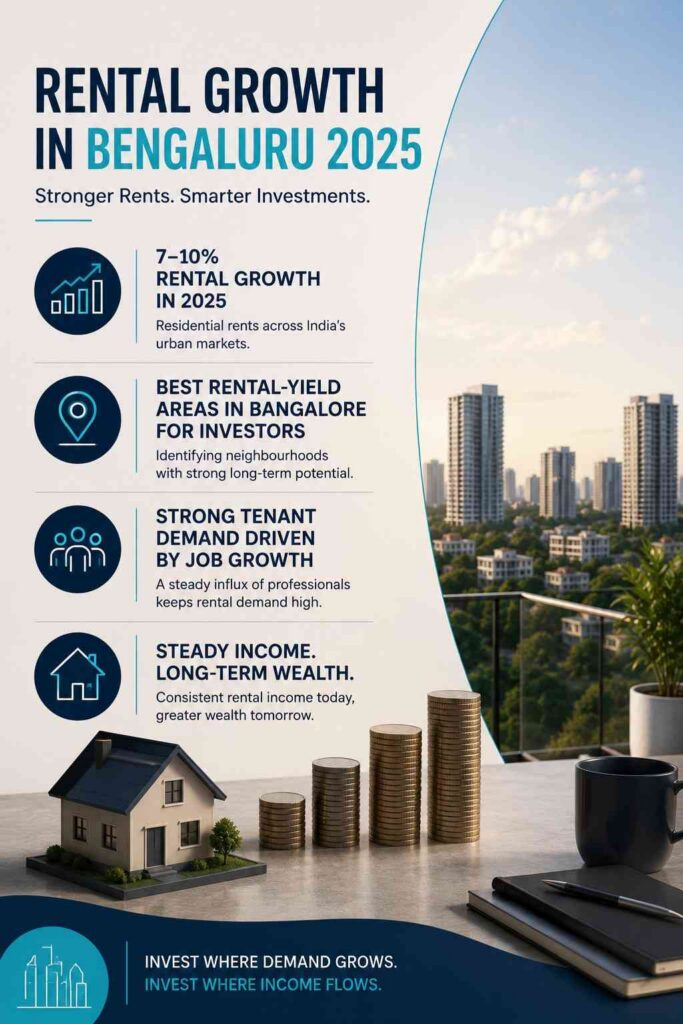
7–10% Rental Growth in Bengaluru 2025: Best Rental Yield Areas in Bangalore for Investors

Everyone Talks About Property Prices. Smart Investors Watch Rental Income.
When Bengaluru’s property market makes headlines, the spotlight usually falls on rising home prices, new project launches or billion-dollar infrastructure announcements. Rental income rarely receives the same attention.
Yet for many long-term investors, that’s where the real story begins.
A property doesn’t have to double in value overnight to become a successful investment. If it consistently attracts tenants, maintains healthy occupancy and generates increasing rental income year after year, it quietly builds wealth while the market goes about its business.
That shift in perspective has become especially relevant in 2026.
According to a Reuters poll of housing experts, residential rents across India’s urban markets are expected to grow by 7–10%, comfortably ahead of projected inflation. Employment-led cities such as Bengaluru are expected to remain among the strongest beneficiaries of this trend, supported by sustained demand from professionals, expanding commercial hubs and continued migration.
For anyone researching the best rental-yield areas in Bangalore 2026, this raises a more meaningful question than simply asking whether property prices will continue to rise.
Which parts of Bengaluru are most likely to keep attracting tenants over the next five years?
The answer lies not in a single project, but in understanding how the city itself is evolving.
The Investment Story Is Changing
For years, residential investing followed a familiar playbook.
Buy early.
Wait for prices to appreciate.
Sell at the right time.
While capital appreciation remains an important part of property investing, today’s market is rewarding a broader strategy.
More investors are beginning to value predictable monthly income alongside long-term price appreciation.
It’s a subtle shift, but an important one.
Steady rental income creates cash flow, cushions market fluctuations and reduces dependence on future resale values. In an environment where residential rents are projected to increase faster than inflation, that income becomes even more valuable over time.
The conversation is gradually shifting from “How much will this property be worth?” to “How well will this property perform while I own it?”
Rental Growth and Rental Yield: Why the Difference Matters
These two terms are often used interchangeably, but they measure different aspects of investment performance.
Rental yield reflects the annual rental income generated as a percentage of a property’s purchase price.
Rental growth measures how much the rental income increases over time.
Think of it this way.
A property purchased today may initially deliver a modest rental yield. However, if rents continue increasing every year because tenant demand remains strong, the investment becomes progressively more rewarding without requiring the owner to sell the asset.
That’s exactly why Bengaluru’s rental market deserves attention.
The headline isn’t unusually high rental yields.
The expectation is that rental income will continue to strengthen across well-connected residential markets.
Bengaluru Isn’t Experiencing One Rental Market. It’s Experiencing Many.
Looking at Bengaluru through a single city-wide average can be misleading.
The city’s rental performance is shaped by dozens of smaller markets, each influenced by different economic drivers.
Whitefield thrives because it combines a mature technology ecosystem with Metro connectivity and established social infrastructure.
North Bengaluru is evolving alongside airport expansion, commercial developments and large infrastructure projects.
Sarjapur Road continues to attract professionals because it offers access to multiple employment corridors rather than depending on a single business district.
Electronic City remains one of the city’s most resilient rental markets, supported by a large technology workforce and comparatively affordable housing options.
Each of these locations attracts different tenant profiles, budgets, and lifestyle preferences.
For investors, that’s an important reminder.
Buying property in Bengaluru isn’t a decision about the city.
It’s a decision about a specific neighbourhood within the city.
Why Rental Demand Keeps Returning
Marketing campaigns don’t drive rental demand.
It follows opportunity.
Every year, Bengaluru welcomes thousands of professionals joining technology companies, Global Capability Centres (GCCs), research organisations, healthcare institutions and multinational businesses.
Many relocate before they’re ready to purchase a home.
Renting becomes the natural first step.
This continuous movement of talent has helped Bengaluru develop one of India’s deepest residential rental markets.
Recent research from JLL and CBRE also points to sustained residential activity, healthy launch pipelines and continued commercial expansion, reinforcing confidence in the city’s long-term housing demand.
Simply put, cities that continue to create jobs usually continue to attract tenants.
Infrastructure Quietly Changes Investment Outcomes
Investors often celebrate infrastructure projects after they’re completed.
The market usually responds much earlier.
A new Metro corridor expands commuting options.
An upgraded road network shortens travel time.
A commercial district creates new employment.
Individually, these developments may appear unrelated.
Together, they influence where people choose to live, how long they stay and how much they’re willing to pay in rent.
That’s why some neighbourhoods continue strengthening even when the broader market becomes more measured.
Infrastructure doesn’t just improve a city.
It reshapes residential demand.
Finding the Right Property Is No Longer the Hard Part
Today’s investors have access to more information than ever before.
Project launches, brochures, online listings and marketing campaigns compete for attention every day.
The challenge isn’t finding investment opportunities.
It’s separating genuine long-term potential from short-term marketing.
That is where research has become a competitive advantage. Rather than relying solely on promotional material, investors increasingly compare neighbourhood trends, employment growth, infrastructure plans and builder credibility before making a decision. Platforms like Proppy support this process by helping buyers evaluate verified residential projects across Bengaluru using practical information that goes beyond brochures and advertisements. In a market where two neighbouring projects can deliver very different investment outcomes, informed comparison has become just as valuable as timing the purchase.
The Best Investment Isn’t Always the One With the Highest Rent
Imagine two apartments generating the same monthly rent today.
Five years from now, they may deliver completely different investment outcomes.
One property may have experienced multiple vacancy periods because new developments flooded the neighbourhood with similar options.
The other may have seen rents steadily increase because employers expanded nearby, infrastructure improved, and the locality continued to attract new residents.
That’s why experienced investors rarely evaluate rental income in isolation.
They look for the reasons behind it.
A neighbourhood that continues to attract people usually creates stronger rental demand than one that relies solely on lower prices.
The apartment may remain the same.
The surrounding ecosystem rarely does.
The Next Rental Hotspots May Not Be the Obvious Ones
Every investment cycle creates new winners.
Five years ago, conversations revolved around Whitefield and Electronic City. Today, those locations remain important, but investors are also paying closer attention to areas benefiting from new infrastructure, commercial expansion and changing work patterns.
Rather than asking “Which area offers the highest rent today?”, a better question is:
“Which area is becoming more attractive to tenants every year?”
Neighbourhoods connected by Metro expansion, employment corridors, and improved social infrastructure often experience stronger rental momentum because they solve everyday problems for tenants—shorter commutes, better schools, healthcare access, and lifestyle convenience.
Rental demand is built around daily life, not marketing campaigns.
The Hidden Cost That Investors Often Ignore
Property investors spend weeks negotiating the purchase price.
Surprisingly few calculate the cost of vacancy.
A property that remains vacant for two or three months between tenants can quietly reduce annual returns, even if it commands a higher monthly rent.
That’s why rental performance should never be measured only by the rent quoted in a property listing.
Questions worth asking include:
- How quickly are similar homes rented in this locality?
- Are employers continuing to hire nearby?
- Is new residential supply increasing faster than tenant demand?
- Does the neighbourhood attract families, professionals or both?
- Will upcoming infrastructure improvements or dilutants affect demand?
These questions often reveal more about future returns than the advertised rental figure.
Good Investments Usually Become Boring
There’s an interesting pattern in real estate.
The investments that make headlines aren’t always the ones that build wealth.
Properties that quietly attract reliable tenants, experience regular rent revisions and maintain low vacancy rates rarely create sensational news stories.
They perform consistently.
Long-term investors understand this.
Instead of chasing extraordinary returns, they often seek predictable income backed by stable demand.
In many ways, Bengaluru’s residential market reflects that philosophy.
A single industry, a single infrastructure project or a single buyer segment doesn’t drive it.
Its strength comes from a diversified economy that continues attracting businesses, professionals and students, creating multiple layers of housing demand. Recent market reports from JLL and CBRE continue to highlight Bengaluru’s resilience in both commercial and residential real estate, reinforcing confidence in the city’s long-term rental ecosystem.
Why Research Is Becoming More Valuable Than Timing
For years, investors debated whether it was better to buy immediately or wait for prices to correct.
That debate often misses a more important point.
Buying the wrong property at the right time is still the wrong investment.
Understanding a location’s long-term fundamentals—employment, infrastructure, builder credibility, future supply and tenant demand—usually has a greater impact than attempting to predict short-term market movements.
This is where technology is changing how people invest.
Instead of relying solely on advertisements or fragmented listings, investors increasingly compare verified data before making a decision. Platforms like Proppy make this process easier by bringing together verified residential projects, neighbourhood insights and builder information in one place, allowing buyers to evaluate opportunities using research rather than assumptions.
For today’s investor, information isn’t scarce.
Reliable information is.
Closing Thoughts
Every investment eventually comes down to one simple question:
Will people continue choosing this location tomorrow, just as they do today?
In Bengaluru, that answer is increasingly shaped by employment growth, infrastructure, connectivity and the quality of neighbourhoods, not just property prices.
The projected 7–10% rental growth expected across urban markets highlights an important shift. Investors are no longer relying solely on capital appreciation to generate returns. Steady rental income, supported by consistent tenant demand, is becoming an equally important part of the investment equation.
For those exploring the best rental-yield areas in Bangalore 2025, the opportunity lies in looking beyond headline numbers. Understanding why one neighbourhood consistently attracts tenants while another struggles often matters more than identifying the cheapest apartment or negotiating the lowest purchase price.
That’s where informed decision-making creates an advantage. By combining verified project information, neighbourhood comparisons and builder insights, Proppy enables investors to move beyond marketing claims and evaluate residential opportunities with greater confidence.
In Bangalore real estate, successful investing isn’t just about buying property in Bangalore. It’s about understanding the city behind it.
Frequently Asked Questions:
Among the most closely watched residential markets are Whitefield, North Bengaluru, Sarjapur Road, Hebbal and Electronic City. These locations continue to benefit from employment hubs, infrastructure improvements, and strong tenant demand.
Technology expansion, Global Capability Centres (GCCs), infrastructure development and continued migration of professionals have strengthened rental demand across multiple residential corridors, supporting projected rental growth of 7–10% in urban markets.
Rental yield measures annual rental income as a percentage of a property’s value. Rental growth measures how much rental income increases over time. Both are important, but they answer different investment questions.
Bengaluru continues to benefit from strong employment growth, infrastructure expansion and sustained housing demand, making it one of India’s most attractive residential markets for long-term investors. Individual investment decisions should always consider location, builder quality and financial goals.
No. Vacancy rates, tenant demand, future infrastructure, builder reputation and neighbourhood development all influence the overall performance of a rental investment.
Proppy helps buyers compare verified residential projects, evaluate neighbourhoods, assess builder credibility, and shortlist homes based on investment priorities, lifestyle needs, and long-term growth potential.
.
Disclaimer
This article is intended for informational purposes only and should not be considered financial, legal or investment advice. Rental growth, rental yields, and property performance vary by location, property type, market conditions, and individual circumstances. The analysis presented is based on publicly available industry research available at the time of writing. Readers should conduct independent due diligence and consult qualified professionals before making any investment decision.
Related Posts

Stranded Pre-Launches & EOI Schemes: Spotting Cash-Flow Red Flags Before You Pay
A pre-launch apartment can look like a smart bargain. The developer offers an early-bird price. The sales team says the...
Read More →
25,000 New Homes in 6 Months: Why Bengaluru Buyers Are More Confused Than Ever
Six months. More than 25,000 new homes. Hundreds of launches spread across Whitefield, Sarjapur Road, North Bengaluru, Electronic City, Devanahalli,...
Read More →
Devanahalli & Doddaballapura Road 2026: Bengaluru’s Next Planned Growth Frontier
Some Places Are Built for Today. Others Are Planned for Tomorrow. Most successful residential destinations become popular after demand arrives....
Read More →