
The Affordability Crisis: Why a ₹1 Crore Home No Longer Buys What It Used To in Bengaluru

When a ₹1 Crore Budget Starts Coming With Compromises
Ask someone who bought a home in Bengaluru five or six years ago what a ₹1 crore budget could get them, and the answer would probably sound very different from what buyers experience today.
Back then, that budget offered meaningful choice. Buyers could compare neighbourhoods, shortlist projects from reputable developers, and still expect to find a home that balanced space, connectivity, and long-term value.
Today, the conversation has changed.
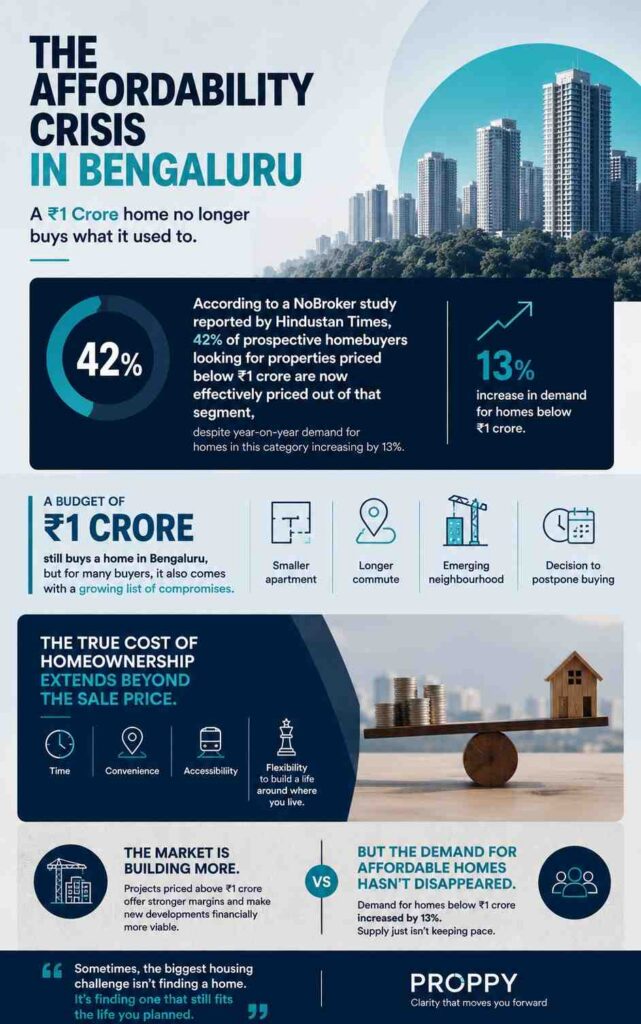
A budget of ₹1 crore still buys a home in Bengaluru, but for many buyers, it also comes with a growing list of compromises. A smaller apartment. A longer commute. An emerging neighbourhood instead of an established one. Or the difficult decision to postpone buying altogether.
The shift isn’t just anecdotal.
According to a NoBroker study reported by Hindustan Times, 42% of prospective homebuyers looking for properties priced below ₹1 crore are now effectively priced out of that segment, despite year-on-year demand for homes in this category increasing by 13%.
That’s what makes the Bangalore housing affordability crisis in 2026 different from previous market cycles. Demand hasn’t weakened. Affordability
The Story Behind the Numbers
At first glance, the data appears contradictory.
If more people are looking for sub-₹1 crore homes, why are fewer able to buy them?
The answer lies in a quiet shift that has been unfolding across Bengaluru’s residential market over the past few years.
As land values increased, construction costs rose, and financing became more expensive, developers gradually redirected their attention towards premium housing. Projects priced above ₹1 crore offered stronger margins and made new developments financially more viable.
From a developer’s perspective, the decision is understandable.
From a buyer’s perspective, it has narrowed the market considerably.
The result is a widening gap between what many households can afford and what the market is increasingly building.
This isn’t simply a pricing issue.
It’s a mismatch between supply and demand.
The Definition of ‘Affordable’ Is Changing
The word affordable means different things to different buyers.
For some, it represents a monthly EMI that fits comfortably within household income.
For others, it’s about buying without compromising future financial security.
In Bengaluru, however, affordability has begun to take on a different meaning.
It now reflects how many compromises a buyer must make before signing the agreement.
The apartment may become smaller.
The project may be further from the workplace.
The possession timeline may be longer.
Or the location may shift from a well-established neighbourhood to one that’s still developing.
None of these choices is necessarily wrong.
But together, they signal a market where affordability is increasingly measured by compromise rather than price alone.
Why This Matters Beyond Home Prices
Housing affordability is often discussed as though it’s only about money.
In reality, it influences something much broader.
Quality of life.
A home that’s ₹15 lakh cheaper but adds two hours of commuting every day isn’t automatically more affordable.
Neither is a property that fits today’s budget but lacks the infrastructure, schools or public transport a family depends on.
The true cost of homeownership extends beyond the sale price.
It includes time.
Convenience.
Accessibility.
And the flexibility to build a life around where you live.
That’s why the affordability conversation shouldn’t end with the question,
“Can I afford this home?”
It should continue with,
“Can I afford the life that comes with this location?”
Developers Didn’t Stop Building Affordable Homes Overnight
It’s tempting to assume developers have simply abandoned the middle-income buyer.
The reality is more nuanced.
The economics of residential development have changed.
Land acquisition costs have risen steadily across Bengaluru.
Construction materials remain expensive.
Labour costs have increased.
Regulatory compliance has become more complex.
Under these conditions, many developers have found it commercially safer to launch premium projects than to compete aggressively in the affordable segment.
That doesn’t mean demand for affordable housing has disappeared.
If anything, the opposite is true.
The 13% increase in demand for homes below ₹1 crore demonstrates that buyers are still actively looking.
The challenge is that supply is no longer keeping pace.
For Buyers, Information Has Become as Valuable as Budget
In a market where affordability is tightening, every decision carries greater consequences.
Choosing the wrong location or stretching beyond a comfortable budget can affect finances for years.
That’s changing how people approach home buying.
Instead of focusing only on advertised prices, buyers are increasingly comparing neighbourhood growth, future infrastructure, commute times, builder credibility and long-term liveability before making a decision.
This is where research becomes more valuable than guesswork.
Rather than simply browsing listings, many buyers now rely on platforms like Proppy to compare verified residential projects across Bengaluru, understand emerging locations and evaluate homes against both current budgets and future priorities. In a market where every rupee matters, making a well-informed decision can often create more value than negotiating a lower purchase price.
Sometimes, the Biggest Housing Challenge Isn’t Finding a Home
It’s finding one that still fits the life you planned. And that’s the question more Bengaluru families are quietly asking in 2026.
When Homebuyers Start Looking Beyond the City Centre
Every affordability challenge reshapes a city’s geography.
Bengaluru is no exception.
Five or six years ago, many buyers began their search in established neighbourhoods and expanded outward only if necessary. Today, that journey often works in reverse.
For a growing number of first-time buyers, emerging corridors are becoming the starting point rather than the alternative.
It’s not because these locations were always the first choice.
It’s because they now represent one of the few remaining opportunities to balance the budget with future growth.
Areas in North Bengaluru, Devanahalli, Hoskote, Budigere Cross, and parts of South-East Bengaluru are increasingly attracting buyers who would have previously focused on more established residential markets. Better infrastructure, planned commercial development and improved connectivity are gradually changing how these neighbourhoods are perceived.
Affordability, in other words, is slowly redrawing Bengaluru’s residential map.
The Biggest Compromise Isn’t the Apartment. It’s Time.
There is another cost that rarely appears in property advertisements.
Time.
Choosing a home 20 kilometres further away might reduce the purchase price, but it could also add hundreds of commuting hours every year.
For working professionals and young families, that trade-off can influence almost every aspect of daily life.
Longer travel times.
Less family time.
Higher transport costs.
Greater dependence on private vehicles.
These hidden costs rarely appear in a property’s brochure, yet they shape how people experience homeownership long after the purchase is complete.
That’s why affordability should never be measured only by the property’s price tag.
Sometimes the more affordable home leads to a more expensive lifestyle.
The Market Is Asking Buyers to Think Differently
For years, buyers approached the market with a simple question:
“Which home fits my budget?”
Today’s market demands a different mindset.
Questions like these have become far more valuable:
- Will this neighbourhood become better connected over the next five years?
- Are employment opportunities expanding nearby?
- Does the builder have a strong delivery record?
- Will schools, healthcare and retail keep pace with residential growth?
- Is this location likely to remain attractive once more projects are completed?
These aren’t just investment questions.
They’re quality-of-life questions.
The answers often determine whether a home continues to feel like a good decision long after possession.
Affordability Doesn’t Always Mean Buying the Cheapest Home
There’s a misconception that affordability is about finding the lowest possible price.
It isn’t.
Real affordability is about sustainability.
A slightly more expensive apartment in a well-connected neighbourhood may reduce commuting costs, improve rental demand and retain stronger resale value over time.
Meanwhile, a cheaper property in an isolated location may require greater long-term compromises despite its lower purchase price.
The smartest buyers rarely compare homes using price alone.
They compare values.
That’s becoming one of the defining characteristics of Bengaluru’s residential market in 2026.
Information Is Becoming a Buyer’s Greatest Advantage
The affordability gap has changed how people search for homes.
Instead of browsing hundreds of listings in hopes of discovering a bargain, buyers are spending more time understanding neighbourhoods, infrastructure projects, and builder credibility before making a decision.
This shift reflects a broader change in buyer behaviour.
Confidence now comes from research rather than urgency.
Buyer side real estate Platforms like Proppy are part of this evolution. Rather than overwhelming buyers with endless listings, Proppy enables them to compare verified residential projects, evaluate locations against their budget and understand long-term factors such as connectivity, infrastructure and builder reputation. When affordability is under pressure, making a well-informed decision becomes just as important as negotiating the purchase price.
Closing Perspective
A few years ago, a ₹1 crore budget represented an opportunity.
Today, it often represents a series of difficult choices.
That doesn’t mean homeownership in Bengaluru has become impossible.
It means buyers need to approach the market differently.
The 42% affordability gap isn’t simply a statistic; it reflects a broader shift in the city’s housing market. Demand for sub-₹1 crore homes remains strong, yet supply struggles to keep pace as developers increasingly focus on premium housing.
For today’s buyers, success isn’t about stretching the budget as far as possible.
It’s about making smarter decisions with the budget they already have.
Understanding neighbourhoods, evaluating long-term infrastructure, comparing builders and recognising future growth corridors are becoming more important than chasing the lowest advertised price.
As Bengaluru continues to expand, affordability will be shaped not only by what buyers can spend, but also by how well they understand the market. Platforms like Proppy help simplify that journey by bringing verified projects, location insights and builder information together, allowing buyers to make confident decisions in an increasingly complex housing landscape.
Buying a home isn’t just about finding a property.
It’s about finding a future that still fits your life.
Frequently Asked Questions
The Bangalore housing affordability crisis 2026 is being driven by rising property prices, increasing land and construction costs, and a reduction in the supply of homes priced below ₹1 crore, even as demand for this segment continues to grow.
According to the NoBroker study reported by Hindustan Times, 42% of prospective buyers looking for homes below ₹1 crore are now priced out, as prices have risen. At the same time, supply in this segment has become more limited.
Higher land acquisition costs, rising construction expenses and changing project economics have encouraged developers to focus on premium residential projects, where margins are generally stronger.
Emerging residential corridors across North Bengaluru, Devanahalli, Hoskote, Budigere Cross and parts of South-East Bengaluru continue to offer relatively better value than many established neighbourhoods. Buyers should evaluate connectivity, infrastructure and long-term growth before making a decision.
Beyond purchase price, buyers should consider commute times, builder credibility, future infrastructure, neighbourhood development and long-term affordability before selecting a home
Proppy helps buyers compare verified residential projects, evaluate builders, understand neighbourhood trends and shortlist homes that align with both their budget and long-term goals.
Related Posts

Stranded Pre-Launches & EOI Schemes: Spotting Cash-Flow Red Flags Before You Pay
A pre-launch apartment can look like a smart bargain. The developer offers an early-bird price. The sales team says the...
Read More →
25,000 New Homes in 6 Months: Why Bengaluru Buyers Are More Confused Than Ever
Six months. More than 25,000 new homes. Hundreds of launches spread across Whitefield, Sarjapur Road, North Bengaluru, Electronic City, Devanahalli,...
Read More →
Devanahalli & Doddaballapura Road 2026: Bengaluru’s Next Planned Growth Frontier
Some Places Are Built for Today. Others Are Planned for Tomorrow. Most successful residential destinations become popular after demand arrives....
Read More →