
The 57% Five-Year Surge: How Bengaluru Became India’s Hottest Housing Market

Five Years. One City. A Completely Different Housing Market.
Walk into any residential project in Bengaluru today, and you’ll notice something interesting. Buyers aren’t just asking about square footage, amenities, or possession dates anymore. They’re asking a much bigger question:
“Have I already missed the best time to invest?”
It’s an understandable concern.
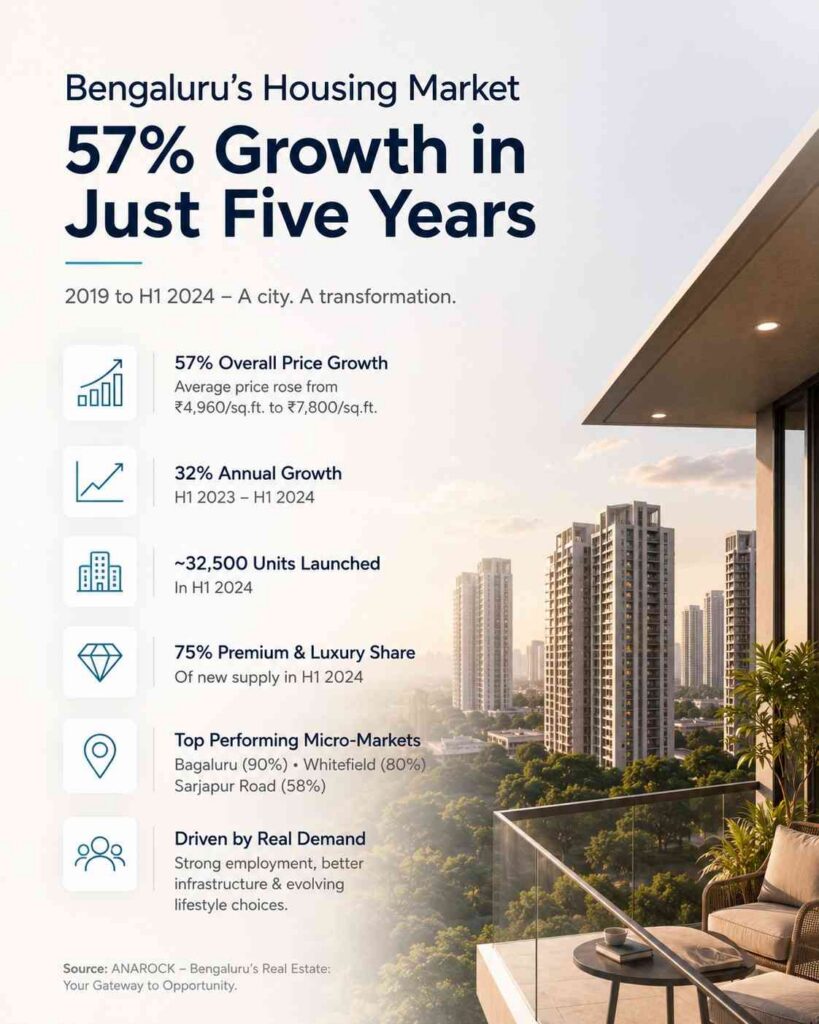
Five years ago, Bengaluru’s residential market looked very different. Average home prices hovered around ₹4,960 per sq. ft. By the first half of 2024, that figure had climbed to approximately ₹7,800 per sq. ft.; a remarkable 57% increase in just five years, according to ANAROCK Research.
That kind of appreciation naturally grabs attention. But numbers alone don’t explain what really happened.
The story of Bengaluru real estate prices over the past 5 years isn’t simply about rising property values. It’s about how one city successfully combined technology-driven employment, infrastructure investment, changing homebuyer aspirations, and economic resilience to become one of India’s most closely watched residential markets.
More importantly, it raises another question:
What lessons can today’s homebuyers learn from Bengaluru’s journey?
A Snapshot of Bengaluru’s Five-Year Transformation
Before we understand why prices climbed, let’s look at what actually changed.
| Average Residential Price | ₹4,960/sq. ft. | ₹7,800/sq. ft. |
| Overall Price Growth | — | 57% |
| Annual Price Growth (H1 2023–H1 2024) | — | 32% |
| Residential Launches (H1 2024) | — | ~32,500 units |
| Premium & Luxury Share of New Supply | — | 75% |
Source: ANAROCK – Bengaluru’s Real Estate: Your Gateway to Opportunity.
Looking at these figures together reveals something important.
This wasn’t a market where prices rose while supply remained stagnant. Developers continued launching new projects, but the nature of that supply changed dramatically. Premium and luxury homes increasingly dominated new launches, reflecting evolving buyer preferences rather than just rising costs.
The Bengaluru of 2019 Wasn’t the Bengaluru of 2024
To understand the Bengaluru property price growth, we need to go back to 2019.
Back then, the city was already India’s technology capital. Still, the residential market was recovering from a period marked by regulatory reforms, cautious buyer sentiment, and the lingering effects of demonetisation and GST implementation. Developers were becoming more selective, buyers were taking longer to make decisions, and price appreciation was relatively measured.
Then came the pandemic.
Initially, many expected housing demand to weaken. Instead, something unexpected happened.
Homes became more than places to live; they became workplaces, classrooms, and long-term lifestyle investments.
Professionals who had previously prioritised proximity to the office started looking for larger homes, dedicated workspaces, better ventilation, and community amenities. This shift reshaped demand across Bengaluru’s residential market.
At the same time, technology companies expanded hiring, Global Capability Centres (GCCs) accelerated their expansion, and Bengaluru continued to attract professionals from across the country. Demand returned faster than many industry observers had anticipated.
Price Growth Was Only Part of the Story
A 57% increase can sound dramatic in isolation.
But appreciation doesn’t happen because sellers decide to charge more.
Several structural changes happened simultaneously.
Employment Continued to Expand
Bengaluru strengthened its position as India’s leading technology and innovation hub.
Established IT companies, startups, multinational corporations, and GCCs continued creating employment opportunities, bringing a steady flow of professionals into the city. Unlike speculative markets, this translated into genuine housing demand from people planning to live and work in Bengaluru.
Infrastructure Began Catching Up
Large infrastructure projects gradually began to change how people viewed different parts of the city.
Metro expansion, improvements to airport connectivity, the Satellite Town Ring Road, the Peripheral Ring Road, and other transport initiatives have made several emerging neighbourhoods more attractive for residential development.
Areas once considered too far from employment centres became viable options for homebuyers seeking more space and better value.
Infrastructure didn’t just improve commuting; it expanded the city’s residential map.
Construction Costs Increased
Developers also faced rising input costs.
Steel, cement, labour, and logistics became more expensive after the pandemic, increasing construction costs across the industry.
While demand remained strong, these higher development costs also contributed to rising residential prices.
The Market Didn’t Become More Expensive Everywhere
One common misconception is that every part of Bengaluru is appreciated equally.
That’s not what happened.
Some locations significantly outperformed others because they benefited from stronger infrastructure, better employment connectivity, or sustained new supply.
ANAROCK’s research highlights how several Bengaluru micro-markets emerged as standout performers during this period.
For instance:
- Bagaluru recorded approximately 90% price appreciation, with average prices increasing from around ₹4,300 per sq. ft. in 2019 to ₹8,151 per sq. ft. by H1 2024.
- Whitefield witnessed nearly 80% appreciation, supported by Metro connectivity, IT parks, and premium residential launches.
- Sarjapur Road experienced around 58% growth, driven by technology corridors and continued residential development.
This reinforces an important lesson for buyers.
Choosing the right micro-market often matters more than simply choosing the right city.
Premium Housing Changed the Market’s Direction
The biggest shift over these five years wasn’t just price appreciation.
It was who developers started building for.
According to ANAROCK, nearly 75% of the approximately 32,500 homes launched in H1 2024 belonged to the premium and luxury segments.
That’s a significant departure from the market seen just a few years earlier.
Several factors contributed to this trend:
- Rising household incomes among technology professionals.
- Greater demand for larger homes after the pandemic.
- Increased interest from NRIs.
- Buyers are prioritising lifestyle amenities over minimum ticket prices.
- Developers are focusing on segments with stronger absorption and healthier margins.
Rather than building more homes, many developers started building different kinds of homes.
A City That Continued Attracting Businesses
Residential demand doesn’t grow in isolation.
It follows employment.
Between 2020 and 2024, Bengaluru continued to strengthen its position as one of India’s busiest office markets.
Office leasing remained robust, supported by technology firms, flexible workspace operators, and Global Capability Centres. Strong commercial activity reinforced confidence in the residential market because employment growth typically translates into sustained housing demand.
This relationship between commercial expansion and housing demand has been one of Bengaluru’s biggest competitive advantages over the past decade.
Where Does Proppy Fit Into This Story?
Looking back at the Bengaluru real estate price history over the past 5 years, one thing becomes clear: buying early wasn’t the only reason some homeowners benefited.
Many of the strongest returns came from choosing the right location, right project, and right stage of development.
For today’s buyers, that’s becoming increasingly challenging as Bengaluru offers thousands of residential options across established and emerging corridors.
Instead of spending weeks manually comparing projects, buyers can use platforms like Proppy to evaluate verified residential developments based on location, builder credibility, budget, and long-term investment potential. In a market where growth varies significantly between micro-markets, informed comparison is often more valuable than simply acting quickly.
Has Bengaluru Reached Its Peak?
Whenever a market witnesses sharp price appreciation, one question inevitably follows:
“Can prices keep rising at the same pace?”
The honest answer is probably not—and that’s perfectly normal.
Real estate doesn’t grow in a straight line. Markets typically move through phases of acceleration, consolidation, and renewed growth. A unique combination of post-pandemic demand, infrastructure expansion, and strong economic fundamentals shaped Bengaluru’s 57% appreciation over five years. While those conditions may not repeat in the same way, the factors supporting the city’s residential market remain firmly in place.
For buyers, that’s an important distinction.
The next opportunity may not come from buying any property in Bengaluru; it will come from identifying the right neighbourhoods, builders, and projects before they become fully mature.
The Next Growth Story May Be Hyperlocal
City-wide averages often dominate headlines, but they rarely tell the complete story.
Even during the last five years, different parts of Bengaluru delivered very different outcomes.
While the city recorded an average 57% price appreciation, some micro-markets performed far better.
| Bagaluru | 90% |
| Whitefield | 80% |
| Sarjapur Road | 58% |
Source: ANAROCK Research.
The reasons varied.
Bagaluru benefited from the airport growth corridor and fresh residential supply.
Whitefield gained momentum through Metro connectivity and the continued expansion of major IT campuses.
Sarjapur Road remained attractive because it connected employment hubs with established residential communities.
The takeaway is simple: city averages are useful, but investment outcomes are often determined at the micro-market level.
What Should Homebuyers Take Away from the Last Five Years?
Looking back, it’s easy to focus only on the appreciation numbers.
But there are several broader lessons hidden behind the data.
First, employment continues to shape housing demand.
Bengaluru’s technology ecosystem, startup culture, and Global Capability Centres have consistently attracted skilled professionals. Housing demand followed employment, not speculation.
Second, infrastructure changes how buyers value locations.
Metro expansion and improved connectivity have steadily reshaped residential preferences, creating opportunities in neighbourhoods that were once considered peripheral.
Third, buyers increasingly value quality over quantity.
Larger homes, integrated communities, lifestyle amenities, and reputed developers have become more important than simply finding the lowest price.
These trends are likely to influence the city’s housing market well beyond 2026.
Looking Ahead: Could the Next Five Years Look Different?
Probably. The market has matured.
Price appreciation may become more measured than it was immediately after the pandemic, but that doesn’t necessarily reduce Bengaluru’s investment appeal.
Instead, buyers may see a market characterised by:
- Continued demand from end-users.
- New infrastructure-led residential corridors.
- Greater emphasis on premium housing.
- More informed and research-driven purchase decisions.
- Wider project choices across established and emerging locations.
For investors, this means careful project selection becomes increasingly important.
For end-users, it means focusing on long-term liveability rather than short-term market timing.
Why Research Matters More Than Ever
Buying a home today isn’t simply about comparing prices.
It’s about understanding:
- Which neighbourhoods are benefiting from new infrastructure?
- Which builders have consistently delivered projects on time?
- Which locations still have room for appreciation?
- Which communities match your lifestyle and budget?
Finding answers requires far more than browsing property listings.
This is where Proppy fits naturally into the buying journey. By bringing together verified residential projects, builder information, and location-based comparisons, Proppy helps buyers narrow down meaningful options instead of getting overwhelmed by hundreds of listings. In a market as dynamic as Bengaluru, informed decision-making is often the biggest advantage a buyer can have.
Closing Thoughts
Five years ago, Bengaluru’s housing market was recovering from regulatory changes and cautious buyer sentiment. Few would have predicted that the city would go on to record a 57% increase in average residential prices, outperforming many of India’s largest real estate markets.
A single event didn’t drive the appreciation. It reflected a combination of employment growth, infrastructure investment, demand for premium housing, rising construction costs, and the city’s ability to attract talent from across the country. Together, these factors reshaped Bengaluru’s real estate price history over the past 5 years, making it one of the strongest growth stories in India’s residential sector.
For today’s buyers, the lesson isn’t to chase yesterday’s returns. It’s to understand where tomorrow’s opportunities may emerge. As Bengaluru continues to evolve, success will depend less on timing the market and more on choosing the right location, builder, and home.
That’s where informed research becomes invaluable. By helping buyers compare verified residential projects across Bengaluru, Proppy supports smarter, more confident home-buying decisions in an evolving market.
Frequently Asked Questions:
According to ANAROCK, average residential property prices in Bengaluru increased by approximately 57% between H1 2019 and H1 2024, rising from ₹4,960 per sq. ft. to ₹7,800 per sq. ft.
The growth was driven by strong housing demand, expansion of the technology sector, rising construction costs, premium housing launches, and major infrastructure projects across the city.
According to ANAROCK, Bagaluru, Whitefield, and Sarjapur Road were among the top-performing micro-markets between 2019 and H1 2024.
Bengaluru continues to benefit from strong employment growth, infrastructure development, and sustained end-user demand, making it one of India’s most resilient residential markets. Investment decisions, however, should always be based on individual financial goals and thorough project evaluation.
Proppy helps buyers discover verified residential projects, compare locations, evaluate builders, and shortlist homes that align with their budget, lifestyle preferences, and long-term investment objectives.
Related Posts

Stranded Pre-Launches & EOI Schemes: Spotting Cash-Flow Red Flags Before You Pay
A pre-launch apartment can look like a smart bargain. The developer offers an early-bird price. The sales team says the...
Read More →
25,000 New Homes in 6 Months: Why Bengaluru Buyers Are More Confused Than Ever
Six months. More than 25,000 new homes. Hundreds of launches spread across Whitefield, Sarjapur Road, North Bengaluru, Electronic City, Devanahalli,...
Read More →
Devanahalli & Doddaballapura Road 2026: Bengaluru’s Next Planned Growth Frontier
Some Places Are Built for Today. Others Are Planned for Tomorrow. Most successful residential destinations become popular after demand arrives....
Read More →