
North Bengaluru 2026: Why Yelahanka, Hennur & Hebbal Are Leading the City’s Next Growth Story
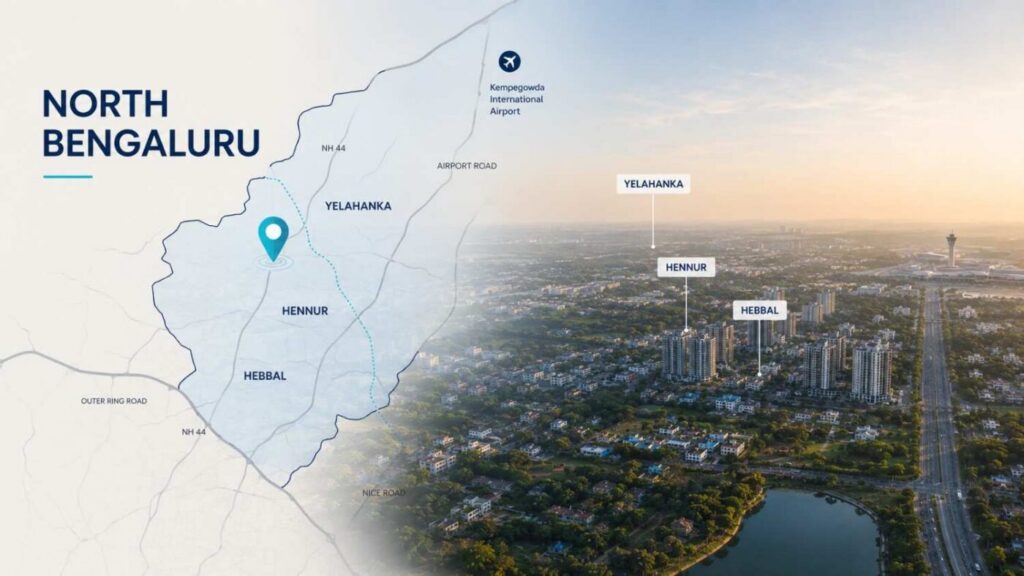
When a City’s Growth Changes Direction
Cities don’t expand evenly.
For years, Bengaluru’s residential growth followed a familiar map. Whitefield, Electronic City, and Sarjapur Road dominated conversations about new launches, infrastructure, and investment opportunities. Buyers looking for appreciation naturally looked east, while developers focused much of their attention on the city’s established technology corridors.
That map is beginning to change.
Today, North Bengaluru is no longer viewed simply as the road leading to Kempegowda International Airport. It has emerged as one of the city’s most active residential regions, attracting developers, homebuyers and long-term investors alike.
What’s particularly interesting isn’t that the region is growing.
It’s why it is growing.
Unlike many real estate hotspots that rely on one catalyst, North Bengaluru is benefiting from several independent growth drivers unfolding simultaneously: major infrastructure investments, expanding commercial activity, proximity to the airport, improving Metro connectivity, Global Capability Centres (GCCs), and large-scale residential developments. Together, these factors are reshaping how buyers view the northern part of the city.
For anyone exploring North Bangalore real estate investment in 2026, understanding this broader transformation is far more valuable than simply tracking property prices.
The real story isn’t about one neighbourhood.
It’s about an entire region finding its moment.
North Bengaluru Is No Longer Just the Way to the Airport
For a long time, North Bengaluru played a supporting role in the city’s growth story.
People travelled through it.
Few imagined it would become one of Bengaluru’s strongest residential markets.
That perception has changed dramatically over the last decade.
The opening of Kempegowda International Airport transformed the city’s geography. What was once considered distant gradually became strategically important. Businesses began recognising the advantages of locating closer to the airport, while developers anticipated long-term residential demand.
As commercial activity expanded, residential development naturally followed.
Townships replaced isolated apartment projects.
Integrated communities became more common.
Retail spaces, educational institutions and healthcare facilities expanded to serve a growing population.
Rather than developing around a single employment hub, North Bengaluru evolved into a network of interconnected residential corridors.
That distinction matters.
Successful property markets rarely grow because of one landmark.
They grow because everyday life becomes easier.
Why Investors Are Looking North
Real estate markets often experience short bursts of attention after a major infrastructure announcement.
North Bengaluru’s momentum feels different.
Its appeal has been building steadily through multiple layers of development.
The region benefits from the presence of major business parks, aerospace and technology companies, logistics hubs and an increasing number of Global Capability Centres. These employment drivers continue attracting professionals who prefer living closer to their workplaces, creating sustained demand for quality housing.
Infrastructure has strengthened that demand.
The expansion of the Namma Metro, ongoing road improvements, Peripheral Ring Road planning, Satellite Town Ring Road (STRR) connectivity and airport-related infrastructure are gradually improving accessibility across the northern corridor. While many of these projects are at different stages of completion, together they reinforce long-term confidence in the region’s growth.
Property markets respond differently when multiple growth factors converge.
Instead of reacting to a single announcement, buyers begin recognising a larger pattern.
North Bengaluru is increasingly reflecting that pattern.
Three Neighbourhoods. Three Different Stories.
One mistake buyers often make is treating North Bengaluru as a single market.
It isn’t.
Each major locality has developed its own identity, attracting different kinds of buyers and investors.
That’s precisely what makes the region more resilient.
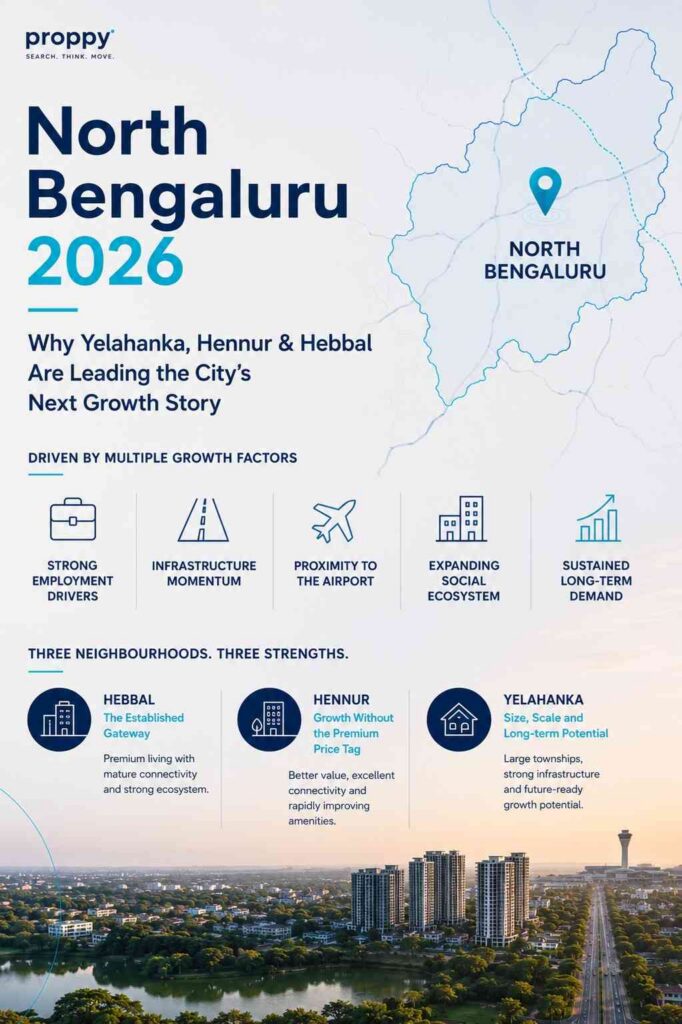
Rather than competing with one another, Hebbal, Hennur and Yelahanka complement different segments of the residential market.
Understanding those differences is often more valuable than comparing prices alone.
Hebbal: The Established Gateway
Hebbal has gradually become one of Bengaluru’s most recognised premium residential destinations.
Its strategic location, strong road connectivity, and proximity to major commercial districts have made it particularly attractive to professionals, senior executives, and investors seeking established neighbourhoods.
Unlike emerging suburbs where buyers often invest primarily for future appreciation, Hebbal attracts many homebuyers because of its mature ecosystem.
Schools.
Hospitals.
Retail destinations.
Business parks.
All of these contribute to a lifestyle that extends beyond residential projects themselves.
As a result, Hebbal continues commanding premium pricing while maintaining healthy end-user demand.
Its strength lies less in speculation and more in sustained desirability.
Hennur: Growth Without the Premium Price Tag
Every city has corridors that quietly gain momentum before entering mainstream conversations.
Hennur appears to be following that trajectory.
Positioned between established commercial hubs and emerging residential developments, Hennur has become attractive to buyers seeking better value while remaining well connected to North and East Bengaluru.
Over the past few years, the locality has witnessed an increase in residential launches, improved civic infrastructure, and expanding social amenities.
Families appreciate its evolving neighbourhood character.
Young professionals value its connectivity.
Investors recognise its long-term potential.
That combination has steadily strengthened residential demand.
Unlike mature premium markets, Hennur still offers buyers the opportunity to participate in a locality that continues evolving.
Yelahanka: Where Long-Term Planning Meets Residential Demand
Yelahanka’s growth has followed a different path.
Instead of rapid expansion, it has benefited from measured development supported by wide roads, educational institutions, defence establishments, green spaces and proximity to the airport corridor.
Its appeal extends across multiple buyer groups.
Families are drawn by established schools and comparatively organised urban planning.
Professionals appreciate improved connectivity.
Long-term investors view it as a balanced market where both infrastructure and liveability support residential demand.
That balance has helped Yelahanka maintain consistent buyer interest even as other parts of Bengaluru experienced more volatile growth cycles.
North Bengaluru Isn’t Replacing East Bengaluru
Perhaps the biggest misconception surrounding North Bengaluru is that it is competing with Whitefield or Sarjapur Road.
It isn’t.
The city’s growth isn’t shifting because one region has stopped performing.
It’s expanding because Bengaluru itself is becoming more economically diverse.
East Bengaluru continues to benefit from its established technology ecosystem.
North Bengaluru is growing through a different combination of aviation, technology, logistics, commercial development and infrastructure-led expansion.
Successful cities rarely rely on a single growth corridor.
They create multiple centres of opportunity.
That is exactly what Bengaluru is doing today. And that’s what makes North Bengaluru one of the most closely watched residential regions heading into 2026.
The Infrastructure Story Is Bigger Than One Metro Line
Infrastructure announcements often dominate real estate headlines.
A new Metro station.
A flyover.
A wider highway.
These projects undoubtedly improve connectivity, but they rarely transform a residential market on their own.
North Bengaluru presents a different story.
Here, multiple infrastructure projects are progressing in parallel, gradually strengthening the region’s appeal rather than relying on a single headline project.
The Namma Metro Blue Line, designed to connect Bengaluru city with Kempegowda International Airport, is expected to improve accessibility across several northern neighbourhoods. Alongside this, upgrades to Bellary Road (NH 44), the planned Satellite Town Ring Road (STRR), Peripheral Ring Road proposals and airport expansion projects are collectively reshaping mobility in the region.
Infrastructure creates value most effectively when it supports an existing ecosystem.
North Bengaluru is reaching that stage.
Commercial hubs are expanding.
Residential communities are growing.
Daily commuting is becoming easier.
Together, these changes strengthen long-term buyer confidence.
Employment Is Following Infrastructure
Real estate rarely succeeds without jobs.
No matter how attractive a residential project appears, sustainable demand depends on people choosing to live close to where they work.
That is one of North Bengaluru’s biggest advantages.
The region has witnessed increasing commercial activity across technology, aerospace, logistics, aviation, manufacturing and Global Capability Centres (GCCs). As businesses continue expanding towards the airport corridor, demand for nearby housing has naturally followed.
This shift is creating a different residential dynamic compared to the past.
Instead of travelling from one side of Bengaluru to another every day, many professionals now prefer living within easier reach of their workplaces.
The result is more than shorter commutes.
It creates neighbourhoods where people choose to stay for years rather than rent temporarily.
That’s a sign of a maturing residential market.
Who Is Buying in North Bengaluru?
One of the most noticeable changes over the past few years is the diversity of buyers entering the market.
North Bengaluru is no longer attracting just one type of purchaser.
Each buyer group arrives with different priorities.
Young professionals are looking for connectivity, convenience and homes close to employment hubs.
Families prioritise educational institutions, healthcare facilities, open spaces and established communities.
NRIs continue to show interest in larger township developments and branded residential projects, viewing the region as a long-term wealth-creation opportunity.
Investors, meanwhile, are increasingly evaluating the corridor not only for capital appreciation but also for future rental demand, supported by expanding employment centres.
When several buyer segments remain active simultaneously, residential markets generally become more resilient.
Demand is no longer dependent on a single source.
Growth Doesn’t Look the Same Across Every Locality
One reason North Bengaluru has become difficult to analyse is that each micro-market is evolving differently.
Hebbal continues strengthening its position as a premium residential destination where location and established infrastructure command higher values.
Hennur remains attractive for buyers seeking comparatively better affordability while benefiting from improving connectivity.
Yelahanka appeals to those prioritising long-term liveability, organised development, and steady appreciation over rapid price spikes.
Looking at these neighbourhoods through the same investment lens can lead to misleading conclusions.
Each represents a different stage of urban maturity.
That’s precisely why comparing projects solely on price often overlooks the bigger picture.
Successful property decisions usually begin with understanding the character of the neighbourhood before evaluating individual developments.
Why Research Matters More Than Ever
Buying property in a rapidly evolving region isn’t simply about identifying the fastest-growing location.
It’s about understanding why one neighbourhood is outperforming another.
Two residential projects may be separated by only a few kilometres.
Yet they can differ significantly in builder reputation, surrounding infrastructure, future supply, connectivity and long-term demand.
Those differences aren’t always obvious from brochures or advertisements.
That’s where research becomes valuable.
Rather than comparing projects solely on launch prices or promotional offers, many buyers now evaluate residential projects based on neighbourhood fundamentals, infrastructure timelines, builder credibility, and future growth indicators.
Platforms like Proppy support this research-driven approach by helping buyers compare verified residential developments across Hebbal, Hennur, Yelahanka and other Bengaluru micro-markets. Instead of relying solely on marketing materials, buyers can evaluate projects using data, location insights, and meaningful comparisons to support more informed decision-making.
North Bengaluru Is Becoming a Region, Not Just a Collection of Localities
Perhaps the most important change isn’t visible on a price chart.
It’s visible on a city map.
Earlier, buyers often evaluated Hebbal, Hennur and Yelahanka independently.
Today, many see them as part of one larger residential ecosystem.
Infrastructure connects them.
Employment supports them.
Commercial development complements them.
Residential demand flows across them.
That’s how successful urban regions evolve.
Not through isolated projects.
But through interconnected growth.
And North Bengaluru appears to be entering that phase.
The Bigger Lesson for Homebuyers
Every property market eventually reaches a point where short-term speculation gives way to long-term confidence.
North Bengaluru seems to be approaching that transition.
The conversation is becoming less about which locality will double first and more about which neighbourhood offers the strongest long-term fundamentals.
That shift matters.
Because sustainable residential markets aren’t built on excitement.
They’re built on employment, infrastructure, liveability and consistent demand.
Those are exactly the factors that continue shaping North Bengaluru’s growth story.
What North Bengaluru’s Growth Really Means for 2026 Buyers
Every successful property market reaches a point where buyers stop asking whether the location will grow.
Instead, they begin asking whether the growth is sustainable.
That is where North Bengaluru stands today.
Its appeal is no longer based on future promises alone.
The region already has expanding employment hubs, improving infrastructure, established social amenities, and a residential market that continues to attract diverse buyer segments.
Could prices continue appreciating?
Possibly.
Will every project deliver the same returns?
Probably not.
That’s why the conversation is gradually shifting away from timing the market and towards choosing the right neighbourhood and the right project.
For homebuyers, this is an important change.
Strong real estate decisions aren’t built on chasing the next hotspot.
They’re built on understanding what keeps people choosing a location year after year.
North Bengaluru is increasingly demonstrating those qualities.
The Future May Belong to Regions, Not Individual Localities
Real estate discussions often revolve around individual neighbourhoods.
Hebbal.
Hennur.
Yelahanka.
Yet the larger story unfolding is about the emergence of an integrated residential region.
As connectivity improves, the boundaries between these micro-markets become less significant.
A professional working near Hebbal may choose to live in Hennur.
A family looking for larger homes may prefer Yelahanka.
An investor may compare projects across all three before making a decision.
Increasingly, buyers aren’t evaluating one locality in isolation.
They’re evaluating the strength of the entire North Bengaluru corridor.
That’s an important shift because regional ecosystems tend to create more resilient property markets than isolated pockets of development.
The Next Phase of Bengaluru’s Growth
Every decade, Bengaluru develops a new growth story.
The central business district once defined the city.
Then came Electronic City.
Whitefield followed.
Sarjapur Road emerged as another residential powerhouse.
North Bengaluru now appears to be writing the next chapter, not by replacing these locations, but by complementing them.
Its growth is supported by multiple economic drivers rather than a single industry, making the region increasingly attractive for professionals, families, NRIs and long-term investors.
Whether that momentum continues will depend on how infrastructure projects progress, how commercial activity expands, and how residential development keeps pace with demand.
The fundamentals, however, suggest that North Bengaluru is no longer an emerging market waiting for attention.
It has already become one of Bengaluru’s defining residential regions.
Looking Beyond Price
One of the biggest mistakes buyers make is assuming that the best investment is always the one with the lowest entry price.
In reality, long-term value comes from a combination of factors.
Employment opportunities.
Connectivity.
Quality infrastructure.
Builder credibility.
Neighbourhood development.
Lifestyle.
Future supply.
Evaluating these together often leads to stronger decisions than focusing only on today’s price per square foot.
That’s why research has become an essential part of the home-buying journey.
Platforms like Proppy help buyers compare verified North Bangalore real estate investment opportunities for 2026 across different micro-markets, understand neighbourhood fundamentals, and shortlist projects based on reliable data rather than promotional messaging. In a rapidly evolving region like North Bengaluru, informed comparisons often make a greater difference than simply entering the market early.
Final Perspective
North Bengaluru’s transformation isn’t the result of one Metro line, one township or one successful developer.
It’s the outcome of several independent forces moving in the same direction.
Infrastructure is improving.
Employment is expanding.
Residential communities are maturing.
Social infrastructure is catching up.
When these trends converge, they create something larger than appreciation.
They create confidence.
For buyers exploring North Bangalore real estate investment in 2026, the real opportunity lies not in predicting which project will appreciate the fastest, but in understanding why this region continues to attract people who want to build their lives here.
Because successful neighbourhoods aren’t remembered for the promises they made.
They’re remembered for the lives they helped build.
Frequently Asked Questions:
North Bengaluru benefits from a combination of expanding commercial activity, proximity to Kempegowda International Airport, improving Metro connectivity, major road infrastructure and growing residential development. Together, these factors have strengthened long-term demand.
Some of the most sought-after residential micro-markets include Hebbal, Yelahanka, Hennur, Thanisandra, Jakkur and Bagalur, each catering to different buyer preferences and investment goals.
Many buyers consider North Bengaluru attractive because of its diversified employment base, improving infrastructure, growing rental demand and continued residential expansion. Investment decisions should always be based on project quality, location and personal financial objectives.
Each locality serves a different purpose.
Hebbal offers a mature, premium residential market.
Hennur appeals to buyers seeking growth potential and comparatively better value.
Yelahanka is known for planned development, liveability and long-term stability.
The right choice depends on individual priorities, not on one location being universally better
Buyers should evaluate a builder’s reputation, connectivity, surrounding infrastructure, social amenities, future supply, rental demand, neighbourhood development, and long-term liveability rather than relying solely on property prices.
Proppy enables buyers to compare verified residential projects across Bengaluru, analyse neighbourhood trends, evaluate builders and make informed decisions using research-backed market insights.
Disclaimer
This article is intended for informational purposes only and should not be considered financial, legal or investment advice. Real estate performance varies by project, builder, market conditions and infrastructure timelines. The analysis is based on publicly available industry reports and market insights available at the time of writing. Readers are encouraged to verify project details independently and consult qualified real estate professionals before making any investment decision.
Related Posts
25,000 New Homes in 6 Months: Why Bengaluru Buyers Are More Confused Than Ever
Six months. More than 25,000 new homes. Hundreds of launches spread across Whitefield, Sarjapur Road, North Bengaluru, Electronic City, Devanahalli,...
Read More →
Devanahalli & Doddaballapura Road 2026: Bengaluru’s Next Planned Growth Frontier
Some Places Are Built for Today. Others Are Planned for Tomorrow. Most successful residential destinations become popular after demand arrives....
Read More →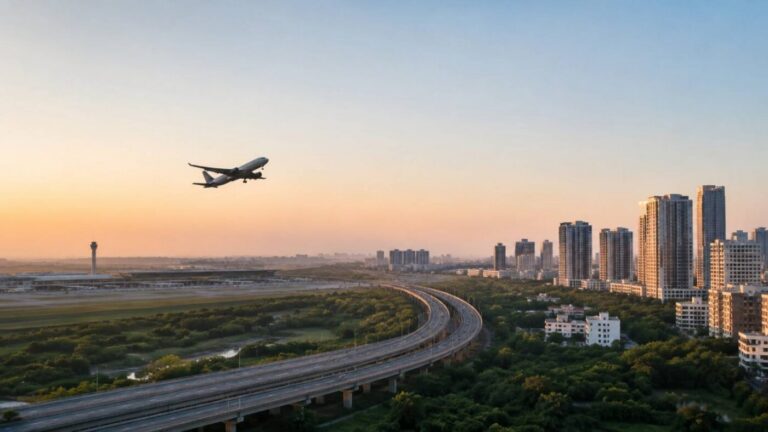
Airport Corridor 2026: Why Bengaluru’s Fastest-Growing Micro-Markets Are Outpacing the City
When an Airport Stops Being Just an Airport Most infrastructure projects make commuting easier. Airports do something much bigger. They...
Read More →