
Between 2020 and 2025, Bangalore’s real estate story has not followed a single straight line. Instead, it has been fragmented, hyper-local, and profoundly shaped by micro-market behaviour. While headline reports often speak broadly about “Bangalore real estate growth,” the on-ground reality tells a more nuanced story — one where property appreciation in Bangalore varies sharply between neighbourhoods, sometimes even within the same corridor.
This is exactly why understanding micro-markets matters.
At Proppy, we closely track how individual pockets evolve — not just through price charts, but through live supply, buyer intent, infrastructure progress, and absorption behaviour. This blog explores how Bangalore’s key micro-markets performed between 2020 and 2025, why certain areas outpaced others, and what these patterns reveal about future market trends.
Why Micro-Markets Matter More Than Ever
Post-2020, blanket assumptions stopped working.
Two apartments with similar specifications but located 8–10 kilometres apart could show very different appreciation outcomes by 2025. Several factors drove this divergence:
- Work-from-home flexibility
- Infrastructure delivery timelines
- Access to employment hubs
- Liveability and social infrastructure
As a result, Bangalore micro-market appreciation became far more relevant than city-wide averages.
2020–2021: The Pause That Reset the Market
The pandemic years introduced uncertainty. Transaction volumes slowed, new launches were delayed, and buyers adopted a cautious approach. However, contrary to widespread fears, prices did not collapse across Bangalore.
In fact, several established residential micro-markets demonstrated price stability.
Areas with:
- Mature IT ecosystems
- Completed infrastructure
- Strong rental demand
Held firm even during reduced activity. This period quietly built the base for the appreciation that followed.
Whitefield: From Volatility to Stability
Whitefield entered 2020 with concerns around oversupply. Yet, between 2021 and 2025, its trajectory changed meaningfully.
Key drivers included:
- Completion of the Purple Line metro
- Improved road connectivity
- A fully developed social ecosystem
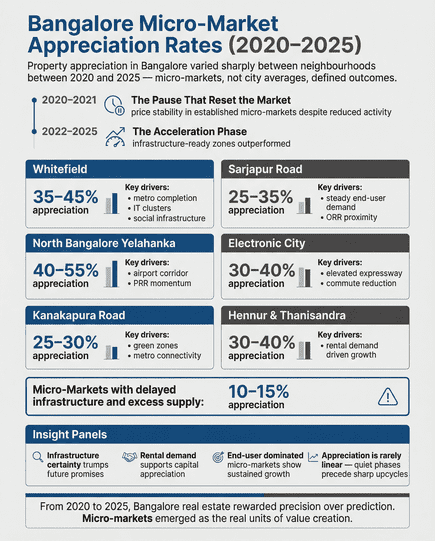
Between 2020 and 2025, Whitefield recorded property appreciation in Bangalore of approximately 35–45%, depending on proximity to metro stations and IT clusters.
Homes closer to ITPL, Hope Farm, and operational metro nodes outperformed those in peripheral stretches, reinforcing a clear market trend: infrastructure certainty trumps future promises.
Sarjapur Road: Steady and Reliable Growth
Sarjapur Road did not witness explosive price spikes — and that consistency worked in its favour.
Supported by:
- Proximity to ORR tech corridors
- Strong mid-income end-user demand
- A dense school ecosystem
Sarjapur Road achieved 25–35% appreciation between 2020 and 2025.
This micro-market reflects a dependable, long-term property investment zone in Bangalore — resilient rather than speculative.
North Bangalore: Infrastructure-Led Acceleration
North Bangalore stands out as one of the clearest examples of infrastructure-driven appreciation.
Between 2020 and 2025, locations around:
- Hebbal
- Yelahanka
- Devanahalli
Benefited from:
- Airport-centric development
- Peripheral Ring Road momentum
- Growth of logistics and business parks
Select residential projects recorded 40–55% appreciation, transitioning from speculative interest to genuine end-user demand. This aligns with evolving real estate market trends in Bangalore, where employment nodes are no longer limited to traditional IT corridors.
Electronic City: The Quiet Comeback
Once considered “too far,” Electronic City experienced a notable turnaround post-2020.
With:
- The elevated expressway
- Reduced commute times
- Integrated township developments
Electronic City saw a 30–40% appreciation between 2020 and 2025.
Value pricing during the downturn attracted first-time buyers and long-term investors, setting the stage for recovery-led growth.
Kanakapura Road: Lifestyle-Driven Appreciation
Kanakapura Road evolved as a lifestyle-oriented micro-market rather than a purely employment-driven one.
Buyer priorities here included:
- Lower-density living
- Green surroundings
- Metro connectivity via the Green Line
Between 2020 and 2025, prices appreciated by 25–30%, with plotted developments outperforming apartments. This shift reflects a broader market trend where quality of life increasingly influences buyer decisions.
Hennur & Thanisandra: Rental Demand as a Growth Anchor
Micro-markets like Hennur and Thanisandra benefited significantly from sustained rental demand.
Proximity to:
- Manyata Tech Park
- ORR
- Airport-bound corridors
Ensured steady tenant absorption.
Between 2020 and 2025, these pockets recorded 30–40% property appreciation in Bangalore, particularly in well-managed gated communities.
Why Some Areas Underperformed
Not all micro-markets kept pace.
Areas affected by:
- Delayed infrastructure execution
- Weak civic planning
- Excess speculative supply
Saw muted appreciation of 10–15% over five years.
This highlights an important reality: location branding does not always translate into investment performance.
2022–2025: The Acceleration Phase
From late 2022 onwards, Bangalore entered a clear upcycle.
Key drivers included:
- Revival in IT hiring
- Improved buyer confidence
- Stable lending conditions
This phase disproportionately benefited micro-markets with strong fundamentals. At Proppy, data clearly showed divergence — even within the same pin code, not all listings appreciated equally.
Micro-Market Appreciation vs Rental Yield
An often-overlooked factor in property appreciation in Bangalore is rental behaviour.
Between 2020 and 2025, micro-markets with:
- Low vacancy cycles
- Consistent tenant demand
- Faster re-leasing timelines
Also demonstrated stronger capital appreciation.
Rental stability reduced distress selling and supported price resilience during uncertain phases. This confirms a subtle but powerful market trend: rental health often precedes capital growth.
Buyer Profile and Its Impact on Appreciation
The buyer mix changed significantly during this period.
- 2020–2021: End-users dominated
- 2022 onwards: End-users and long-term investors
- Speculative investors: Reduced
Micro-markets with higher end-user participation experienced greater organic, sustained appreciation. Family-oriented zones like Sarjapur Road, Kanakapura Road, and Yelahanka benefited from this stability.
Infrastructure Timing vs Announcement Cycles
One clear takeaway from 2020–2025 is that execution matters more than announcements.
Areas with delivered infrastructure — not just planned — saw tangible price movement. Metro-ready corridors consistently outperformed corridors awaiting approvals.
At Proppy, infrastructure delivery history is a key filter in evaluating micro-market potential, as appreciation follows execution, not intent.
Supply Saturation and Its Impact
Unchecked supply emerged as a silent limiter of appreciation.
Micro-markets with:
- High launch density
- Similar product configurations
- Limited differentiation
Struggled to push prices upward despite the broader market recovery.
Scarcity remains a core driver of property appreciation in Bangalore, especially in low-density residential areas.
Lifestyle Repricing Post-2020
Post-pandemic, lifestyle began influencing pricing in measurable ways.
Buyers increasingly valued:
- Open spaces
- Walkability
- Community planning
- Proximity to schools and healthcare
This led to a repricing of previously overlooked micro-markets, reinforcing a long-term market trend shaping buyer behaviour.
Appreciation Is Rarely Linear
Between 2020 and 2025, appreciation occurred in phases.
Many micro-markets remained flat for extended periods before experiencing sharp upward movement once demand thresholds were crossed. Buyers who entered during the quiet phases benefited the most during the recovery.
What This Means for Buyers in 2025
For buyers today, the lessons are clear:
- Micro-markets outperform macro assumptions
- Infrastructure certainty outweighs speculation
- Rental demand supports appreciation
- Supply discipline matters
Instead of asking “Which area is booming?”, a better question is:
Which micro-market is structurally improving but not overheated?
Proppy’s Micro-Market Approach
At Proppy, Bangalore is not treated as one market.
We analyse:
- Historical price movement
- Live inventory stress
- Buyer demand signals
- Rental absorption patterns
This micro-level approach helps buyers navigate real market trends with clarity and confidence.
Final Perspective
From 2020 to 2025, Bangalore real estate rewarded precision over prediction.
Micro-markets emerged as the actual units of value creation. Buyers who understood this shift navigated the cycle more effectively, avoiding hype-driven decisions.
As Bangalore continues to evolve, property appreciation will remain uneven — and that unevenness creates opportunities for informed buyers. With the correct data, timing, and micro-market lens, long-term value is still very much achievable — and that’s precisely where Proppy fits in.
Frequently Asked Questions
A micro-market refers to a specific residential pocket or corridor within the city that shares similar infrastructure access, buyer profile, price behaviour, and demand patterns. In Bangalore, micro-markets often perform very differently from one another, which is why analysing them individually is crucial when evaluating property appreciation in Bangalore
Appreciation varies based on multiple local factors such as infrastructure execution, proximity to employment hubs, rental demand, supply levels, and liveability. Even small differences in connectivity or social infrastructure can significantly impact long-term value and broader market trends.
No. The appreciation ranges mentioned are indicative and based on historical observations. Actual returns depend on several variables including project quality, purchase timing, market cycles, and individual property characteristics
Micro-markets with strong end-user demand and completed infrastructure—such as Sarjapur Road, parts of Whitefield, and select North Bangalore pockets—demonstrated relatively stable and consistent growth during this period.
Rental demand plays a critical role. Micro-markets with healthy rental absorption often experience better price stability and long-term appreciation, as steady tenant demand reduces distress selling and supports overall market confidence.
Yes. Work-from-home flexibility changed buyer preferences, increasing demand in areas offering better living environments, open spaces, and social infrastructure. This shift influenced appreciation patterns and reshaped several real estate market trends in Bangalore
Metro connectivity is a strong driver but not the only one. Appreciation is highest when metro access is combined with employment hubs, established neighbourhoods, and quality residential supply. Announced projects matter less than operational connectivity.
First-time buyers should focus on micro-markets with stable demand, good social infrastructure, and realistic price entry points. Analysing micro-market trends helps avoid overpaying in overheated zones
Yes, but only where infrastructure execution is visible and demand is end-user driven. Peripheral areas with speculative supply and delayed projects may show slower appreciation despite future announcements
Proppy analyses micro-level data such as price movement, inventory stress, rental demand, and infrastructure progress to help buyers make informed decisions based on real market trends rather than broad assumptions.
Last modified: January 17, 2026


[…] the Bangalore real estate micro market ground-level analysis for a detail […]