
Bangalore’s real estate market is unique. It’s emotional, data-driven, and unpredictable all at once. On one side, you have homebuyers trying to secure a home that feels right. On the other hand, you have sellers and developers trying to maximise returns in a city where demand hasn’t slowed down in a decade. This dynamic makes property negotiation an art — not just a transaction.
In 2025, Bengaluru has seen rapid price adjustments, new infrastructure, and inventory absorption across East and North Bangalore. If you’re entering the market now, relying solely on luck won’t be enough. You need strategy, timing, behavioural understanding, and clarity on local micro-markets. Over the past few years, Proppy has observed thousands of buyer-seller interactions across Whitefield, Sarjapur Road, Outer Ring Road (ORR), Kanakapura Road, Yelahanka and Hebbal — and the patterns repeat consistently.
Below are negotiation strategies that work reliably in Bengaluru’s market today. These insights blend real buyer behaviour, market psychology, and practical Bangalore real estate tips that actually move numbers.
1. Understand Your Micro-Market Before Negotiating
The biggest mistake buyers make? Negotiating blindly, without knowing the actual price behaviour of that locality. Bangalore cannot be negotiated as one single market. Whitefield behaves differently from Electronic City. Kanakapura Road acts differently from Yelahanka. And within each area, projects behave differently depending on demand and the inventory cycle.
Before you negotiate, understand:
- Current launch prices in comparable projects
- Recent resale transactions
- Supply and ready-unit availability
- Builder reputation and liquidity
- Rental demand in that specific micro-zone
- Upcoming infra (like metro extensions)
Knowing these gives you leverage. It transforms your approach from “Can I get a discount?” to
“Here’s why this pricing should be reconsidered.”
This is where property price trends in Bangalore, Bangalore micro-market research, and real estate due diligence form the foundation for your negotiation.
2. Use Timing to Your Advantage (It Matters More Than You Think)
In Bengaluru, timing can swing negotiations by 2–10%. Developers and individual sellers both behave differently at:
- Quarter-end
- Year-end
- Festive periods (Dussehra, Diwali, Ugadi)
- Financial year closing
- Launch phase vs near-completion phase
If you visit a project in the last 10 days of a quarter, you might find a visibly different tone from the sales team. Targets matter—cash flow matters. Pressure creates opportunity.
This is a classic real estate negotiation strategy that most buyers ignore.
Proppy’s analysis across multiple builder interactions shows that discounts are easiest in:
- First 10% inventory of a new launch (early-bird buyers)
- Last 10% unsold inventory (builder wants to close the project cycle)
- Units with vastu deviations
- Lower floors / higher floors, depending on project trends
Knowing this timing gives you natural leverage without sounding like a “discount-seeking buyer.”
3. Always Anchor the Conversation First
Anchoring is one of the strongest psychological tools in property negotiation.
If you let the seller or salesperson anchor first, the rest of the negotiation revolves around their number.
If you anchor first (strategically, not aggressively), you define the tone and range.
Here’s a subtle and effective way of anchoring in Bangalore:
“I’ve seen recent transactions in this locality close at around X. I’m comfortable working around that bracket if the terms make sense.”
This is powerful because:
- It’s not confrontational
- It uses data
- It shows you’re serious
- It sets the range
- It prevents inflated counter-anchors
Anchoring well can reduce the final price by 3–5% in strong-demand areas and even 7–10% in moderately-demand areas.
4. Don’t Negotiate on the Asking Price Alone — Break Down the Components
Buyers often make the mistake of saying:
“Give me a discount.”
Smart negotiators break down the deal into components such as:
- Base price
- Floor rise
- PLC charges
- Car parking cost
- Maintenance deposits
- Legal charges
- Clubhouse charges
- Possession-linked costs
This gives you multiple negotiation windows rather than a single rigid number.
For example:
You may not get ₹300 per sq ft off the base price, but you may get:
- ₹100 off floor rise
- Waiver of the clubhouse fee
- Reduced maintenance deposit
- Flexible payment plan
- Free upgrades (modular kitchen, wardrobes, grill, geysers)
This reduces your effective cost without the builder losing face by dropping the “headline price.”
This is one of the most effective Bangalore homebuyer negotiation tactics today.
5. Show That You’re a Serious Buyer (This Always Works)
The fastest way to lose negotiation power is to look unsure.
The fastest way to gain it is to show:
- You are financially ready
- You have clarity
- You have a timeline
- You know what you want
- You are evaluating alternatives
Serious buyers get respect. Uncertain buyers get ignored.
The most potent line in real estate negotiation?
“If the numbers make sense today, I’m willing to close the discussion.”
This sentence shifts the dynamic instantly.
It tells the seller/developer you’re not window-shopping.
This is why buyers following Bangalore real estate tips often secure better rates than casual walk-ins.
6. Use Comparative Market Data (But Use It Correctly)
There are two ways to use market data in negotiation:
Wrong way:
“Your price is too high; the builder next door is cheaper.”
Right way:
“I’ve evaluated three properties within 1–1.5 km. The pricing range is between X and Y. I’m comfortable if we can be in that competitive bracket, considering the amenities here.”
This is:
- Respectful
- Factual
- Non-combative
- Shows knowledge
- Leaves room for agreement
- Encourages the seller to “match the market,” not “give a discount”
Proppy consistently sees Bangalore buyers close deals faster using the second approach.
7. Know the Seller’s Motivation Before Negotiating
Every seller has a reason to sell. Understand it.
Developers may be seeking:
- Cash flow for the next project
- Target closure
- Inventory liquidation
- Near-possession payment collection
Individual sellers may want:
- Urgent liquidity
- To shift cities/jobs
- To move to a bigger home
- To exit an older project
When you identify the seller’s motivation, you identify negotiation leverage.
A seller in a hurry will negotiate 2–3X more than one who is casually selling.
This is a classic Home buyer psychology strategy that works exceptionally well in the Bengaluru market.
8. Negotiate as a Human, Not a Calculator
Real estate negotiation in Bangalore often succeeds when the buyer is respectful and relationship-driven.
Avoid aggressive statements like:
- “This price is ridiculous.”
- “No one will buy at this rate.”
- “Reduce it, or I walk away.”
Real estate is emotional. Sellers respond to trust, not confrontation.
Use lines like:
“I really like the home. If we can find a middle ground that works for both of us, I’d like to move forward.”
It sounds simple, but it opens doors — especially in individual resale negotiations.
9. Use Walk-Away Power (But Only If You Mean It)
Walk-away power is a strong tool in property negotiation, but it must be used carefully.
If you bluff, you lose credibility.
If you mean it, you gain leverage.
The right way to frame it:
“This is my best workable number. If it fits within your expectations, I’d love to take this ahead today.”
This shows firmness without disrespect.
Sometimes sellers come back within 24–48 hours with an improved offer — especially if they were uncertain earlier.
10. Negotiate Beyond Price — Focus on Total Value
Often, you can gain more value by negotiating:
- Payment plan flexibility
- Waivers on one-time charges
- Added amenities
- Interior upgrades
- Early possession benefits
- Parking adjustments
- Extra storage/utility space
- Home automation upgrades
Many builders are more willing to modify terms than drop the base price.
This is one of those advanced Bangalore real estate tips rarely discussed publicly.
11. Know When Not to Negotiate
Yes, sometimes not negotiating wins.
Examples:
- A project that is selling out extremely fast
- A builder with high brand value (Prestige, Sobha, Brigade, Purva)
- A unit that is rare (corner, park-facing, top-floor, premium view)
- A locality with extremely tight supply (Hennur, JP Nagar, certain parts of ORR)
In these cases, negotiation can make you lose the unit altogether.
The right approach is to negotiate on terms or add-ons — not on price.
12. Document Everything and Avoid Verbal Promises
Whatever you negotiate — discounts, waivers, modifications, upgrades —
Get it in writing.
Bangalore’s real estate ecosystem is large. Sales teams change. Channels change. CRM teams miscommunicate.
Written confirmation protects you.
This forms part of the property legal checklist, homebuyer documentation tips, and real estate due diligence steps in Bangalore. Check How to verify property documents while buying a home in bangalore
13. Use the “Silence Technique” (It Works Surprisingly Well)
When you quote your expected number, stay silent.
Don’t over-explain.
Don’t defend.
Don’t justify.
Silence forces the other person to respond.
Negotiation specialists consider silence one of the strongest tools in real estate price negotiation.
14. Keep Emotions Stable — Sellers Respect Control
If you appear too excited about a property, negotiations weaken.
Maintain a balanced tone:
“I like the home, but the numbers need alignment.”
It shows interest, not desperation.
This emotional balance makes your property negotiation more strategic and less reactive.
Final Thoughts: Negotiating Smart in Bangalore’s 2025 Market
Negotiation is a combination of data, psychology, timing, and tone. In Bengaluru — where appetite for residential property remains strong — you cannot negotiate using outdated or aggressive methods.
Buyers who win negotiations generally have three things:
- Market understanding
- Clear financial readiness
- A calm and structured negotiation approach
Whether you’re buying in Whitefield, Sarjapur Road, Yelahanka, Electronic City, Kanakapura Road or Hebbal, the strategies above are practical and time-tested.
Approach the seller respectfully. Use data where needed.
Negotiate on value, not just price. Know when to walk away and when to close. And always remember — the proper negotiation doesn’t make the seller “lose.” It helps both parties move forward with clarity and confidence. If you are looking to buy property in Bangalore, Proppy AI helps you from end to end from search to keys.
Frequently Asked Questions:
Very important. In a city where demand is strong and pricing varies across micro-markets, good property negotiation can save you anywhere from 2% to 10% depending on the project, timing, and seller motivation. Negotiating smartly can reduce your effective cost even if the base price doesn’t change.
Quarter-end, financial year closing, and pre-festive periods usually offer better flexibility. Developers often revise pricing during targets, which makes these phases ideal for negotiation. This is one of the most reliable Bangalore real estate tips Proppy has observed over years of buyer-seller interactions
Yes, but the negotiation is usually on terms, not price. For example, you may get flexibility in payment plans, waiver on certain charges, or interior upgrades. In high-demand projects, price drops are rare, so negotiate smartly around overall value instead of focusing only on base price. This is where property negotiation in premium projects works differently.
In strong-demand areas like Whitefield, Hebbal, or Sarjapur Road, buyers typically secure 2–5% if they use data-driven negotiation. In moderate-demand pockets, it may go up to 7–10%. The actual percentage depends on inventory levels, urgency of the seller, and your readiness to close quickly.
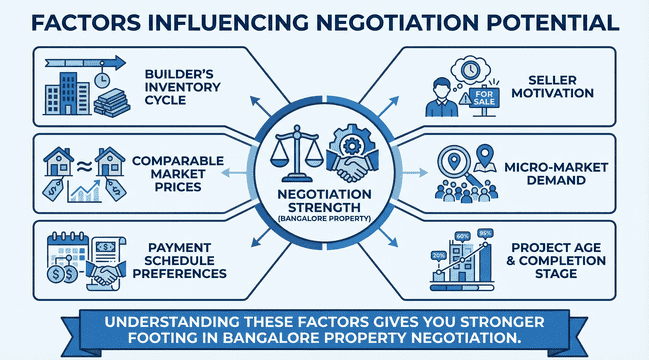
Several variables affect negotiation strength:
1. Builder’s inventory cycle
2. Seller motivation
3. Micro-market demand
4. Project age and completion stage
5. Payment schedule preferences
6. Comparable market prices
Understanding these factors gives you stronger footing in Bangalore property negotiation.
Not necessarily. Often, you get more value by negotiating on components like maintenance deposits, parking charges, clubhouse fees, floor-rise charges, or preferred location charges. This breaks the deal into negotiable pieces and improves your total savings. This is a key insight in real estate negotiation strategies used by experienced Bangalore buyers.
Absolutely. After quoting your expected number, staying silent signals confidence and forces the seller to respond. It’s a psychological technique widely used in large-value negotiations and is especially effective in Bangalore real estate negotiation where buyers who appear too eager tend to lose leverage.
Yes. Individual sellers often have personal reasons—relocation, liquidity needs, or upgrading homes—that create more flexibility. You may secure better deals in resale property negotiation compared to brand-new builder units, where prices are more structured.
Yes, but use it subtly. Instead of saying “prices are cheaper next door,” frame your point with respect and clarity:
“I’ve evaluated nearby projects, and the pricing range falls between X and Y. Can we work within that bracket?”
This approach is far more effective and aligns with strong property negotiation techniques.
Avoid being aggressive, emotional, or uninformed. Never negotiate without checking recent transactions in that micro-market. Don’t rush or reveal desperation. And always document agreed terms in writing. These mistakes can weaken your position in Bangalore real estate negotiation.
Yes, but cautiously. When demand is high, price drops are unlikely. Instead, negotiate for better payment timelines, waived charges, or extra value additions. In high-absorption areas, smart buyers focus on “value negotiation,” not “price negotiation.”
Sellers—whether individuals or developers—respond strongly to serious buyers. When you show readiness with documents, budgets, and timelines, negotiation becomes easier. Uncertain buyers usually get lower priority. This behavioural shift is a subtle but important part of effective property negotiation in Bengaluru.
Last modified: January 19, 2026