
Buying a home in Bengaluru is one of those dreams that live quietly in the heart until they become a need. It starts with weekend property tours, long conversations about location, and hours of scrolling through listings. Yet, many homebuyers discover — sometimes too late — that the number printed on the brochure is only the surface of the real expenditure.
The actual cost of owning a home in Bengaluru is layered, dynamic, and sometimes surprising.
This guide helps you understand everything beyond the sale price, so your home-buying budget in Bangalore is grounded, realistic, and future-proof. The goal isn’t to overwhelm you — it is to empower you.
1. Why the Sale Price Isn’t the Whole Picture
If you speak to anyone who has recently bought a house in Bengaluru — whether in Whitefield, Hebbal, Electronic City, or Yelahanka — you will hear one common line:
“We didn’t expect the final amount to be so different from the quoted price.”
This happens because most people calculate affordability only based on:
- per-square-foot cost
- total sale price
- loan eligibility
But the hidden costs in Bangalore property purchases are real, and ignoring them can distort your financial planning.
What contributes to this gap?
Beyond the builder price, you encounter:
- Registration charges
- Stamp duty
- GST in some cases
- Interior and furnishing expenses
- Corpus funds
- Maintenance deposits
- Legal review costs
- Parking fees
- Clubhouse charges
- And many more variables that vary from project to project
Your home-buying budget is not just about “Can I afford this flat?” but rather “Can I afford everything that comes with it?”
2. Registration, Stamp Duty & Government Fees: What You Actually Pay
One of the biggest shockers for first-time homebuyers is the mandatory government charges. These are predictable but often not factored into the initial mental budget.
Stamp Duty
For most parts of Bengaluru, stamp duty is between 2%–5% of the property’s value.
At a flat price of ₹80 lakh, this alone becomes a substantial amount.
Registration Charges
Usually around 1%, this also adds up quickly.
BBMP/BDA/BMRDA Betterment Charges
Depending on the zone and jurisdiction, you may need to factor additional development charges into your plan.
Together, these fees can add 8%–9% to the sale price — a significant portion often overlooked in the early stages.
This is why people who plan an ₹80 lakh home buying budget sometimes end up needing closer to ₹90 lakh.
3. GST: When It Applies & When It Doesn’t
Many people still get confused about whether GST applies to apartments in Bengaluru.
To simplify:
- GST applies to under-construction properties
- GST does not apply to ready-to-move-in properties
Under-construction GST rates can be:
- 1% for affordable housing
- 5% for non-affordable housing
This small percentage on paper results in big differences when applied to multi-crore properties.
When planning a home-buying budget in Bangalore, simply choosing ready-to-move vs. under-construction can alter your total cash outflow by several lakhs.
4. Legal, Documentation & Due-Diligence Costs
A legal review can save you years of potential trouble. Many Bengaluru buyers assume that if the project comes from a top builder, they don’t need legal validation. That’s not true.
Key legal expenses include:
- Title verification
- Document vetting
- Agreement review
- Khata transfer
- Encumbrance certificate checks
- Property tax validation
These legal expenses usually range from ₹10,000–₹50,000, but for high-value projects or villa communities, they may be higher.
A well-informed channel partner like Proppy.ai helps buyers connect with trusted legal networks, keeping the process clean and avoiding unnecessary repetition of the brand name.
5. Interior Costs: The Silent Budget Breaker
If there is one cost that consistently exceeds expectations, it is interiors.
Most unfurnished homes require:
- Wardrobes
- Modular kitchen
- Lofts
- False ceiling
- Electrical enhancements
- Lighting
- Bed structures
- Geysers
- Safety grills
- Painting
- Small architecture changes
Even a simple 2BHK interior plan can range between ₹4 lakh–₹20 lakh, depending on:
- Materials chosen
- Customisation level
- Carpenter vs modular design
- Premium fittings
This is why your home-buying budget must always set aside an interior buffer. Otherwise, the financial pressure begins right after possession.
6. Parking, Amenities & Clubhouse Fees
Many buyers assume these charges are included in the sale price — until the builder’s cost sheet arrives.
You may pay separately for:
- Covered parking
- Second car parking
- Clubhouse membership
- Amenity usage
- Gym or sports facilities
- Wellness centre access
- Community hall access
In premium projects, these alone can range from ₹2 lakh to ₹10 lakh.
If you’re looking at a villa or a plotted development, these charges may appear under different names, such as development fees or community infrastructure fees.
7. Advance Maintenance, Corpus Fund & Monthly Charges
Builders in Bengaluru often collect:
- 1–2 years of advanced maintenance
- A one-time corpus fund
- Sinking fund charges
The corpus fund is significant because it helps the community manage long-term expenses like:
- Lift repair
- Power backup maintenance
- Water treatment units
- Security systems
- Sewage treatment plant servicing
Most corpus funds range from ₹50,000 to ₹2 lakh.
Monthly maintenance, especially in luxury apartments, can go beyond ₹6,000–₹12,000, depending on:
- Lift size
- Number of towers
- Number of units
- Amenities
- Security levels
This is why it’s essential to add post-purchase recurring expenses into your overall budget.
8. Loan Processing, Insurance & Bank-Related Costs
If you’re taking a home loan, add the following:
Bank Costs
- Processing fee
- Technical valuation fee
- Legal verification fee
- MOD (Memorandum of Deposit) charges
These can range from ₹10,000 to ₹25,000, or slightly more, depending on your bank.
Home Insurance
Most people skip it, but it’s wise to include both:
- Property insurance
- Loan liability insurance (in case of emergencies)
While this recurring cost is part of the overall home-buying budget, it is still part of the overall home-buying budget.
9. Moving-In, Furnishing & Utility Setup Costs
These seem minor until you start calculating them correctly.
You may need funds for:
- Packers & movers
- Setting up the internet
- Setting up DTH
- Curtains
- AC installation
- Water purifier
- Beds
- Sofas
- Dining table
- Carpets
- Appliances
Most first-time homeowners underestimate this section by a huge margin.
A realistic post-possession furnishing budget for Bengaluru is at least ₹1.5 lakh–₹5 lakh for minimal setups.
10. Hidden Lifestyle Costs After Moving into a New Neighbourhood
This is the part almost nobody talks about. Where you live influences how much you spend monthly.
For example:
- Fuel costs may increase if you move to a longer commute area
- Food delivery charges differ from zone to zone
- School fees vary drastically
- Supermarket prices differ across neighbourhoods
- Social spending changes depending on access to cafés and entertainment
These are not one-time expenses — they shape your long-term financial stability.
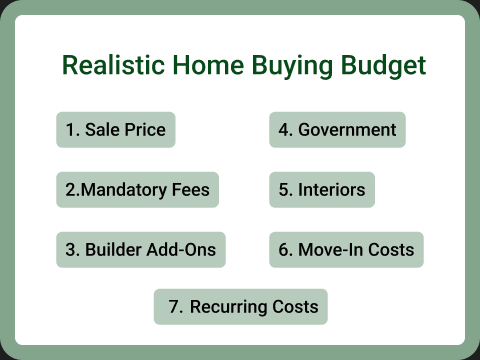
11. Setting a Realistic Home Buying Budget for Bangalore
Instead of calculating just the sale price and the loan EMI, create a Bangalore home buying budget using a broader approach:
Step 1: Sale Price
(Builder quote + negotiation buffer)
Step 2: Mandatory Fees
Stamp duty, registration, GST (if applicable)
Step 3: Builder Add-Ons
- Parking
- Amenities
- Infrastructure charges
- Clubhouse fee
Step 4: Government / Legal
- Legal review
- Khata work
- Property tax
- EC checks
Step 5: Interiors
- Modular kitchen
- Wardrobes
- Electricals
- Furnishings
Step 6: Move-In Costs
- Furniture
- Appliances
- Packers
- Utility setups
Step 7: Recurring Costs
- Maintenance
- Sinking fund
- Lifestyle upgrades
- Fuel & commute changes
When you apply this structure, the gap between the sale price and total outflow often widens by 15%–30%.
This helps you plan finances without stress or surprise.
12. How Proppy.ai Helps You Budget Smarter
Most homebuyers don’t have the time or experience to analyse:
- Actual market rates
- Hidden cost structures
- Builder negotiations
- Legal inconsistencies
- Loan strategies
- Resale potential
That’s where having a transparent, data-backed channel partner makes a difference.
Instead of being overwhelmed by brochures, WhatsApp forwards, and marketing pitches, buyers get:
- Price comparisons
- Neighbourhood insights
- Project verification
- Builder credibility analysis
- Long-term appreciation potential
- Unbiased property matching with AI
The experience becomes less about guesswork and more about clarity.
The platform simplifies property search with real data, removes confusion, and ensures you understand the complete financial picture.
13. Final Thoughts — Your Home is a Financial Journey, Not a One-Time Transaction
Buying a home in Bengaluru is one of the most significant milestones in life. But it’s also one of the most important financial decisions—and it needs clarity, awareness, and planning.
When you understand:
- The hidden costs in Bangalore property buying,
- the difference between the sale price and the total cost,
- And the long-term financial responsibilities,
You make a decision rooted in confidence, not doubt. Your home-buying budget is more than a number—it’s a blueprint for stability, comfort, and financial security.
And when you have the proper guidance, insights, and a transparent partner supporting your journey, the road to your dream home becomes far smoother than you ever imagined.
Frequently Asked Questions:
The real cost of buying a home in the city goes beyond the builder’s quote. You need to include stamp duty, registration fees, GST (if applicable), corpus fund, legal charges, parking fees, interiors, and moving-in expenses. Most buyers notice that their home buying budget in Bangalore increases by 15–30% when all hidden elements are added.
Many costs—like interiors, parking, club house access, advance maintenance, and government fees—are not part of the sale price. These are revealed at different stages of the process. Understanding hidden costs in Bangalore property helps buyers avoid financial surprises and plan better.
No. GST applies only to under-construction properties. If you’re buying a ready-to-move-in home, GST is not applicable. This single factor can change your home buying budget significantly, especially for premium projects
Most homebuyers pay around between 2%–5% stamp duty and 2% registration fee. These government charges are mandatory and form a major part of the total purchase cost. Always include them while planning your Bengaluru property budget.
Interior costs vary depending on materials and design. For a 2BHK, interiors may range from ₹4 lakh to ₹20 lakh. Items like wardrobes, kitchen setup, lighting, and electrical work contribute heavily. Interiors are one of the most underestimated parts of the home buying budget in Bangalore.
The corpus fund is a one-time amount paid by homebuyers to help manage future maintenance, repairs, and community expenses. It covers lift replacements, STP servicing, security systems, and other long-term needs. It varies by project but is essential for smooth community functioning.
Not always. Covered parking, second car parking, and clubhouse membership may be billed separately. These can add a few lakhs to your total cost, especially in large or luxury communities.
Yes. A legal review protects you from title issues, encumbrances, mismatched approvals, or documentation errors. Spending on due-diligence early can save you from years of issues. It is a recommended part of the Bangalore property purchase checklist.
Most homeowners spend ₹1.5 lakh to ₹5 lakh on furniture, appliances, curtains, AC installation, packers and movers, internet connection, and basic household needs. These recurring setup costs should be included while building a full Bangalore home buying budget.
Where you live influences fuel expenses, school fees, food delivery charges, daily shopping costs, and lifestyle spending. For example, shifting from central Bengaluru to suburban areas may reduce rent but increase commute time and fuel costs. It’s important to view your home as a long-term financial ecosystem.
A platform built on data and verified listings helps you understand real prices, builder credibility, neighbourhood insights, and cost structures. You also get clarity on hidden expenses and the total cost of ownership, not just the sale price. This prevents miscalculations and supports confident decisions.
There’s no universal “best” time. Prices adjust based on demand, locality development, builder inventory, and interest rates. The best time is when your finances are stable, your home buying budget is clear, and you’ve evaluated all hidden costs.
Under-construction projects offer flexible payment plans but attract GST. Ready-to-move homes have higher upfront costs but save GST and give immediate possession. Your choice should depend on your financial planning, timeline, and risk comfort.
Most financial planners recommend keeping 3–6 months of EMIs as an emergency reserve. This ensures that you stay financially stable even if unexpected costs arise after possession.
Last modified: January 19, 2026